Formation et évolution des galaxies

Comment les galaxies assemblent-elles leur masse ? Comment évoluent-elles au sein de la structure à grande échelle ?

J’ai utilisé des simulations cosmologiques hydrodynamiques multi-zoom pour quantifier la masse assemblée par fusions et par accrétion diffuse de gaz (L'Huillier, Combes & Semelin 2012).

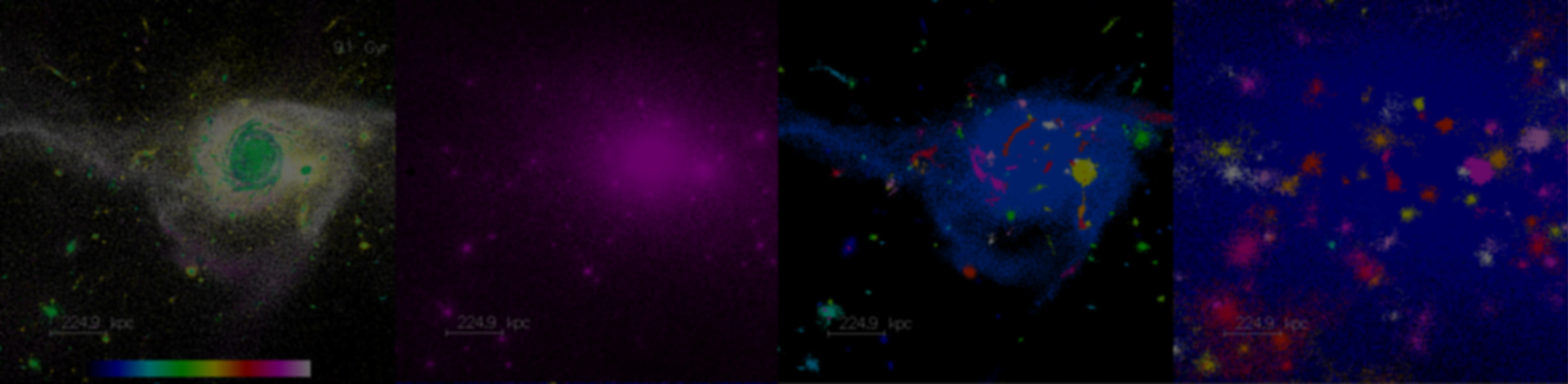
Zoom sur un amas de galaxies dans une simulation hydrodynamique
Zoom sur un amas dans une simulation hydrodynamique, d’après L'Huillier, Combes & Semelin (2012), A&A.

À l’aide de la simulation Horizon Run 4 (Kim et al. 2015), j’ai quantifié le taux d’interaction des halos — fusions et passages rapprochés (L'Huillier, Park & Kim 2015) — et leurs alignements (L'Huillier, Park & Kim 2017) en fonction de leur environnement (masse et densité à grande échelle).

Dans une étude menée par David Fernández Gil et publiée dans Nature Astronomy, nous avons détecté un alignement faible mais significatif entre la région centrale des jets d’AGN, observée par interférométrie à très longue base, et la forme optique de leurs galaxies hôtes dans plusieurs relevés (Fernández Gil et al. 2025, Nat. Astron.).

Articles sur les galaxies et les AGN

Les résumés des articles sont en anglais.

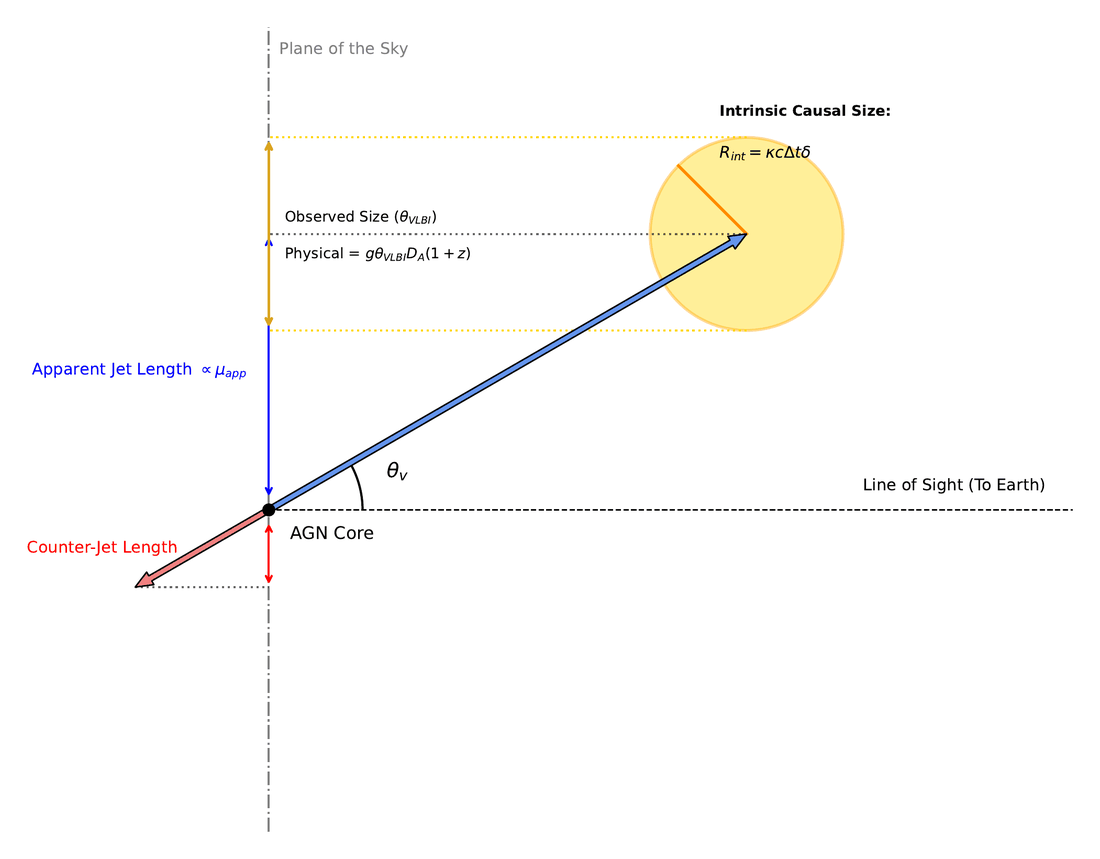
The speed-gun counter-jet method: the approaching jet looks longer and faster than the counter-jet, which fixes the viewing angle and speed.

2026 · A&A 712 (2026) A240

A refined method for measuring cosmological distances using variability and proper motions in AGNs with VLBI-detected counter jets

Hodgson, J. A., Carr, A., Parkinson, D., Statti, M., Myeong, J., L'Huillier, B., Shafieloo, A., Liodakis, I., Oh, S.-H.

We extend the ‘speed-gun’ distance method using the proper motions of both the approaching jet and the counter-jet, which removes its dependence on the Doppler factor. For 3C 84 we obtain an angular-diameter distance of 71–79 Mpc depending on the assumed geometry; the spherical case agrees with SH0ES-calibrated supernovae.

DOI · arXiv:2608.02202
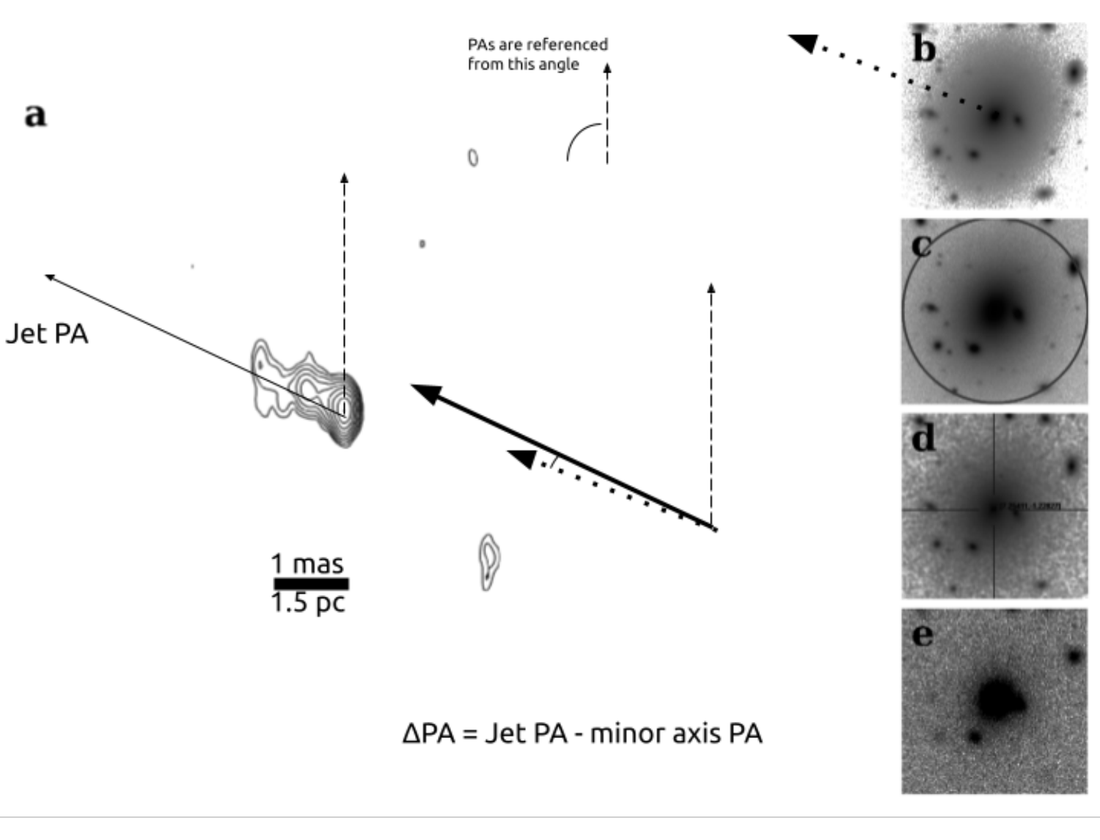
How the jet–host angle is measured: VLBI jet position angle (a) against the minor axis of the optical host in DES, DESI LS, SDSS and SkyMapper (b–e).

2025 · Nature Astronomy 9 (2025) 302

Detection of an orthogonal alignment between parsec-scale AGN jets and their host galaxies

Fernández Gil, D.†, Hodgson, J. A., L'Huillier, B., Asorey, J., Saulder, C., Finner, K., et al.

Comparing VLBI jet directions with optical host-galaxy shapes for about 6,000 AGN, we detect a weak but significant alignment between the parsec-scale jet and the minor axis of its host galaxy: a link between the black hole and its host across three orders of magnitude in scale.

DOI · arXiv:2411.09099
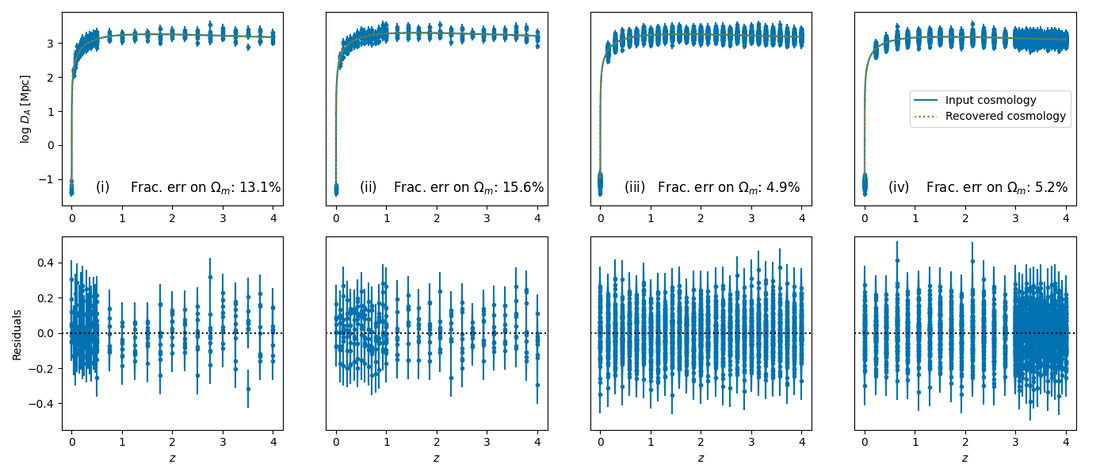
Simulated speed-gun distance measurements (30 sources, 10 flares each) for four redshift distributions, with the recovered cosmology.

2023 · MNRAS 521 (2023) L44

Estimating the feasibility of ‘standard speed-gun’ distances

Hodgson, J. A., L'Huillier, B., Liodakis, I., Lee, S.-S., Shafieloo, A.

We extend the ‘standard speed-gun’ distance method by using the maximum intrinsic brightness temperature of a source instead of its Doppler factor. Forecasts show that recovering the cosmology depends mainly on how well this temperature is known and on the number of observed flares.

DOI · arXiv:2301.06252
How the jet–host angle is measured: VLBI jet position angle (a) against the minor axis of the optical host in DES, DESI LS, SDSS and SkyMapper (b–e). (Figure from the 2025 follow-up paper.)

2023 · prépublication arXiv

Exploring connections between the VLBI and optical morphology of AGNs and their host galaxies

Fernández Gil, D.†, Hodgson, J. A., L'Huillier, B.

Matching over 9,000 VLBI sources from the Astrogeo catalogue to their optical host galaxies and fitting the hosts' shapes, this first study finds no clear correlation between host morphology and jet direction.

arXiv:2305.06713
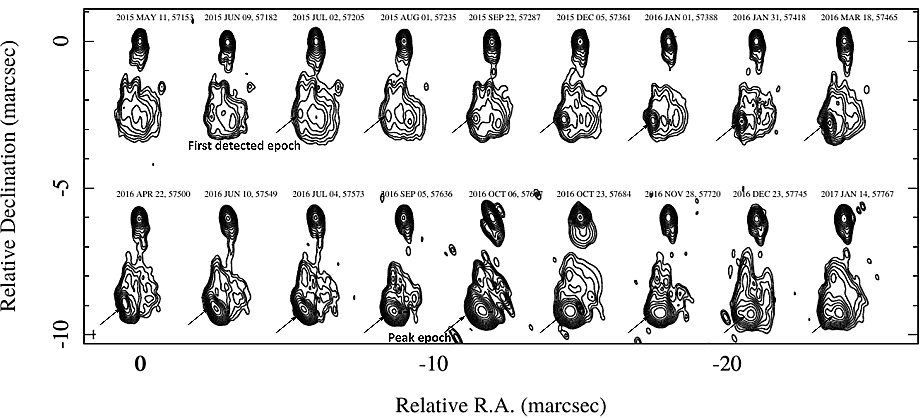
43 GHz VLBI maps of 3C 84 (2015–2017). The arrow marks the flaring region used for the distance measurement.

2020 · MNRAS 495 (2020) L27

Using variability and VLBI to measure cosmological distances

Hodgson, J. A., L'Huillier, B., Liodakis, I., Lee, S.-S., Shafieloo, A.

We propose measuring AGN distances by comparing the physical size implied by variability with the angular size measured by VLBI. For 3C 84 we find Mpc, consistent with other measurements at that redshift.

DOI · arXiv:2003.10278
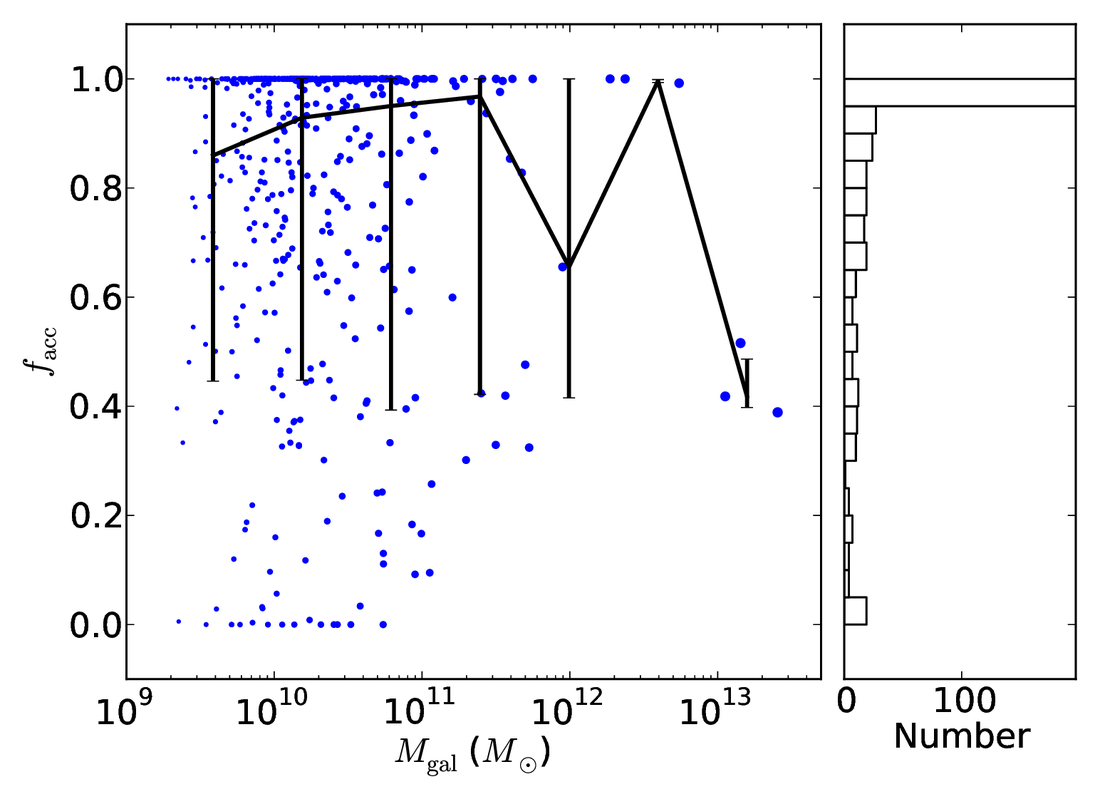
Fraction of stellar mass gained through smooth accretion rather than mergers, versus galaxy mass. The mean is 77%.

2012 · A&A 544 (2012) A68

Mass assembly of galaxies: smooth accretion versus mergers

L'Huillier, B., Combes, F., Semelin, B.

Multi-zoom cosmological simulations show that galaxies grow mostly by smooth accretion, which brings on average 77% of their mass, while mergers bring 23%. Only the most massive galaxies grow significantly through mergers.

DOI · arXiv:1108.4247