Publications

Simulations

11 papers

My main research tool is cosmological simulations, which I use to study the evolution of galaxies and their dark matter haloes within the large-scale structure of the Universe.

  • I studied the effects of the initial conditions on the large-scale structure — the matter power spectrum, the halo mass function, and the distribution of structures (L'Huillier, Park & Kim 2014).
  • I participated in the design and analysis of the Horizon Run 4 simulation (HR4, Kim et al. 2015).
  • I used HR4 to study galaxy evolution within its environment (L'Huillier et al. 2015, 2017a).
  • I studied the effect of the primordial power spectrum on the large-scale structure at low redshift (L'Huillier et al. 2018).

Publications

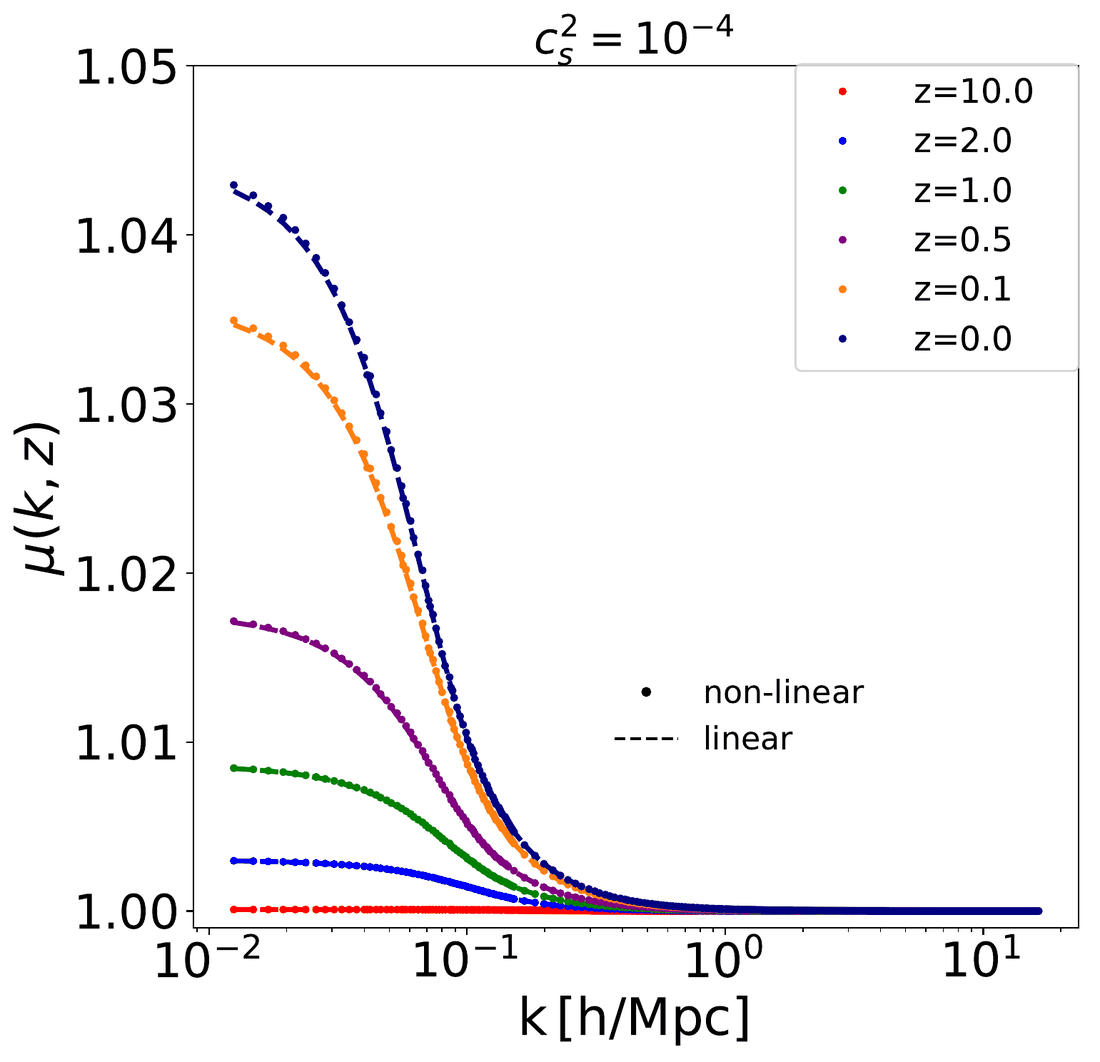
Ratio mu(k,z) of the k-essence to ΛCDM gravitational potential for sound speed cs2 = 10-4, non-linear (points) versus linear (dashed).
Ratio μ(k,z)\mu(k,z) of the k-essence to ΛCDM gravitational potential for sound speed cs2=10−4c_s^2 = 10^{-4}, non-linear (points) versus linear (dashed).

2020 · JCAP 04 (2020) 039

Parametrising non-linear dark energy perturbations

Hassani, F., L'Huillier, B., Shafieloo, A., Kunz, M., Adamek, J.

Using k-evolution N-body simulations, we quantify non-linear k-essence dark energy perturbations through an effective modification μ\mu of the Poisson equation, show that linear theory is accurate at large sound speeds, and propose a simulation-calibrated parametrisation of μ\mu.

DOI · arXiv:1910.01105

Dark energyLarge-scale structureSimulations

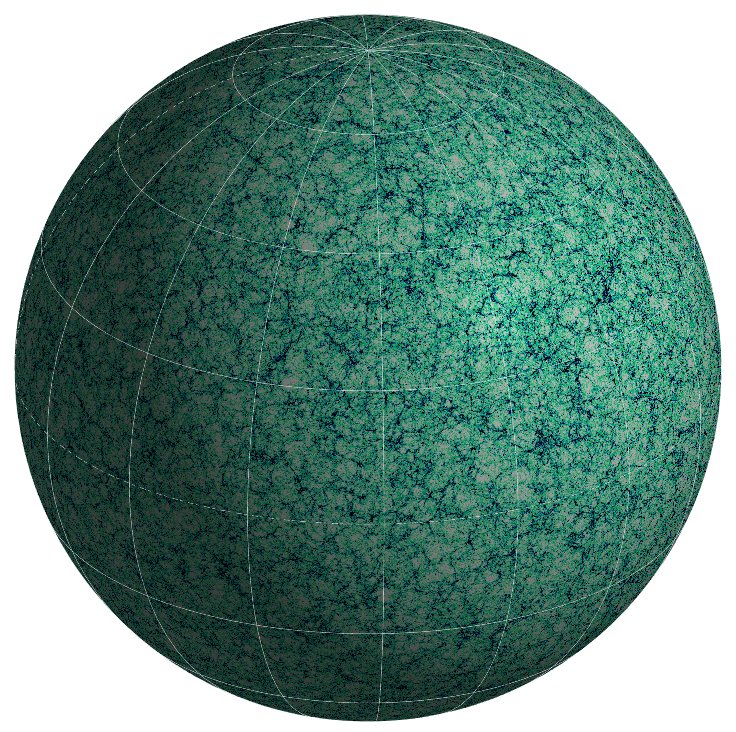
Sub-halo counts in a 60h-1Mpc shell of the Horizon Run 4 lightcone at z = 0.36, projected on the sphere.
Sub-halo counts in a 60 h−1 Mpc60\,h^{-1}\,\mathrm{Mpc} shell of the Horizon Run 4 lightcone at z=0.36z = 0.36, projected on the sphere.

2018 · MNRAS 477 (2018) 2772

Cylinders out of a top hat: counts-in-cells for projected densities

Uhlemann, C., Pichon, C., Codis, S., L'Huillier, B., Kim, J., et al.

Large-deviation statistics predict the one-point PDF and clustering of projected densities in cylinders, in agreement with the Horizon Run 4 simulation to within a few percent in the quasi-linear regime: a tool for photometric surveys such as DES and Euclid.

DOI · arXiv:1711.04767

Large-scale structureSimulations

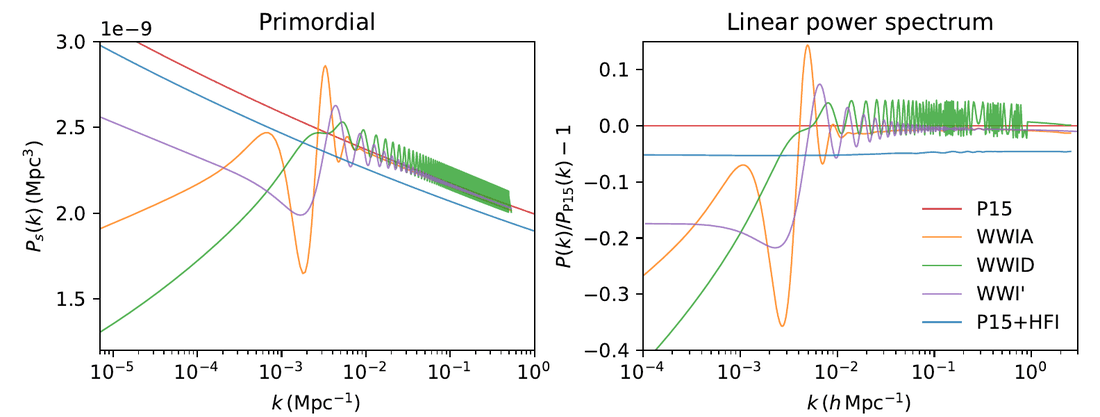
Primordial power spectra with features (left) and the resulting linear matter power spectra relative to Planck 2015 (right).

2018 · MNRAS 477 (2018) 2503

Probing features in the primordial perturbation spectrum with large-scale structure data

L'Huillier, B., Shafieloo, A., Hazra, D. K., Smoot, G. F., Starobinsky, A. A.

Can large-scale structure distinguish primordial power spectra with features that the CMB cannot? With 15 DESI-like N-body simulations, we show that the halo mass function and two-point correlation function cannot, but simple counts-in-cells statistics can.

DOI · arXiv:1710.10987

Early UniverseLarge-scale structureSimulationsFirst author

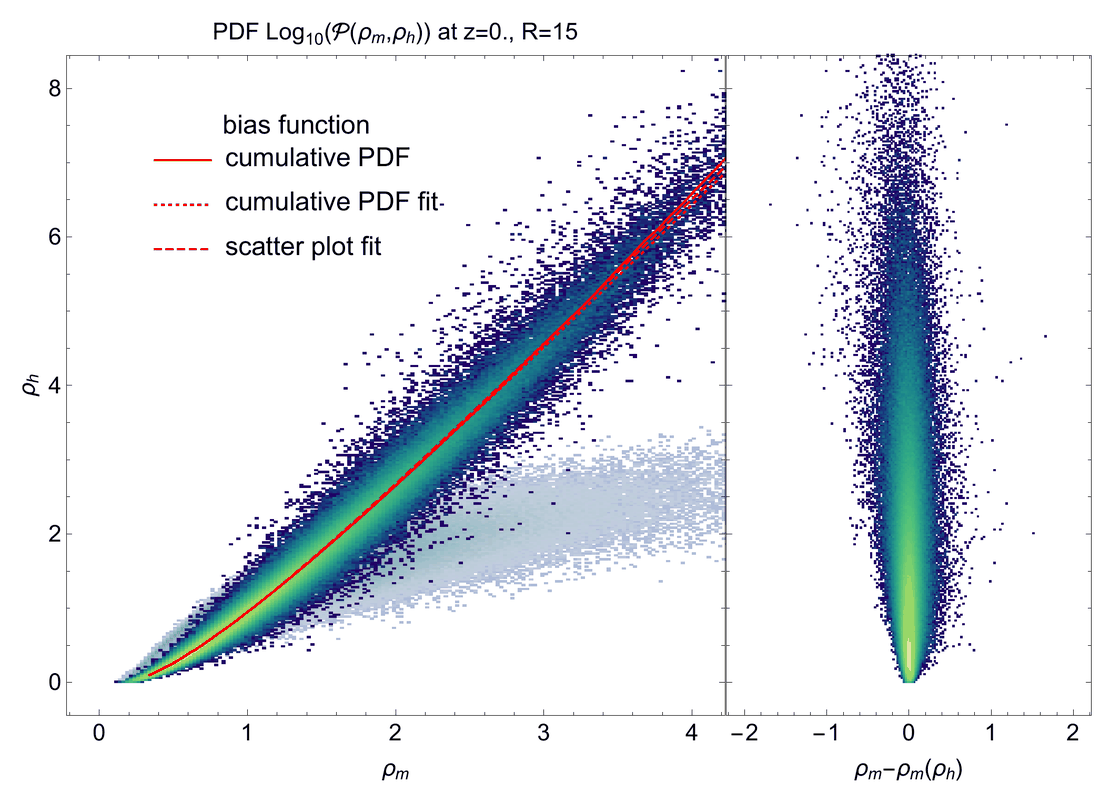
Halo density against dark matter density in spheres of 15h-1Mpc at z = 0, with the reconstructed bias function (red).
Halo density against dark matter density in spheres of 15 h−1 Mpc15\,h^{-1}\,\mathrm{Mpc} at z=0z = 0, with the reconstructed bias function (red).

2018 · MNRAS 473 (2018) 5098

A question of separation: disentangling tracer bias and gravitational non-linearity with counts-in-cells statistics

Uhlemann, C., Feix, M., Codis, S., Pichon, C., Bernardeau, F., et al. (incl. L'Huillier, B.)

We model the bias of tracer densities in spheres with a quadratic bias relation and the large-deviation dark matter PDF, validated on Horizon Run 4 subhaloes. This allows a joint estimate of the non-linear dark matter variance and the bias parameters.

DOI · arXiv:1705.08901

Large-scale structureSimulations

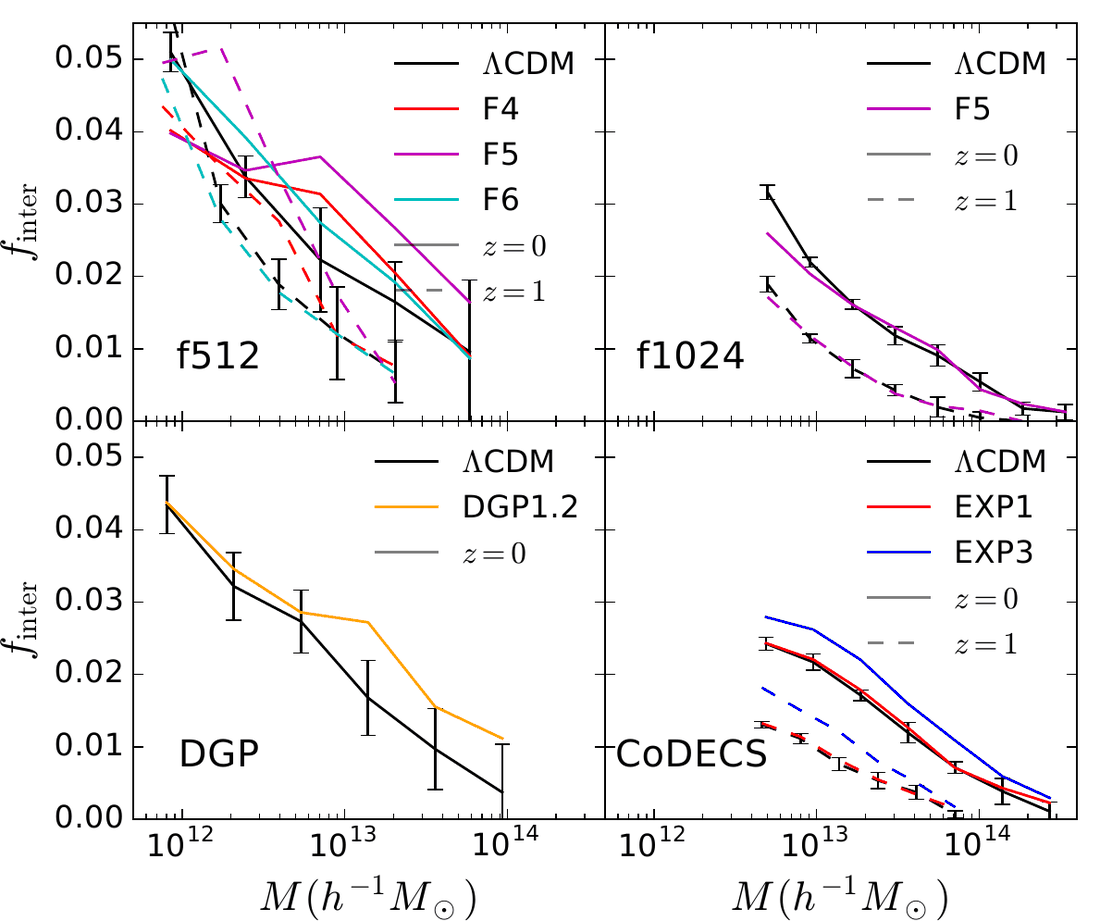
Halo interaction rate versus mass in ΛCDM and in f(R), DGP and coupled dark energy simulations.
Halo interaction rate versus mass in ΛCDM and in f(R)f(R), DGP and coupled dark energy simulations.

Haloes beyond General Relativity

2017 · MNRAS 468 (2017) 3174

Dark matter haloes in modified gravity and dark energy: interaction rate, small- and large-scale alignment

L'Huillier, B., Winther, H. A., Mota, D. F., Park, C., Kim, J.

In N-body simulations of f(R)f(R) gravity, DGP and coupled dark energy, f(R)f(R) raises halo spin and weakens the spin alignment of interacting pairs, while only strongly coupled dark energy increases the halo interaction rate and the alignment of halo shapes with the large-scale structure.

DOI · arXiv:1703.07357

Key papersModified gravityDark energyDark matter haloesSimulationsFirst author

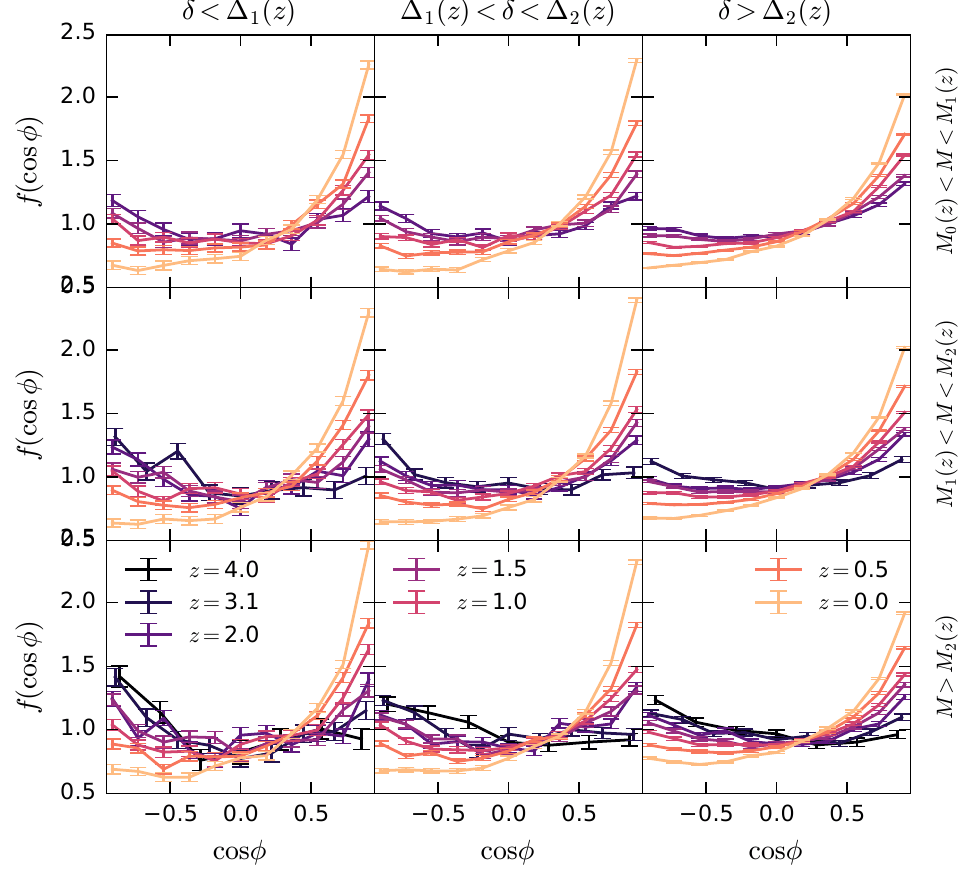
Evolution of the alignment between the spins of interacting haloes, by environment (columns) and mass (rows).

2017 · MNRAS 466 (2017) 4875

Ecology of dark matter haloes – II. Effects of interactions on the alignment of halo pairs

L'Huillier, B., Park, C., Kim, J.

In Horizon Run 4, interacting haloes have lower spin and are more spherical than typical haloes. Pairs start with antiparallel spins that gradually become parallel, interactions are mostly radial, and alignments are strongest for massive, close pairs and persist up to z=4z = 4.

DOI · arXiv:1701.04417

Galaxy formationDark matter haloesSimulationsFirst author

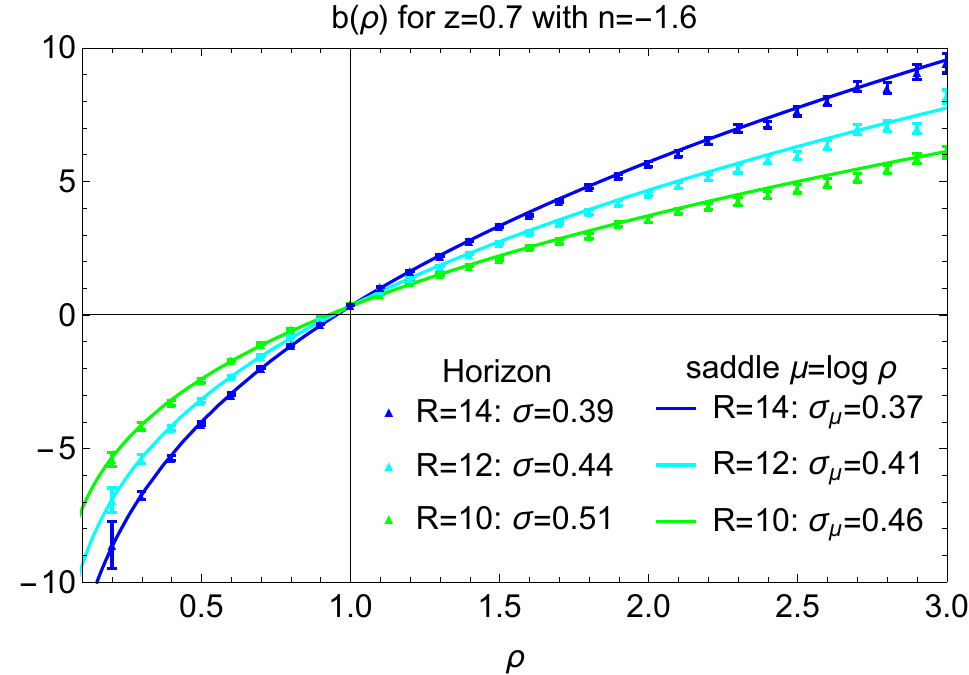
Density-dependent clustering bias b(rho) in Horizon Run 4 at z = 0.7 (points) against the saddle-point prediction (lines).
Density-dependent clustering bias b(ρ)b(\rho) in Horizon Run 4 at z=0.7z = 0.7 (points) against the saddle-point prediction (lines).

2017 · MNRAS 466 (2017) 2067

Beyond Kaiser bias: mildly non-linear two-point statistics of densities in distant spheres

Uhlemann, C., Codis, S., Kim, J., Pichon, C., Bernardeau, F., et al. (incl. L'Huillier, B.)

Parameter-free analytic bias functions extend Kaiser bias into the mildly non-linear regime, using large-deviation statistics and spherical collapse. They match Horizon Run 4 at the percent level down to about 10 h−1 Mpc10\,h^{-1}\,\mathrm{Mpc}, and reduce the variance of the estimator about fivefold.

DOI · arXiv:1607.01026

Large-scale structureSimulations

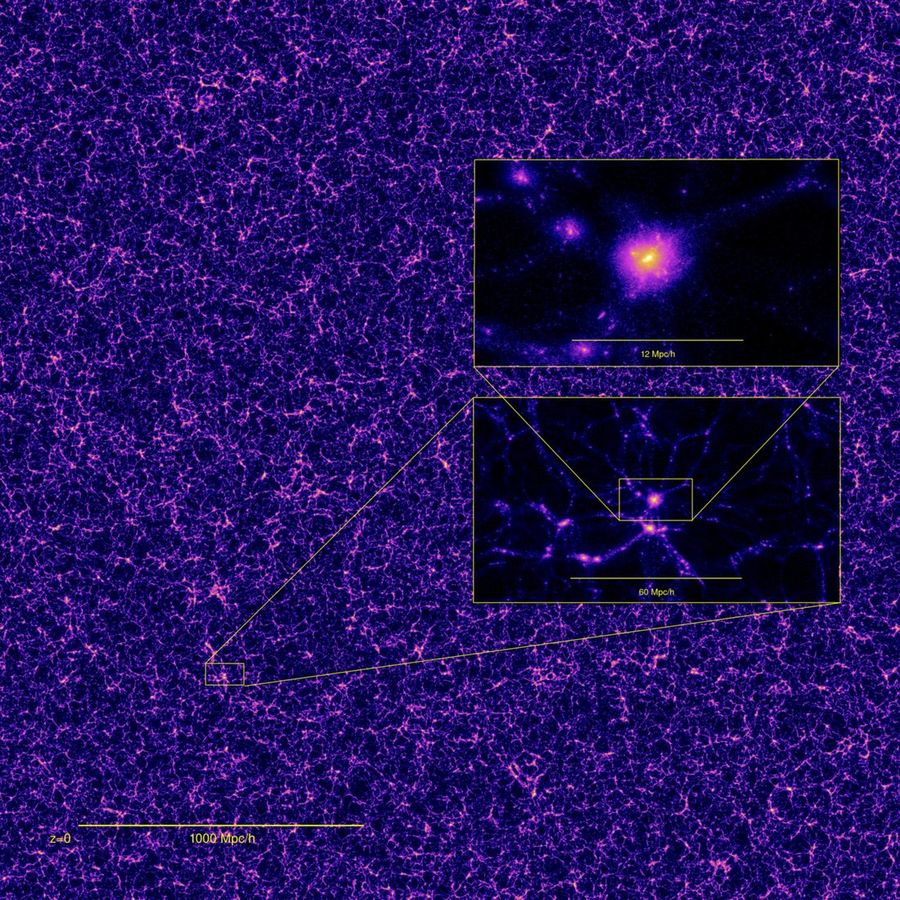
A 7h-1Mpc-thick slice through Horizon Run 4 at z = 0, with two successive zooms onto a galaxy cluster.
A 7 h−1 Mpc7\,h^{-1}\,\mathrm{Mpc}-thick slice through Horizon Run 4 at z=0z = 0, with two successive zooms onto a galaxy cluster.

2015 · J. Korean Astron. Soc. 48 (2015) 213

Horizon Run 4 simulation: coupled evolution of galaxies and large-scale structures of the Universe

Kim, J., Park, C., L'Huillier, B., Hong, S. E.

Horizon Run 4 follows 630036300^3 particles in a 3150 h−1 Mpc3150\,h^{-1}\,\mathrm{Mpc} box, with halo merger trees down to 2.7×10¹¹ h−1 M⊙2.7\times10^{11}\,h^{-1}\,M_\odot. The halo mass function departs from universality and evolves with redshift, and the BAO peak in mock galaxy correlations broadens and shifts. The data are public.

DOI · arXiv:1508.05107

Key papersLarge-scale structureDark matter haloesSimulations

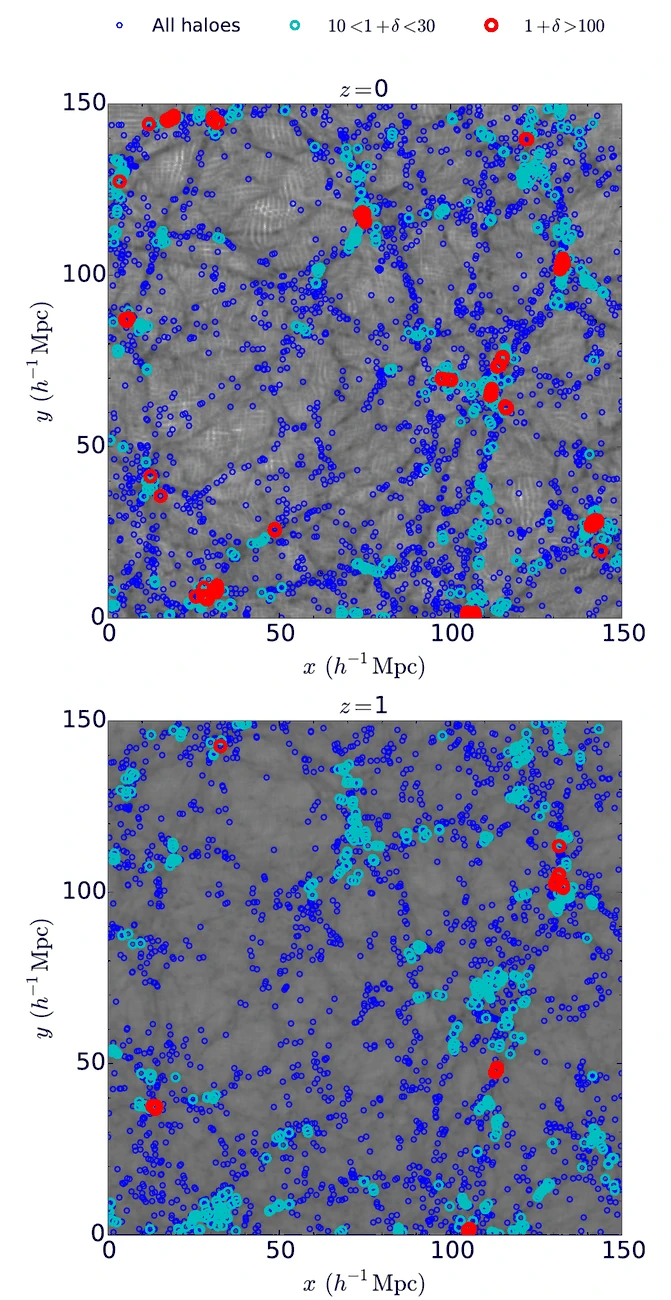
Haloes in the cosmic web at z = 0 (top) and z = 1 (bottom): the densest environments (red) sit in the nodes, intermediate ones (cyan) in filaments.
Haloes in the cosmic web at z=0z = 0 (top) and z=1z = 1 (bottom): the densest environments (red) sit in the nodes, intermediate ones (cyan) in filaments.

2015 · MNRAS 451 (2015) 527

The ecology of dark matter haloes – I. The rates and types of halo interactions

L'Huillier, B., Park, C., Kim, J.

Using Horizon Run 4, we measure how often haloes interact as a function of environment, separation, mass ratio, mass and redshift. Most interactions happen at density contrast δ≈20\delta \approx 20, while the interacting fraction peaks at δ≈1000\delta \approx 1000; we provide a fitting formula and identify two interaction modes.

DOI · arXiv:1505.00788

Galaxy formationDark matter haloesSimulationsFirst author

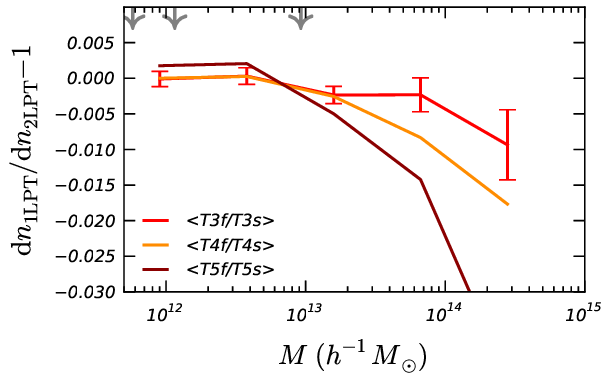
Effect of the order of Lagrangian perturbation theory (1LPT vs 2LPT) in the initial conditions on the halo mass function.

2014 · New Astron. 30 (2014) 79

Effects of the initial conditions on cosmological N-body simulations

L'Huillier, B., Park, C., Kim, J.

We test how the pre-initial configuration, the order of Lagrangian perturbation theory and the starting redshift affect N-body results. Glass and grid give similar results at z≲2z \lesssim 2, while first-order LPT underestimates massive haloes by about 2% and small-scale power by 6%.

DOI · arXiv:1401.6180

Key papersSimulationsFirst author

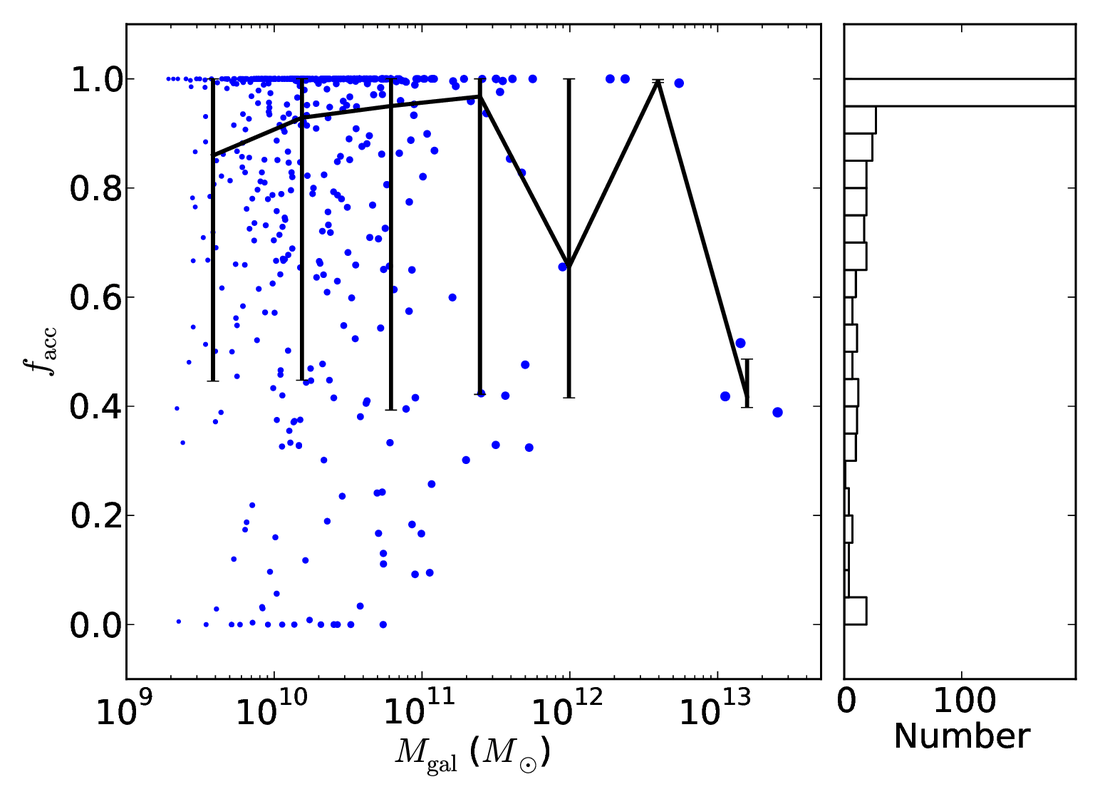
Fraction of stellar mass gained through smooth accretion rather than mergers, versus galaxy mass. The mean is 77%.

2012 · A&A 544 (2012) A68

Mass assembly of galaxies: smooth accretion versus mergers

L'Huillier, B., Combes, F., Semelin, B.

Multi-zoom cosmological simulations show that galaxies grow mostly by smooth accretion, which brings on average 77% of their mass, while mergers bring 23%. Only the most massive galaxies grow significantly through mergers.

DOI · arXiv:1108.4247

Key papersGalaxy formationSimulationsFirst author

← All papers