Publications

Large-scale structure

8 papers

Publications

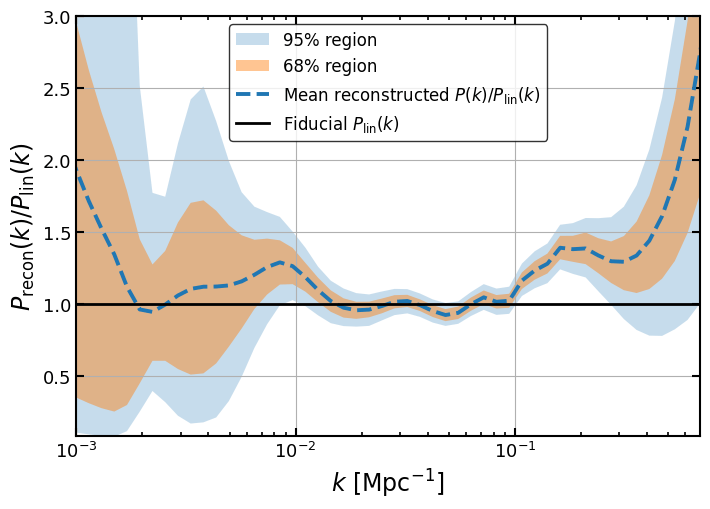
Reconstructed linear matter power spectrum divided by the fiducial prediction, with 68% and 95% Monte Carlo bands.

2026 · arXiv preprint

Finding the distribution of matter using lenses – I: deconvolution-based reconstruction with CMB lensing

Dawn, A., Jiang, J.-Q., Hazra, D. K., L'Huillier, B., Shafieloo, A.

We reconstruct the linear matter power spectrum at z=0z = 0 from joint Planck PR4, ACT DR6 and SPT-3G CMB lensing, using a modified Richardson–Lucy deconvolution. The result follows the linear prediction on large scales, lies systematically higher for k≳0.1 Mpc−1k \gtrsim 0.1\,\mathrm{Mpc}^{-1}, and partly preserves the BAO feature.

arXiv:2609.08457
Large-scale structureGravitational lensing

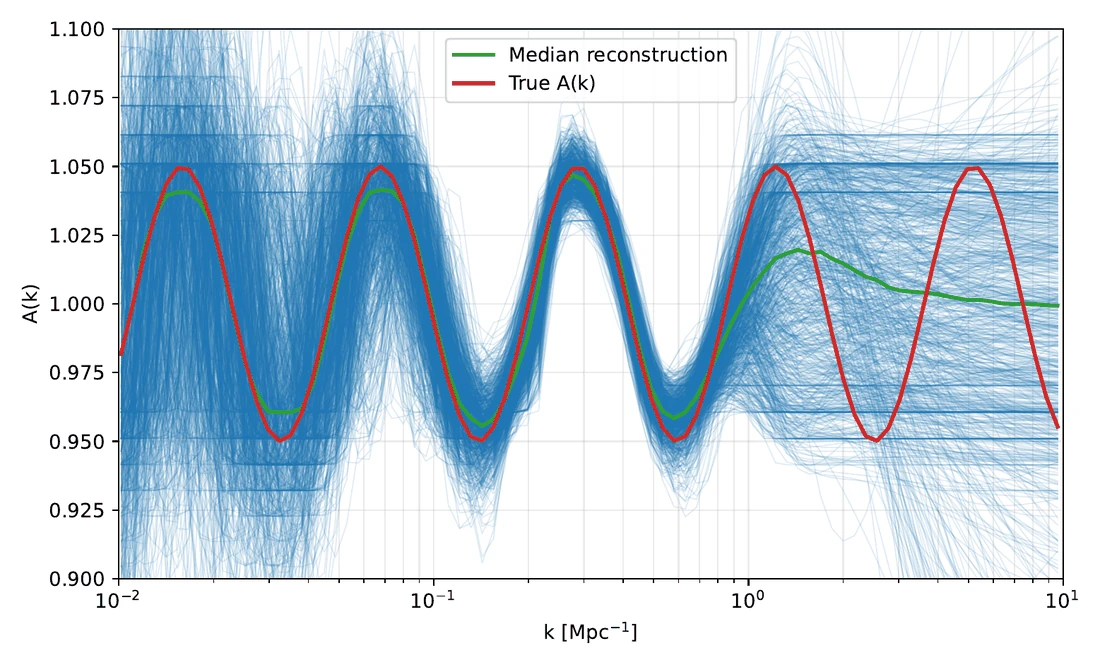
Reconstructions of a 5% oscillatory feature from 1000 noisy LSST-like mocks (blue), their median (green) and the truth (red).

2026 · arXiv preprint

Finding the distribution of matter using lenses – II: deconvolution-based reconstruction with 3×23\times2pt measurements

Jiang, J.-Q., Dawn, A., Hazra, D. K., L'Huillier, B., Shafieloo, A.

A regularised Richardson–Lucy framework tests scale-dependent departures from the nonlinear matter power spectrum using galaxy clustering, galaxy–galaxy lensing and cosmic shear. On LSST Year-10-like mocks, oscillations of about 1% or more are recovered over 0.1≲k≲0.5 Mpc−10.1 \lesssim k \lesssim 0.5\,\mathrm{Mpc}^{-1}, and a 1% oscillation is detected at about 2.6σ2.6\sigma.

arXiv:2609.08460

Large-scale structureGravitational lensing

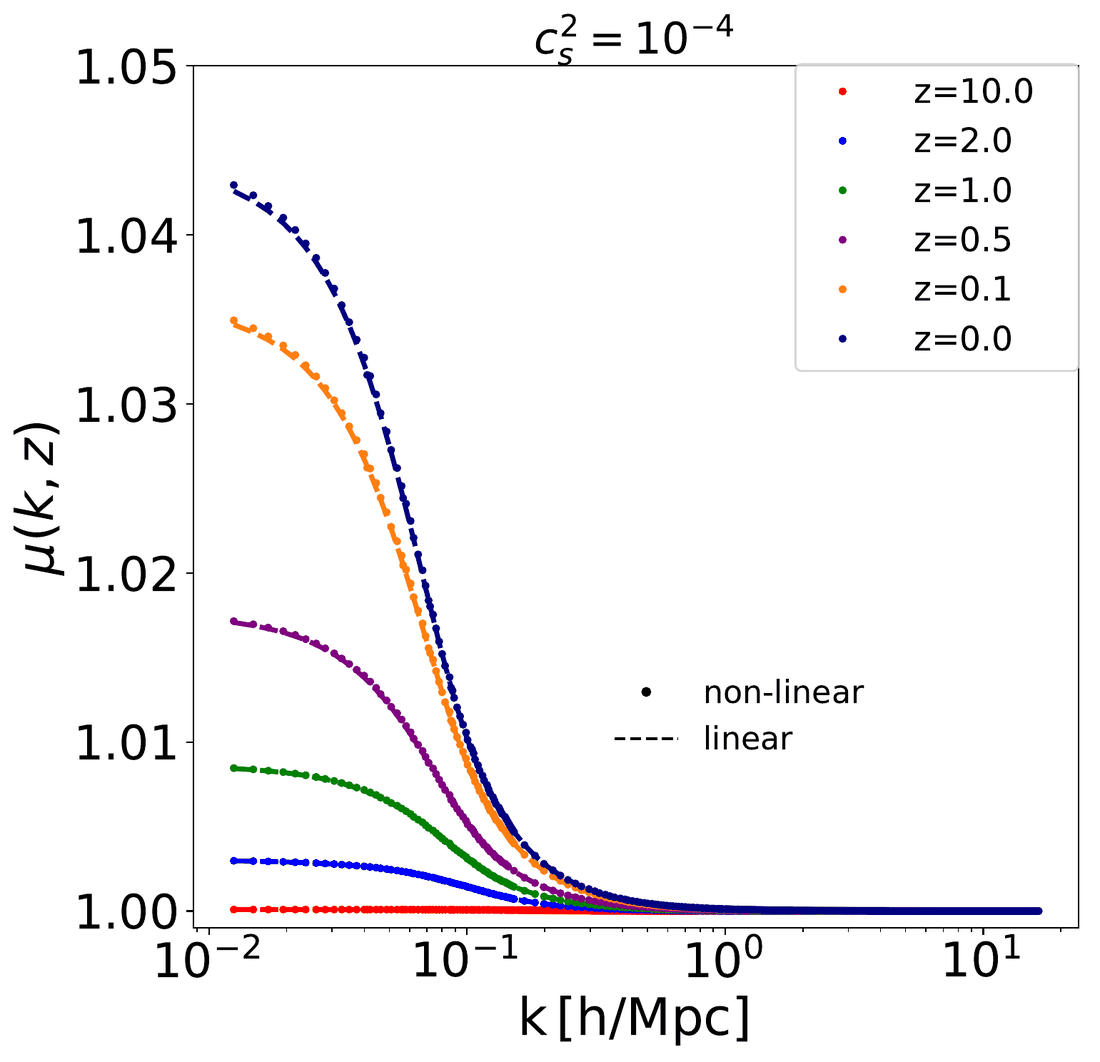
Ratio mu(k,z) of the k-essence to ΛCDM gravitational potential for sound speed cs2 = 10-4, non-linear (points) versus linear (dashed).
Ratio μ(k,z)\mu(k,z) of the k-essence to ΛCDM gravitational potential for sound speed cs2=10−4c_s^2 = 10^{-4}, non-linear (points) versus linear (dashed).

2020 · JCAP 04 (2020) 039

Parametrising non-linear dark energy perturbations

Hassani, F., L'Huillier, B., Shafieloo, A., Kunz, M., Adamek, J.

Using k-evolution N-body simulations, we quantify non-linear k-essence dark energy perturbations through an effective modification μ\mu of the Poisson equation, show that linear theory is accurate at large sound speeds, and propose a simulation-calibrated parametrisation of μ\mu.

DOI · arXiv:1910.01105

Dark energyLarge-scale structureSimulations

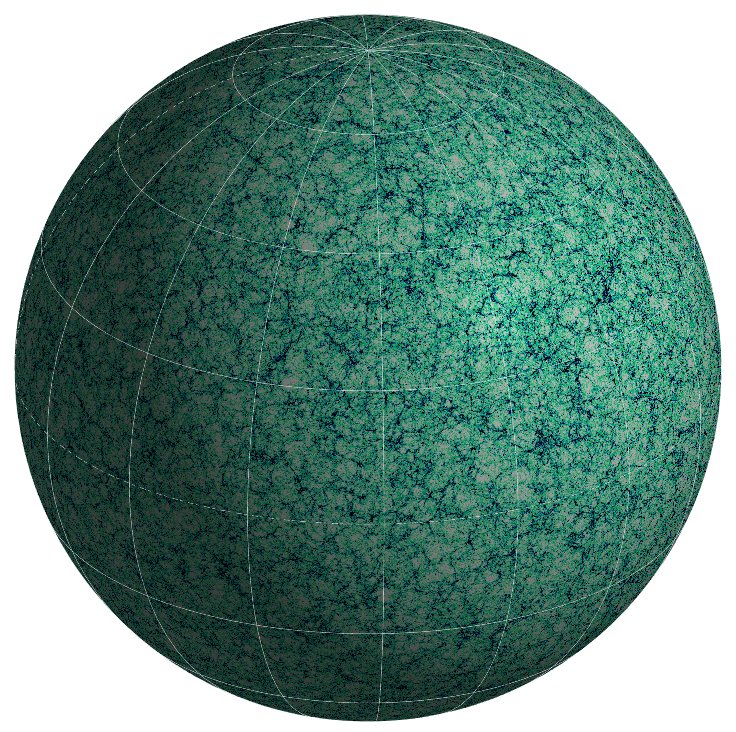
Sub-halo counts in a 60h-1Mpc shell of the Horizon Run 4 lightcone at z = 0.36, projected on the sphere.
Sub-halo counts in a 60 h−1 Mpc60\,h^{-1}\,\mathrm{Mpc} shell of the Horizon Run 4 lightcone at z=0.36z = 0.36, projected on the sphere.

2018 · MNRAS 477 (2018) 2772

Cylinders out of a top hat: counts-in-cells for projected densities

Uhlemann, C., Pichon, C., Codis, S., L'Huillier, B., Kim, J., et al.

Large-deviation statistics predict the one-point PDF and clustering of projected densities in cylinders, in agreement with the Horizon Run 4 simulation to within a few percent in the quasi-linear regime: a tool for photometric surveys such as DES and Euclid.

DOI · arXiv:1711.04767

Large-scale structureSimulations

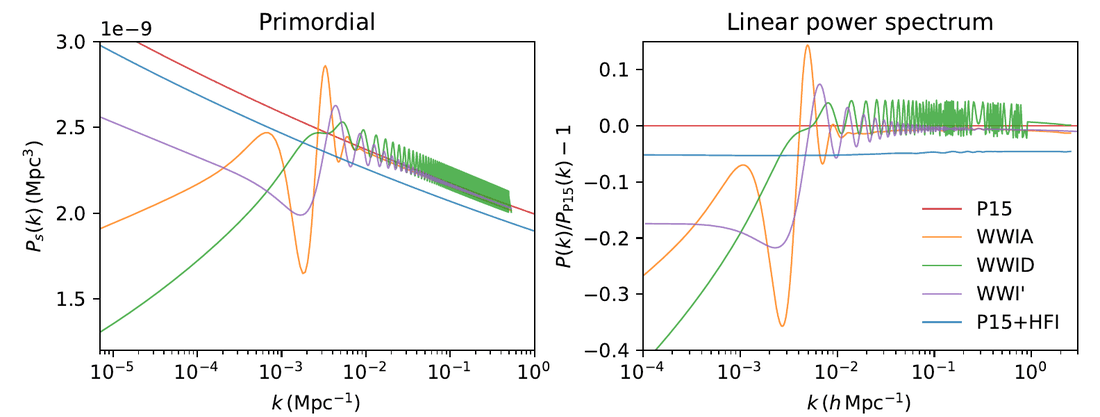
Primordial power spectra with features (left) and the resulting linear matter power spectra relative to Planck 2015 (right).

2018 · MNRAS 477 (2018) 2503

Probing features in the primordial perturbation spectrum with large-scale structure data

L'Huillier, B., Shafieloo, A., Hazra, D. K., Smoot, G. F., Starobinsky, A. A.

Can large-scale structure distinguish primordial power spectra with features that the CMB cannot? With 15 DESI-like N-body simulations, we show that the halo mass function and two-point correlation function cannot, but simple counts-in-cells statistics can.

DOI · arXiv:1710.10987

Early UniverseLarge-scale structureSimulationsFirst author

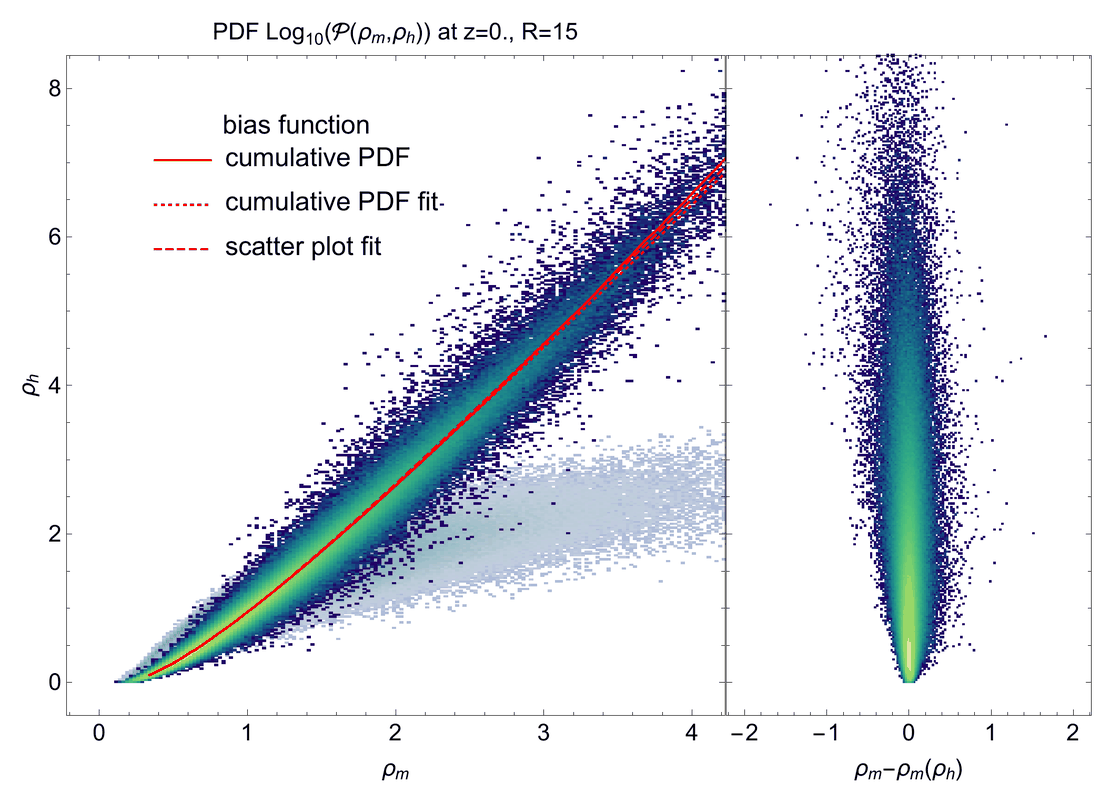
Halo density against dark matter density in spheres of 15h-1Mpc at z = 0, with the reconstructed bias function (red).
Halo density against dark matter density in spheres of 15 h−1 Mpc15\,h^{-1}\,\mathrm{Mpc} at z=0z = 0, with the reconstructed bias function (red).

2018 · MNRAS 473 (2018) 5098

A question of separation: disentangling tracer bias and gravitational non-linearity with counts-in-cells statistics

Uhlemann, C., Feix, M., Codis, S., Pichon, C., Bernardeau, F., et al. (incl. L'Huillier, B.)

We model the bias of tracer densities in spheres with a quadratic bias relation and the large-deviation dark matter PDF, validated on Horizon Run 4 subhaloes. This allows a joint estimate of the non-linear dark matter variance and the bias parameters.

DOI · arXiv:1705.08901

Large-scale structureSimulations

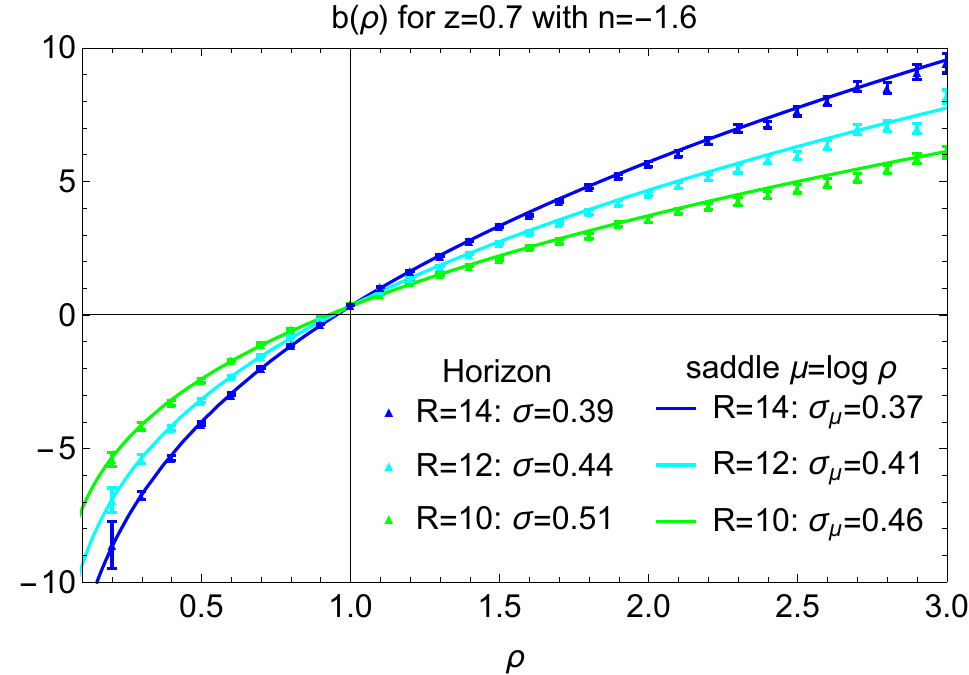
Density-dependent clustering bias b(rho) in Horizon Run 4 at z = 0.7 (points) against the saddle-point prediction (lines).
Density-dependent clustering bias b(ρ)b(\rho) in Horizon Run 4 at z=0.7z = 0.7 (points) against the saddle-point prediction (lines).

2017 · MNRAS 466 (2017) 2067

Beyond Kaiser bias: mildly non-linear two-point statistics of densities in distant spheres

Uhlemann, C., Codis, S., Kim, J., Pichon, C., Bernardeau, F., et al. (incl. L'Huillier, B.)

Parameter-free analytic bias functions extend Kaiser bias into the mildly non-linear regime, using large-deviation statistics and spherical collapse. They match Horizon Run 4 at the percent level down to about 10 h−1 Mpc10\,h^{-1}\,\mathrm{Mpc}, and reduce the variance of the estimator about fivefold.

DOI · arXiv:1607.01026

Large-scale structureSimulations

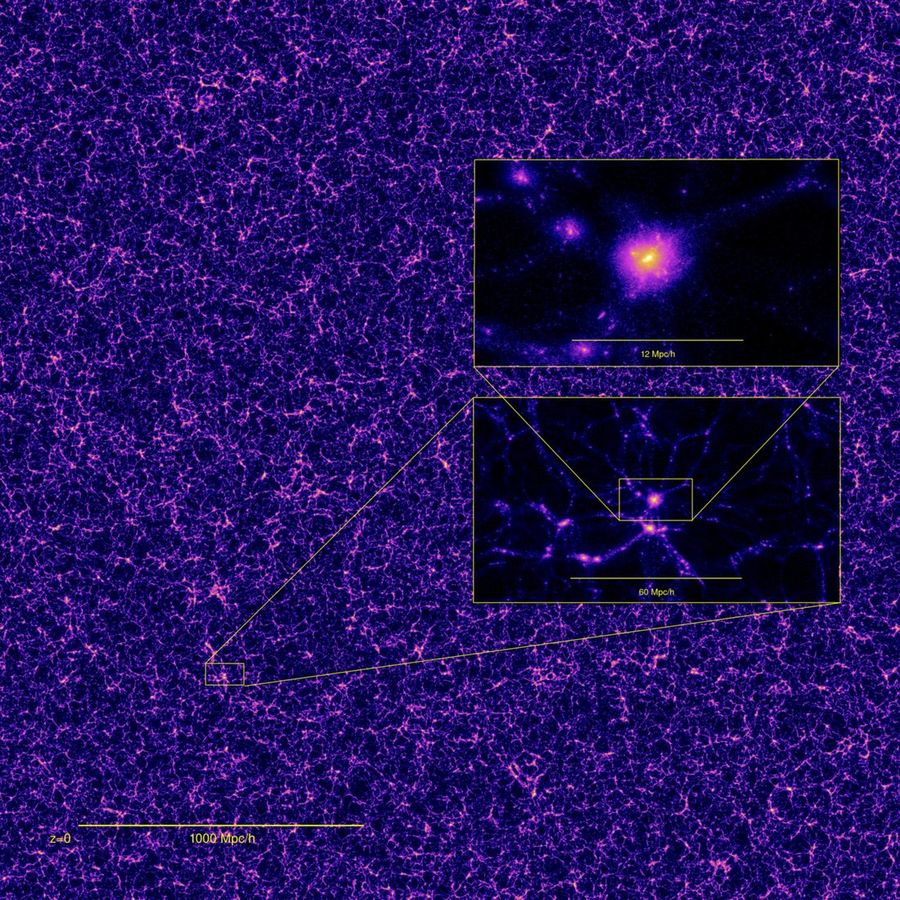
A 7h-1Mpc-thick slice through Horizon Run 4 at z = 0, with two successive zooms onto a galaxy cluster.
A 7 h−1 Mpc7\,h^{-1}\,\mathrm{Mpc}-thick slice through Horizon Run 4 at z=0z = 0, with two successive zooms onto a galaxy cluster.

2015 · J. Korean Astron. Soc. 48 (2015) 213

Horizon Run 4 simulation: coupled evolution of galaxies and large-scale structures of the Universe

Kim, J., Park, C., L'Huillier, B., Hong, S. E.

Horizon Run 4 follows 630036300^3 particles in a 3150 h−1 Mpc3150\,h^{-1}\,\mathrm{Mpc} box, with halo merger trees down to 2.7×10¹¹ h−1 M⊙2.7\times10^{11}\,h^{-1}\,M_\odot. The halo mass function departs from universality and evolves with redshift, and the BAO peak in mock galaxy correlations broadens and shifts. The data are public.

DOI · arXiv:1508.05107

Key papersLarge-scale structureDark matter haloesSimulations

← All papers