Publications

Gaussian processes

6 papers

Gaussian process regression reconstructs a smooth function, such as a distance, the Hubble rate or the growth rate, directly from data, with its uncertainties and without choosing a parametric form. I use it to reconstruct the expansion and growth histories and to derive dark energy and modified-gravity quantities from them.

Its results depend on the mean function and on the kernel hyperparameters. With my students, we showed how to choose them and marginalise over them, so that the reconstruction does not quietly assume the model it is meant to test.

Publications

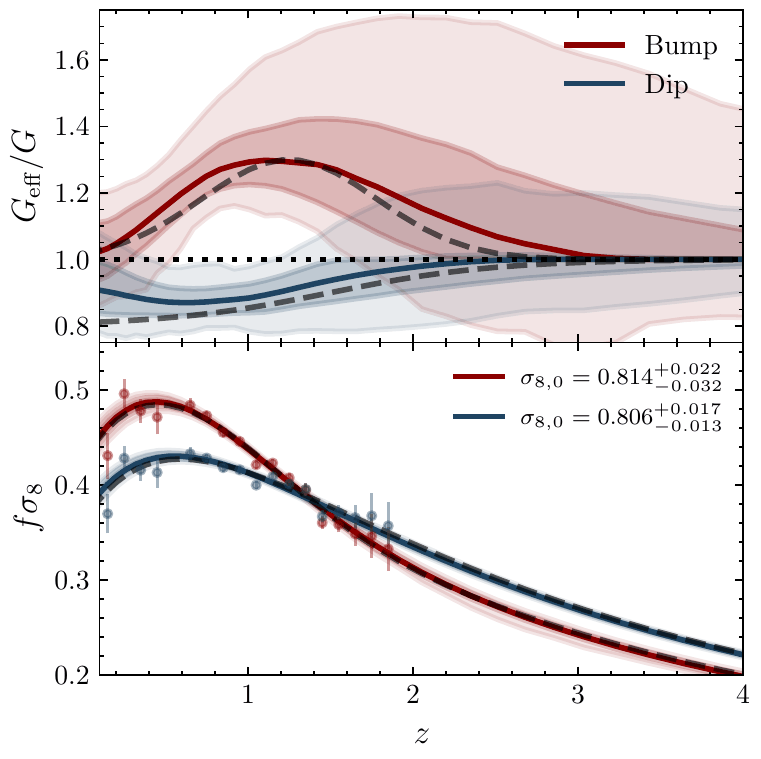
Realistic forecast: reconstructed Geff/G and fsigma8 for two modified-gravity scenarios (bump and dip). Both rule out GR at more than 2sigma around z approx 1.
Realistic forecast: reconstructed Geff/GG_\mathrm{eff}/G and fσ8f\sigma_8 for two modified-gravity scenarios (bump and dip). Both rule out GR at more than 2σ2\sigma around z≈1z \approx 1.

2023 · Phys. Rev. D 108 (2023) 023504

Joint reconstructions of growth and expansion histories from stage-IV surveys with minimal assumptions. II. Modified gravity and massive neutrinos

Calderón, R., L'Huillier, B., Polarski, D., Shafieloo, A., Starobinsky, A. A.

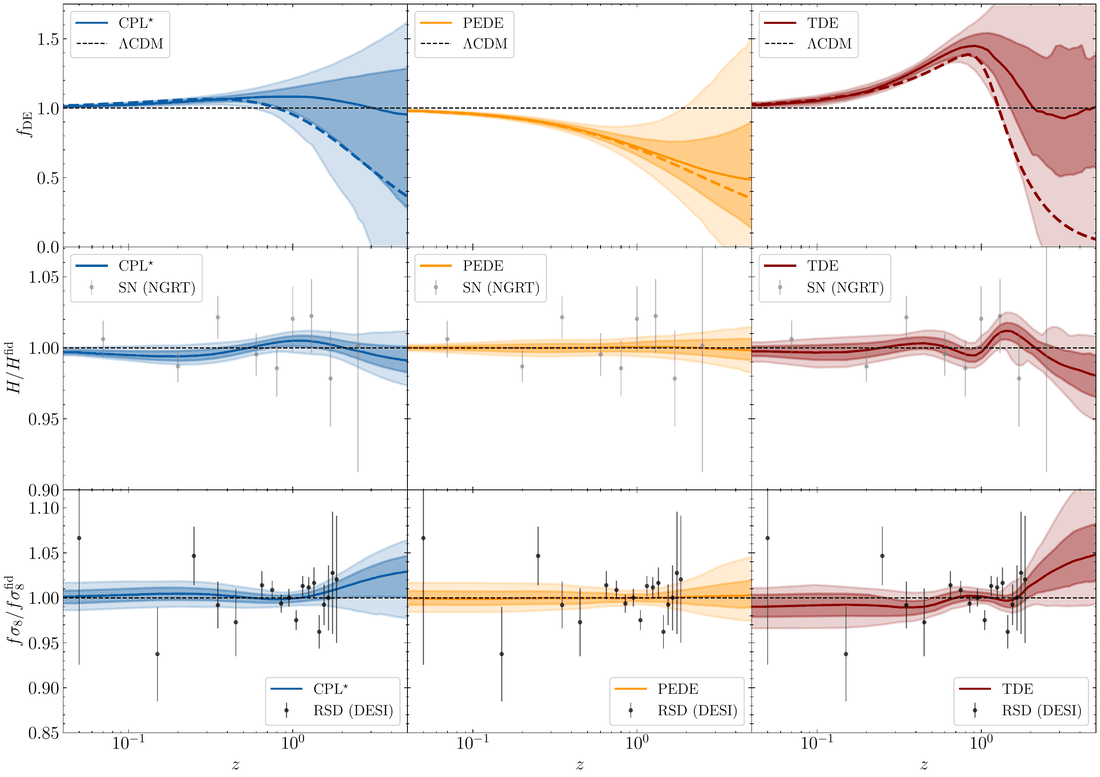
We reconstruct the effective gravitational coupling Geff(z)G_\mathrm{eff}(z) as a Gaussian process from forecast stage-IV growth data. DESI-like surveys could detect departures from General Relativity if dark energy is well determined; massive neutrinos do not change this, but assuming a ΛCDM expansion biases the inferred Ωm\Omega_\mathrm{m} and σ8\sigma_8.

DOI · arXiv:2301.00640

Modified gravityGrowth of structure (RSD)Gaussian processes

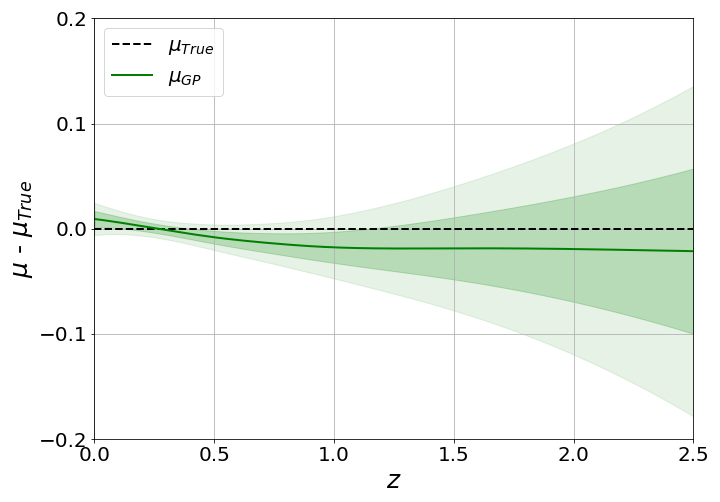
Gaussian-process reconstruction of the distance modulus relative to the truth, fully marginalised over hyperparameters and CPL parameters.

Gaussian processes, done right

2023 · JCAP 02 (2023) 014

How to use GP: effects of the mean function and hyperparameter selection on Gaussian process regression

Hwang, S.-g.†, L'Huillier, B.*, Keeley, R. E., Jee, M. J., Shafieloo, A.

The choice of mean function and hyperparameters biases Gaussian process reconstructions of supernova distances: a zero mean gives unphysical results and a best-fit ΛCDM mean biases them. Marginalising over a family of mean functions and over the hyperparameters removes the bias, whatever the kernel.

DOI · arXiv:2206.15081

Key papersType Ia supernovaeGaussian processesWith my students

Joint reconstructions of the effective gravitational coupling, H(z) and fsigma8(z) for three fiducial cosmologies; dashed lines show the truth.
Joint reconstructions of the effective gravitational coupling, H(z)H(z) and fσ8(z)f\sigma_8(z) for three fiducial cosmologies; dashed lines show the truth.

2022 · Phys. Rev. D 106 (2022) 083513

Joint reconstructions of growth and expansion histories from stage-IV surveys with minimal assumptions I: dark energy beyond Λ\Lambda

Calderón, R., L'Huillier, B., Polarski, D., Shafieloo, A., Starobinsky, A. A.

Gaussian processes reconstruct the dark energy density from forecast stage-IV supernova, BAO and redshift-space-distortion data, assuming only a flat FLRW universe that becomes matter-dominated at high redshift, which also yields the growth history. Several dark energy models can be distinguished from ΛCDM at 2σ2\sigma or more.

DOI · arXiv:2206.13820

Dark energyType Ia supernovaeBAOGrowth of structure (RSD)Gaussian processes

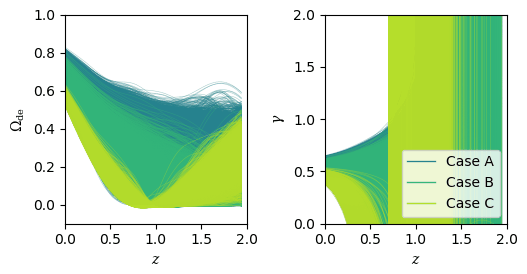
Reconstructions of Omegade(z) (left) and the growth index gamma(z) (right) that fit the growth data better than ΛCDM, for three cases.
Reconstructions of Ωde(z)\Omega_\mathrm{de}(z) (left) and the growth index γ(z)\gamma(z) (right) that fit the growth data better than ΛCDM, for three cases.

2020 · MNRAS 494 (2020) 819

Defying the laws of Gravity I: model-independent reconstruction of the Universe expansion from growth data

L'Huillier, B., Shafieloo, A., Polarski, D., Starobinsky, A. A.

From redshift-space distortion data alone, we reconstruct the growth history with crossing statistics and Gaussian processes, derive the expansion history from it, and fit supernovae to constrain Ωm,0\Omega_{\mathrm{m},0} and σ8,0\sigma_{8,0}. The results are consistent with flat ΛCDM and General Relativity.

DOI · arXiv:1906.05991

Modified gravityGrowth of structure (RSD)Type Ia supernovaeGaussian processesFirst author

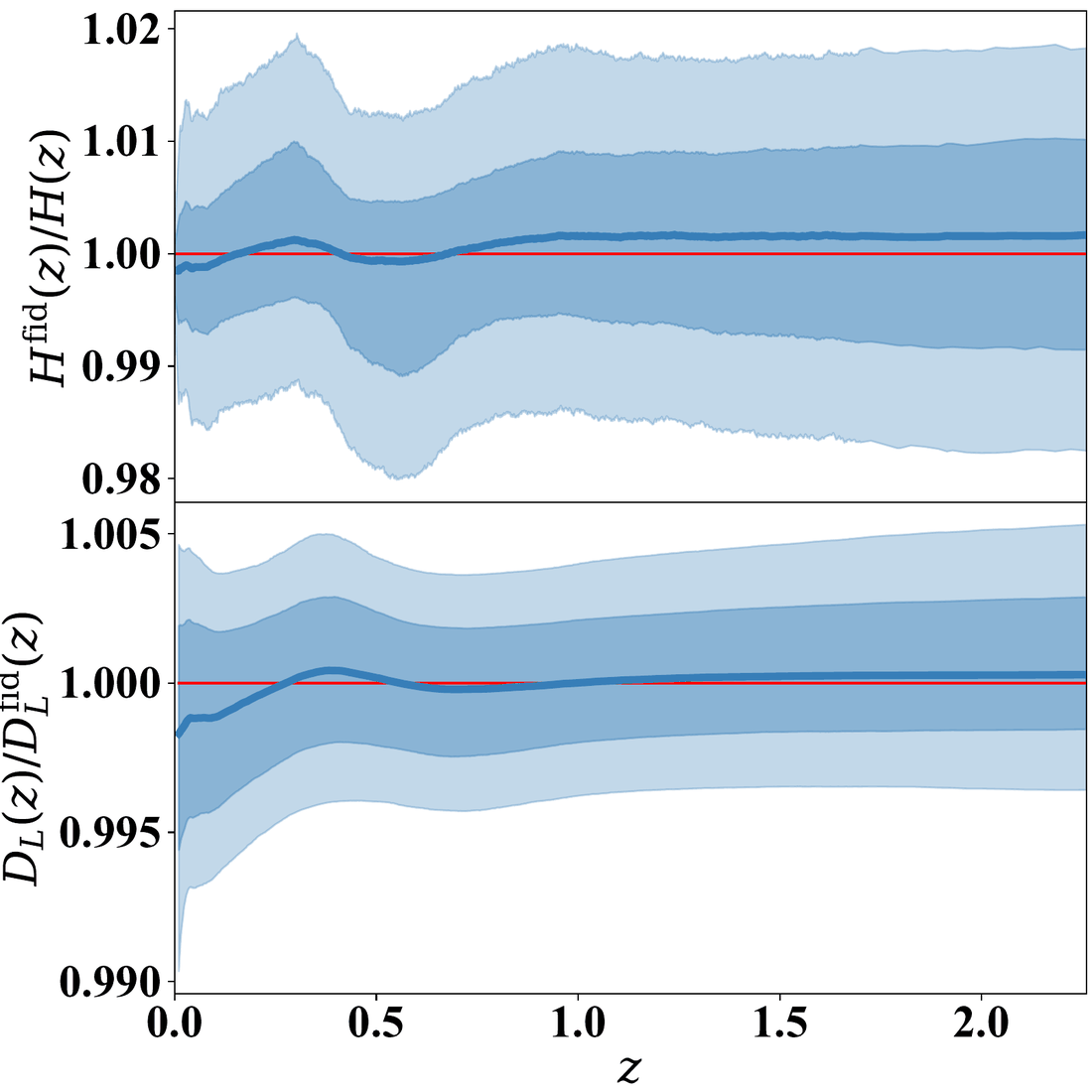
Gaussian-process reconstructions of 1/H(z) and DL(z) from standard sirens and supernovae for a ΛCDM input, relative to the best-fit ΛCDM.
Gaussian-process reconstructions of 1/H(z)1/H(z) and DL(z)D_L(z) from standard sirens and supernovae for a ΛCDM input, relative to the best-fit ΛCDM.

2020 · MNRAS 491 (2020) 3983

Debiasing cosmic gravitational wave sirens

Keeley, R. E., Shafieloo, A., L'Huillier, B., Linder, E. V.

Gaussian process regression can remove the bias in reconstructing H(z)H(z) from gravitational-wave standard sirens, and combined with supernovae it tests H0H_0 and ΛCDM. Dark-siren redshifts need close to spectroscopic precision to avoid significant bias.

DOI · arXiv:1905.10216

Gravitational wavesType Ia supernovaeGaussian processes

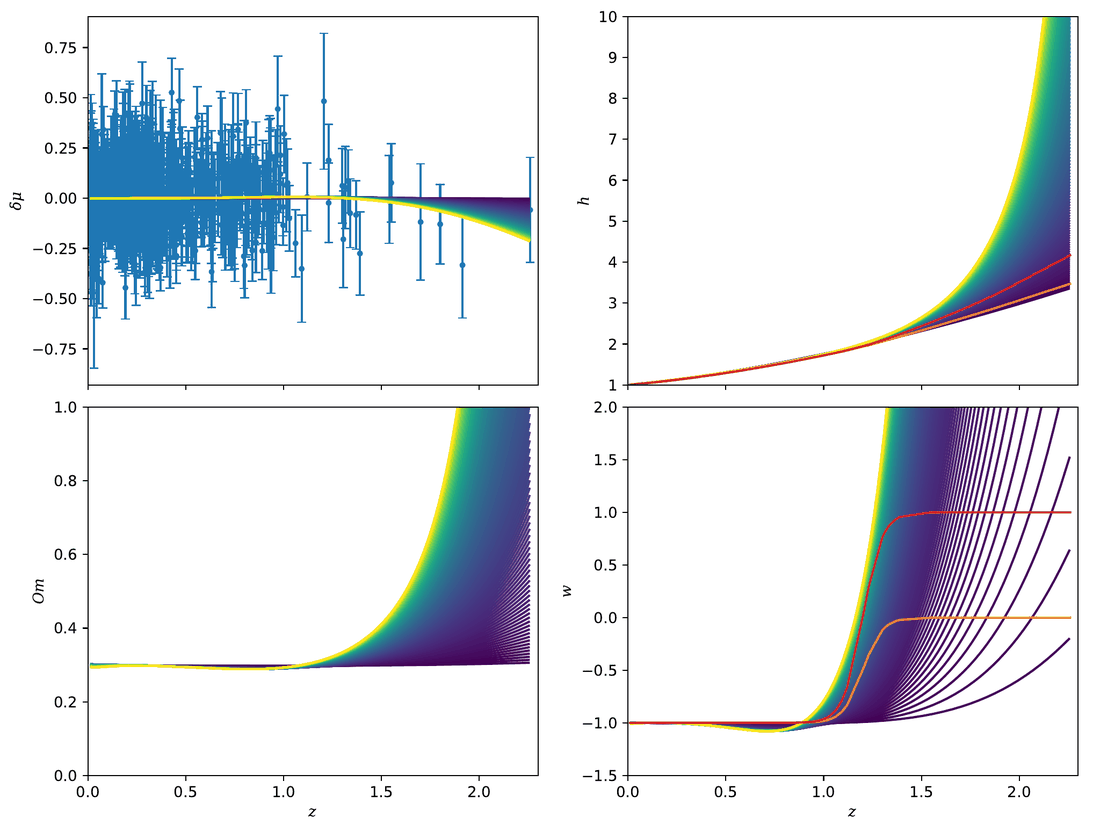
Iterative smoothing of Pantheon: residuals, h(z), the Om diagnostic and w(z). Every curve fits the data better than the best-fit ΛCDM.
Iterative smoothing of Pantheon: residuals, h(z)h(z), the OmOm diagnostic and w(z)w(z). Every curve fits the data better than the best-fit ΛCDM.

2019 · MNRAS 485 (2019) 2783

Model independent expansion history from supernovae: cosmology versus systematics

L'Huillier, B., Shafieloo, A., Linder, E. V., Kim, A. G.

A model-independent analysis of the Pantheon supernovae shows deviations from ΛCDM at z≳1z \gtrsim 1. They vanish with a simple Malmquist-like correction, but neither χ2\chi^2 tests nor Gaussian processes find that this extra correction is statistically required.

DOI · arXiv:1812.03623

Type Ia supernovaeGaussian processesFirst author

← All papers