Publications

Galaxy formation

5 papers

How do galaxies assemble their mass? How do galaxies evolve within the large-scale structure?

I used multi-zoom cosmological hydrodynamical simulations to quantify the mass assembled through mergers and through smooth gas accretion (L'Huillier, Combes & Semelin 2012).

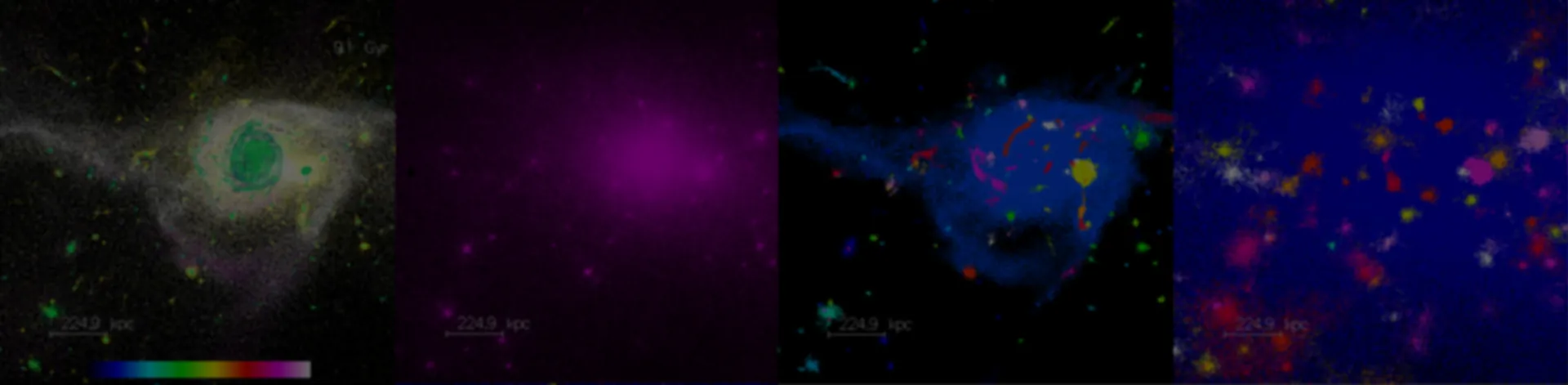
Zoom on a galaxy cluster in a hydrodynamical simulation
Zoom on a cluster in a hydrodynamical simulation, from L'Huillier, Combes & Semelin (2012), A&A.

Using the Horizon Run 4 simulation (Kim et al. 2015), I quantified the interaction rate — mergers and flybys (L'Huillier, Park & Kim 2015) — and the alignments (L'Huillier, Park & Kim 2017) of haloes as a function of their environment (mass and large-scale density).

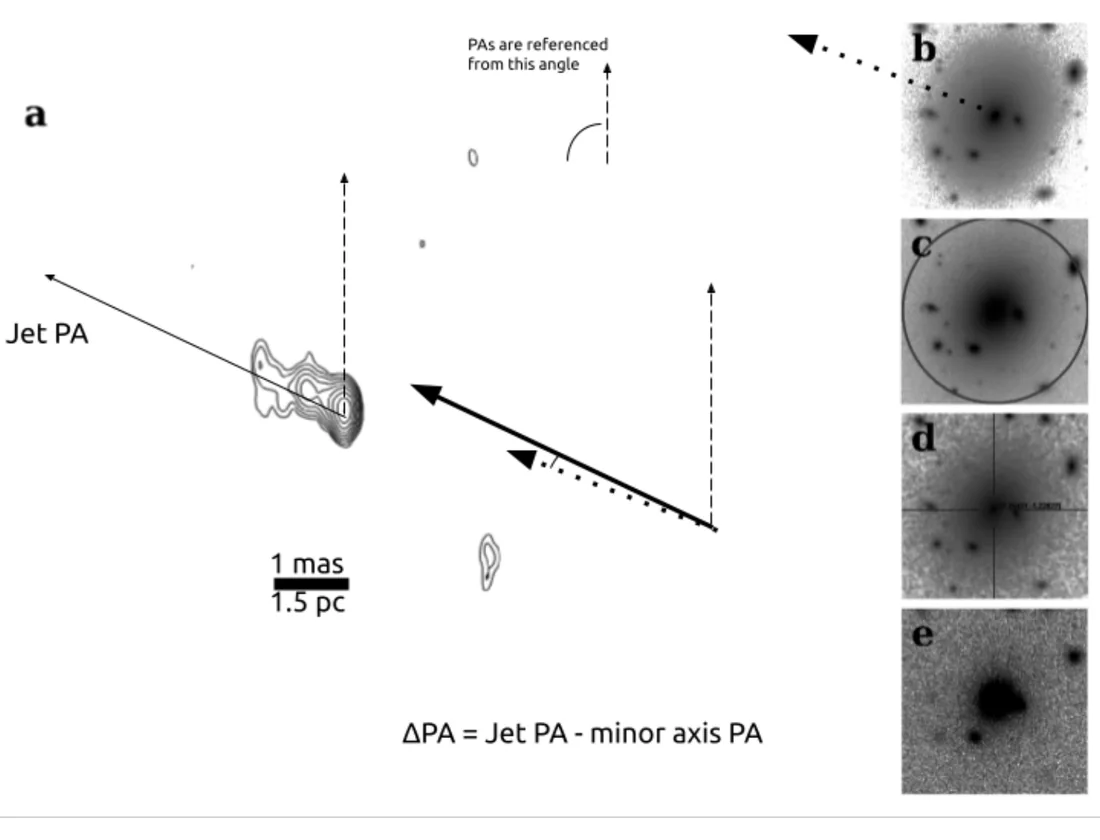
In a study led by David Fernández Gil and published in Nature Astronomy, we detected a weak but significant alignment between the central region of AGN jets, as seen by very long baseline interferometry, and the optical shape of their host galaxies from various surveys (Fernández Gil et al. 2025, Nat. Astron.).

Publications

How the jet–host angle is measured: VLBI jet position angle (a) against the minor axis of the optical host in DES, DESI LS, SDSS and SkyMapper (b–e).

Black-hole jets know their host galaxy

2025 · Nature Astronomy 9 (2025) 302

Detection of an orthogonal alignment between parsec-scale AGN jets and their host galaxies

Fernández Gil, D.†, Hodgson, J. A., L'Huillier, B., Asorey, J., Saulder, C., Finner, K., et al.

Comparing VLBI jet directions with optical host-galaxy shapes for about 6,000 AGN, we detect a weak but significant alignment between the parsec-scale jet and the minor axis of its host galaxy: a link between the black hole and its host across three orders of magnitude in scale.

DOI · arXiv:2411.09099
Key papersAGN & jetsGalaxy formationVLBIWith my students

How the jet–host angle is measured: VLBI jet position angle (a) against the minor axis of the optical host in DES, DESI LS, SDSS and SkyMapper (b–e). (Figure from the 2025 follow-up paper.)

2023 · arXiv preprint

Exploring connections between the VLBI and optical morphology of AGNs and their host galaxies

Fernández Gil, D.†, Hodgson, J. A., L'Huillier, B.

Matching over 9,000 VLBI sources from the Astrogeo catalogue to their optical host galaxies and fitting the hosts' shapes, this first study finds no clear correlation between host morphology and jet direction.

arXiv:2305.06713

AGN & jetsGalaxy formationVLBIWith my students

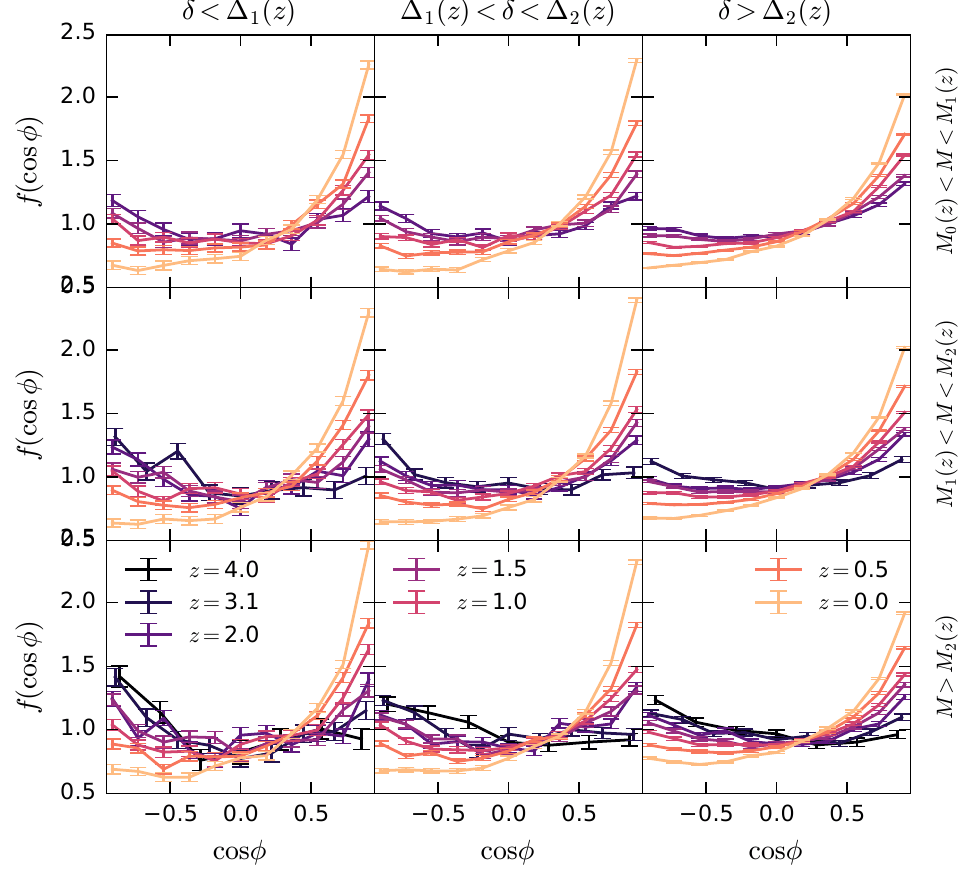
Evolution of the alignment between the spins of interacting haloes, by environment (columns) and mass (rows).

2017 · MNRAS 466 (2017) 4875

Ecology of dark matter haloes – II. Effects of interactions on the alignment of halo pairs

L'Huillier, B., Park, C., Kim, J.

In Horizon Run 4, interacting haloes have lower spin and are more spherical than typical haloes. Pairs start with antiparallel spins that gradually become parallel, interactions are mostly radial, and alignments are strongest for massive, close pairs and persist up to z=4z = 4.

DOI · arXiv:1701.04417

Galaxy formationDark matter haloesSimulationsFirst author

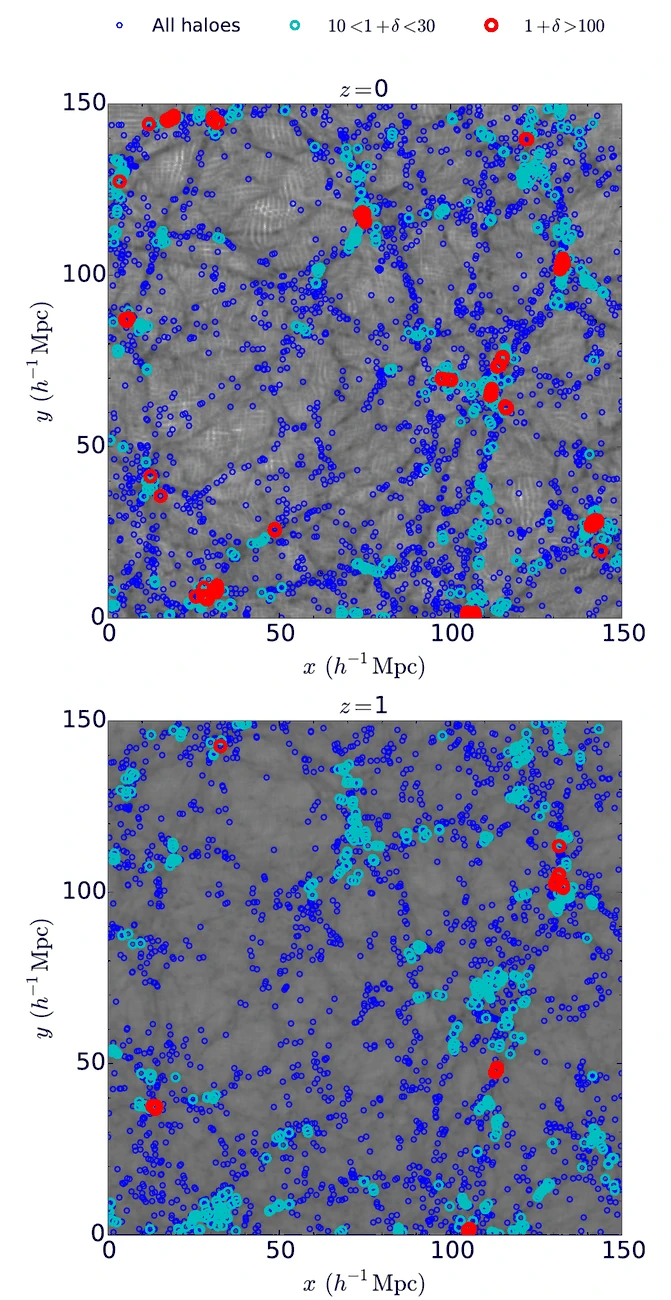
Haloes in the cosmic web at z = 0 (top) and z = 1 (bottom): the densest environments (red) sit in the nodes, intermediate ones (cyan) in filaments.
Haloes in the cosmic web at z=0z = 0 (top) and z=1z = 1 (bottom): the densest environments (red) sit in the nodes, intermediate ones (cyan) in filaments.

2015 · MNRAS 451 (2015) 527

The ecology of dark matter haloes – I. The rates and types of halo interactions

L'Huillier, B., Park, C., Kim, J.

Using Horizon Run 4, we measure how often haloes interact as a function of environment, separation, mass ratio, mass and redshift. Most interactions happen at density contrast δ≈20\delta \approx 20, while the interacting fraction peaks at δ≈1000\delta \approx 1000; we provide a fitting formula and identify two interaction modes.

DOI · arXiv:1505.00788

Galaxy formationDark matter haloesSimulationsFirst author

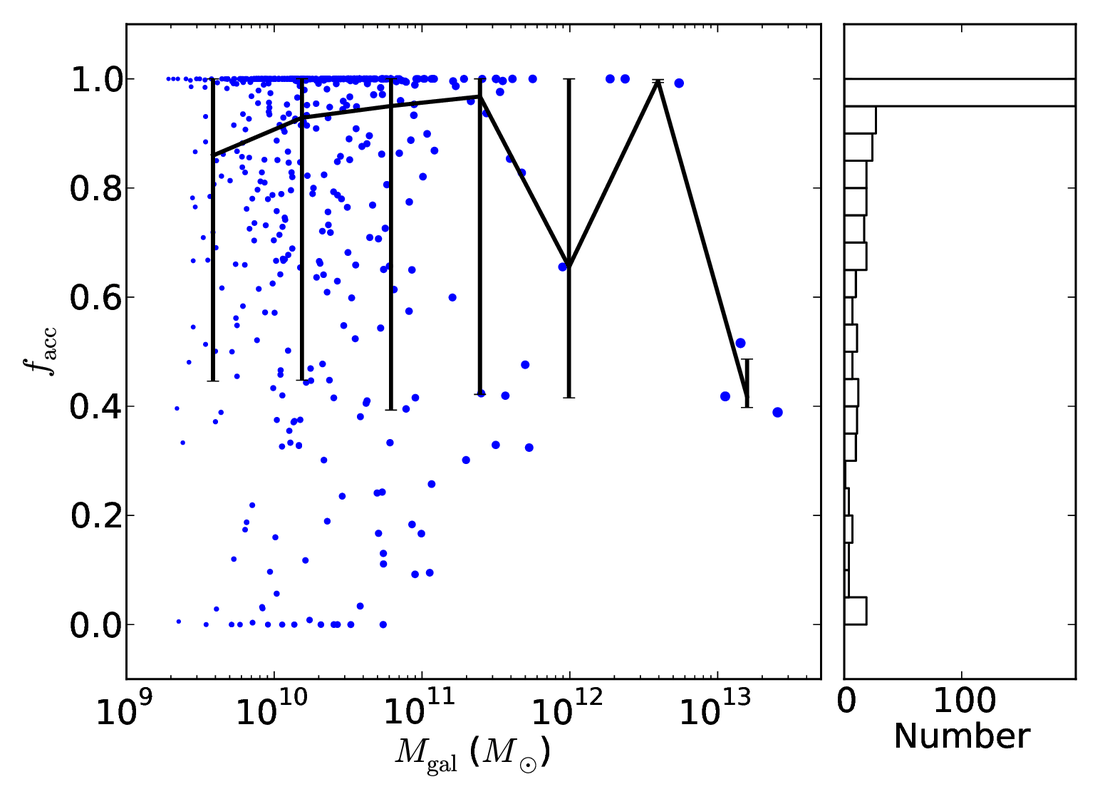
Fraction of stellar mass gained through smooth accretion rather than mergers, versus galaxy mass. The mean is 77%.

2012 · A&A 544 (2012) A68

Mass assembly of galaxies: smooth accretion versus mergers

L'Huillier, B., Combes, F., Semelin, B.

Multi-zoom cosmological simulations show that galaxies grow mostly by smooth accretion, which brings on average 77% of their mass, while mergers bring 23%. Only the most massive galaxies grow significantly through mergers.

DOI · arXiv:1108.4247

Key papersGalaxy formationSimulationsFirst author

← All papers