Publications

First author

11 papers

Publications

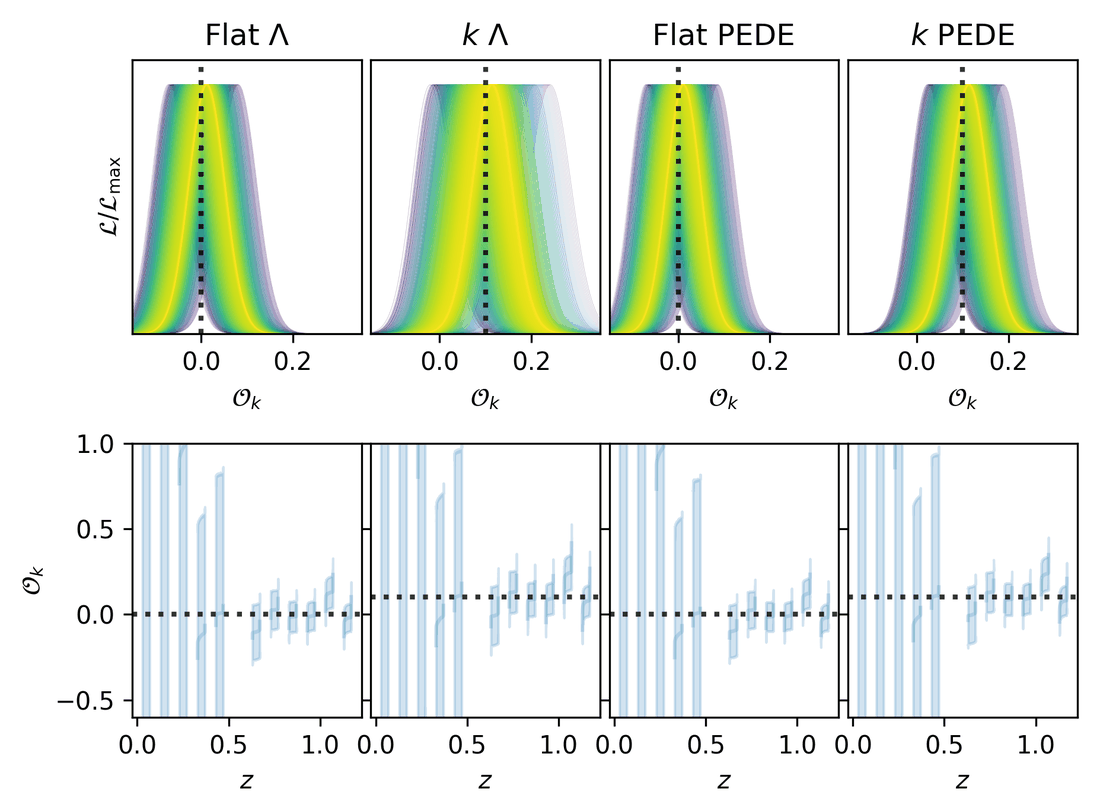
The curvature diagnostic Ok on mocks from four fiducial models: it recovers Omegak,0 = 0.1 when the input is curved.
The curvature diagnostic Ok\mathcal{O}_k on mocks from four fiducial models: it recovers Ωk,0=0.1\Omega_{k,0} = 0.1 when the input is curved.

Litmus tests for Rubin and DESI

2025 · JCAP 05 (2025) 030

Litmus tests of the flat ΛCDM model and model-independent measurement of H0rdH_0 r_\mathrm{d} with LSST and DESI

L'Huillier, B., Mitra, A., Shafieloo, A., Keeley, R. E., Koo, H.

Reconstructing the expansion history from simulated LSST supernovae and combining it with simulated DESI 5-year BAO, we forecast constraints of up to ±4% on the curvature and ±0.1 on c/(H0rd)c/(H_0 r_\mathrm{d}), without assuming any form of dark energy.

DOI · arXiv:2407.07847

Key papersCurvature & FLRWType Ia supernovaeBAOIterative smoothingFirst author
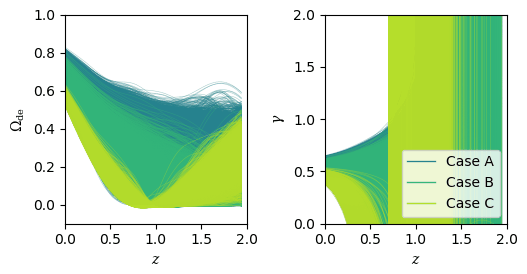
Reconstructions of Omegade(z) (left) and the growth index gamma(z) (right) that fit the growth data better than ΛCDM, for three cases.
Reconstructions of Ωde(z)\Omega_\mathrm{de}(z) (left) and the growth index γ(z)\gamma(z) (right) that fit the growth data better than ΛCDM, for three cases.

2020 · MNRAS 494 (2020) 819

Defying the laws of Gravity I: model-independent reconstruction of the Universe expansion from growth data

L'Huillier, B., Shafieloo, A., Polarski, D., Starobinsky, A. A.

From redshift-space distortion data alone, we reconstruct the growth history with crossing statistics and Gaussian processes, derive the expansion history from it, and fit supernovae to constrain Ωm,0\Omega_{\mathrm{m},0} and σ8,0\sigma_{8,0}. The results are consistent with flat ΛCDM and General Relativity.

DOI · arXiv:1906.05991

Modified gravityGrowth of structure (RSD)Type Ia supernovaeGaussian processesFirst author

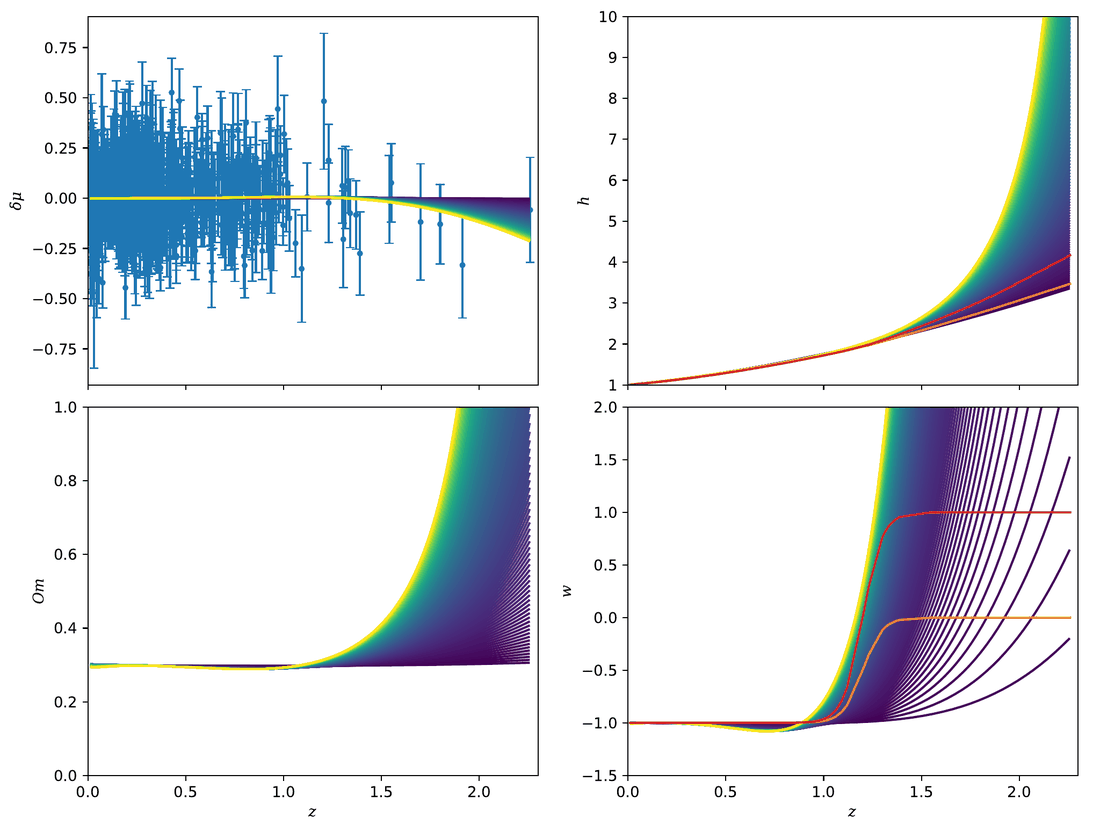
Iterative smoothing of Pantheon: residuals, h(z), the Om diagnostic and w(z). Every curve fits the data better than the best-fit ΛCDM.
Iterative smoothing of Pantheon: residuals, h(z)h(z), the OmOm diagnostic and w(z)w(z). Every curve fits the data better than the best-fit ΛCDM.

2019 · MNRAS 485 (2019) 2783

Model independent expansion history from supernovae: cosmology versus systematics

L'Huillier, B., Shafieloo, A., Linder, E. V., Kim, A. G.

A model-independent analysis of the Pantheon supernovae shows deviations from ΛCDM at z≳1z \gtrsim 1. They vanish with a simple Malmquist-like correction, but neither χ2\chi^2 tests nor Gaussian processes find that this extra correction is statistically required.

DOI · arXiv:1812.03623

Type Ia supernovaeGaussian processesFirst author

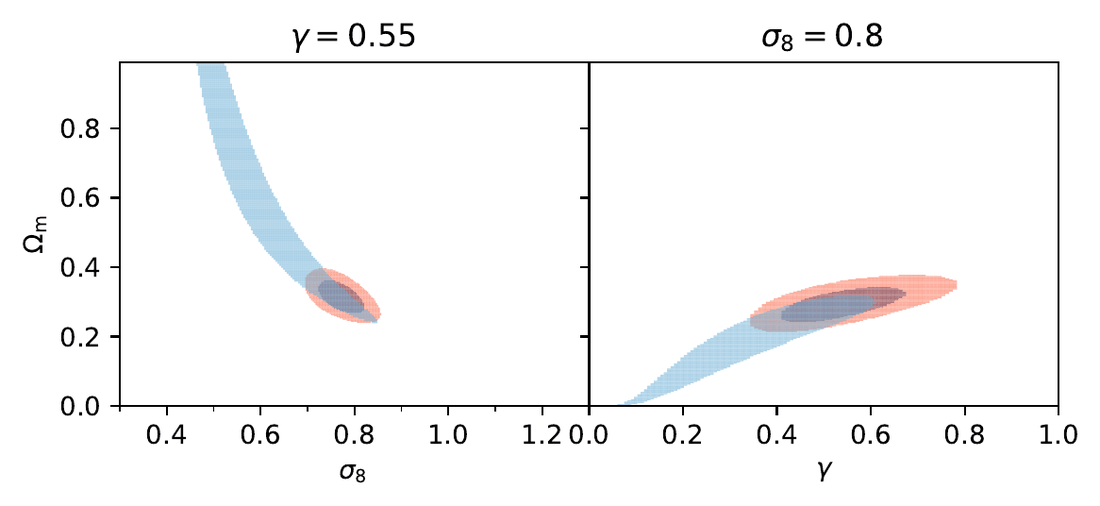
Model-independent regions allowed by growth data (blue) compared with ΛCDM (red), at fixed gamma = 0.55 (left) and fixed sigma8 = 0.8 (right).
Model-independent regions allowed by growth data (blue) compared with ΛCDM (red), at fixed γ=0.55\gamma = 0.55 (left) and fixed σ8=0.8\sigma_8 = 0.8 (right).

2018 · MNRAS 476 (2018) 3263

Model-independent cosmological constraints from growth and expansion

L'Huillier, B., Shafieloo, A., Kim, H.†

We reconstruct the expansion history from supernovae and fit growth-rate data to constrain Ωm\Omega_\mathrm{m}, the growth index γ\gamma and σ8\sigma_8 without a dark energy model. The results agree with ΛCDM in General Relativity, and requiring a positive dark energy density tightens them further.

DOI · arXiv:1712.04865

Key papersModified gravityType Ia supernovaeGrowth of structure (RSD)First authorWith my students

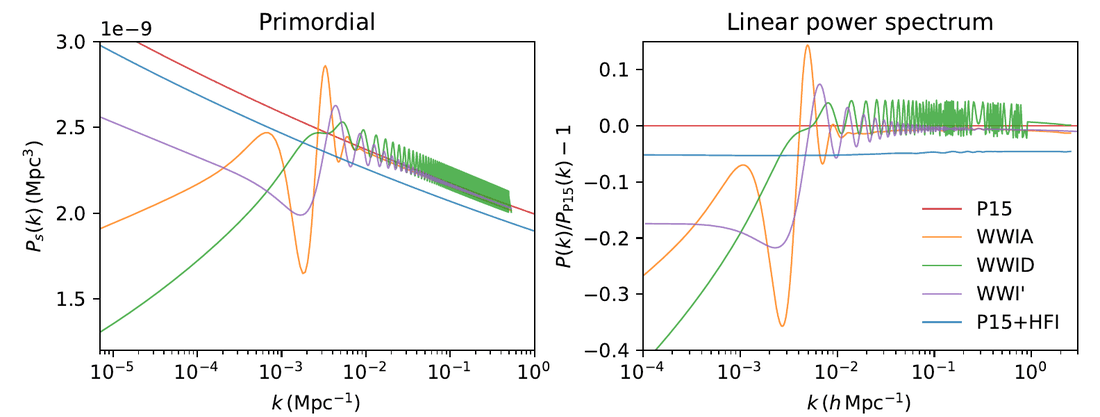
Primordial power spectra with features (left) and the resulting linear matter power spectra relative to Planck 2015 (right).

2018 · MNRAS 477 (2018) 2503

Probing features in the primordial perturbation spectrum with large-scale structure data

L'Huillier, B., Shafieloo, A., Hazra, D. K., Smoot, G. F., Starobinsky, A. A.

Can large-scale structure distinguish primordial power spectra with features that the CMB cannot? With 15 DESI-like N-body simulations, we show that the halo mass function and two-point correlation function cannot, but simple counts-in-cells statistics can.

DOI · arXiv:1710.10987

Early UniverseLarge-scale structureSimulationsFirst author

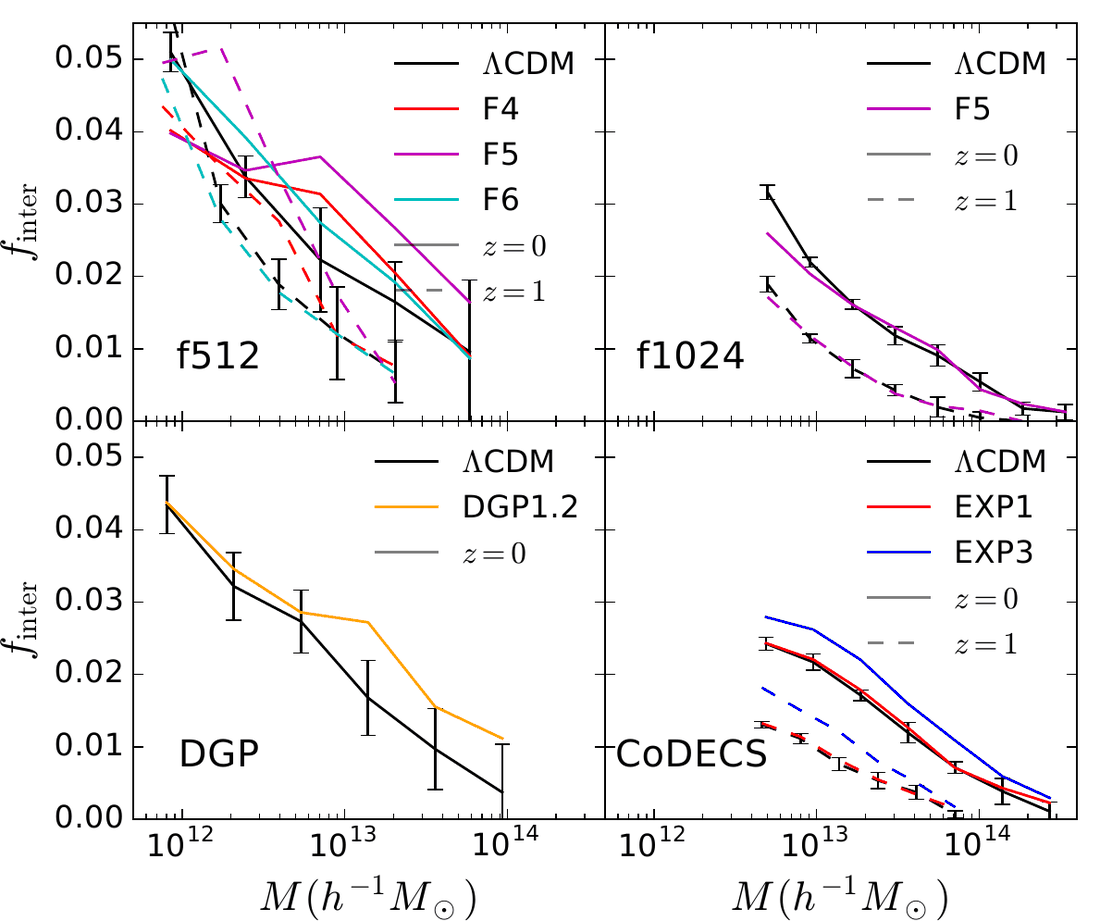
Halo interaction rate versus mass in ΛCDM and in f(R), DGP and coupled dark energy simulations.
Halo interaction rate versus mass in ΛCDM and in f(R)f(R), DGP and coupled dark energy simulations.

Haloes beyond General Relativity

2017 · MNRAS 468 (2017) 3174

Dark matter haloes in modified gravity and dark energy: interaction rate, small- and large-scale alignment

L'Huillier, B., Winther, H. A., Mota, D. F., Park, C., Kim, J.

In N-body simulations of f(R)f(R) gravity, DGP and coupled dark energy, f(R)f(R) raises halo spin and weakens the spin alignment of interacting pairs, while only strongly coupled dark energy increases the halo interaction rate and the alignment of halo shapes with the large-scale structure.

DOI · arXiv:1703.07357

Key papersModified gravityDark energyDark matter haloesSimulationsFirst author

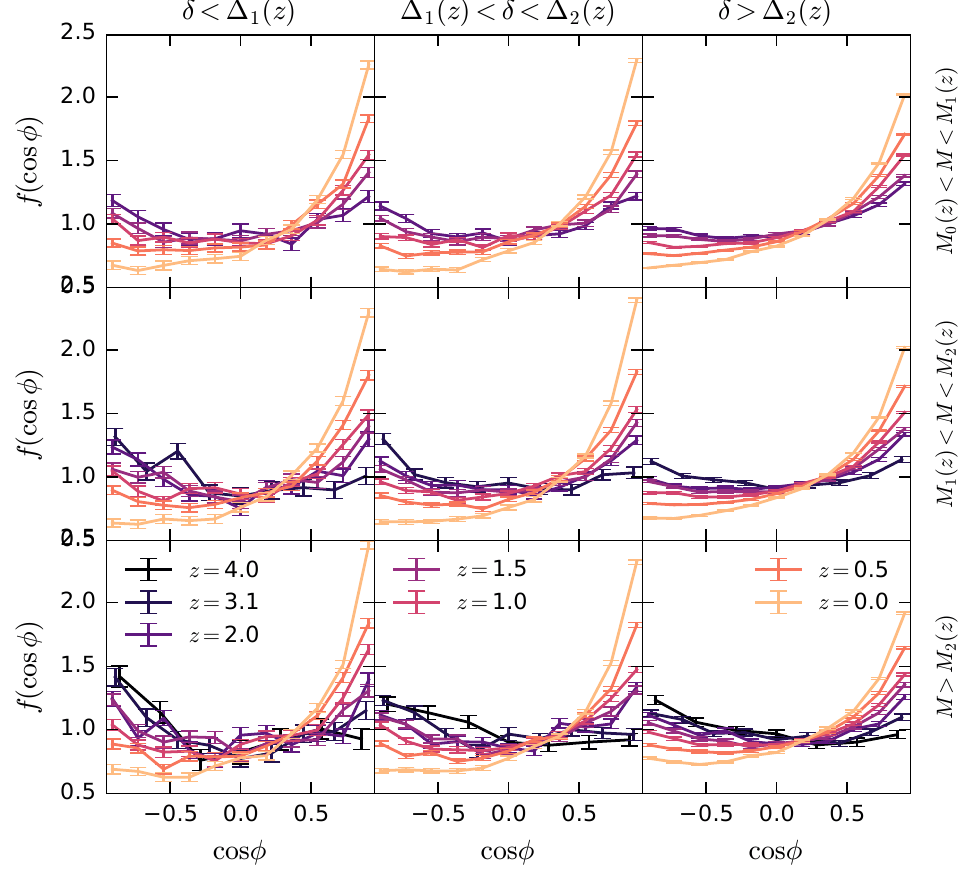
Evolution of the alignment between the spins of interacting haloes, by environment (columns) and mass (rows).

2017 · MNRAS 466 (2017) 4875

Ecology of dark matter haloes – II. Effects of interactions on the alignment of halo pairs

L'Huillier, B., Park, C., Kim, J.

In Horizon Run 4, interacting haloes have lower spin and are more spherical than typical haloes. Pairs start with antiparallel spins that gradually become parallel, interactions are mostly radial, and alignments are strongest for massive, close pairs and persist up to z=4z = 4.

DOI · arXiv:1701.04417

Galaxy formationDark matter haloesSimulationsFirst author

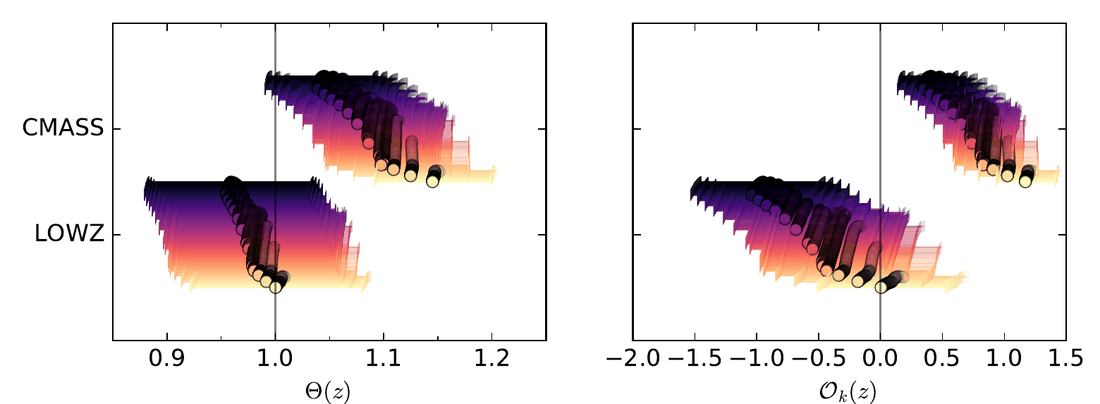
Theta(z) and the curvature diagnostic Ok(z) at the BOSS LOWZ and CMASS redshifts, one point per supernova-based reconstruction. A flat FLRW universe gives Theta = 1 and Ok = 0.
Θ(z)\Theta(z) and the curvature diagnostic Ok(z)\mathcal{O}_k(z) at the BOSS LOWZ and CMASS redshifts, one point per supernova-based reconstruction. A flat FLRW universe gives Θ=1\Theta = 1 and Ok=0\mathcal{O}_k = 0.

Testing ΛCDM without assuming it

2017 · JCAP 01 (2017) 015

Model-independent test of the FLRW metric, the flatness of the Universe, and non-local measurement of H0rdH_0 r_\mathrm{d}

L'Huillier, B., Shafieloo, A.

Combining BOSS DR12 BAO with JLA supernovae, we measure H0rdH_0 r_\mathrm{d} without assuming a cosmological model and introduce the Θ(z)\Theta(z) diagnostic of the flat-FLRW metric. The results are consistent with a flat FLRW universe within 2σ2\sigma.

DOI · arXiv:1606.06832

Key papersCurvature & FLRWType Ia supernovaeBAOIterative smoothingFirst author
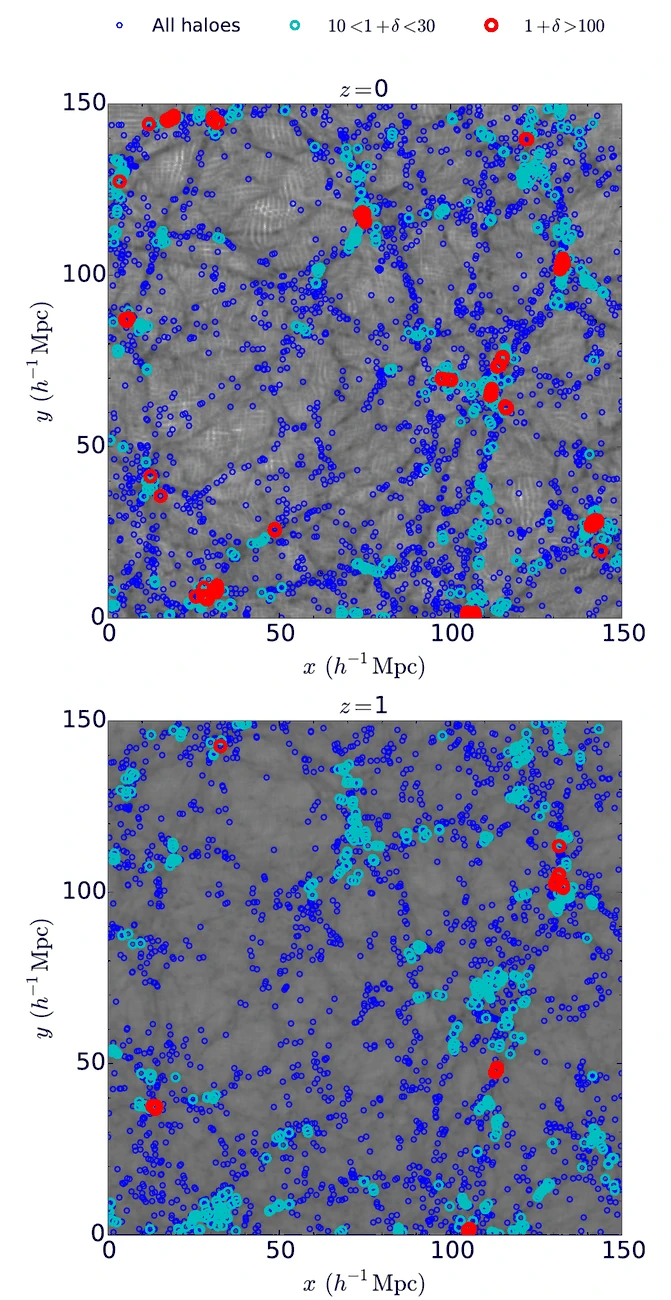
Haloes in the cosmic web at z = 0 (top) and z = 1 (bottom): the densest environments (red) sit in the nodes, intermediate ones (cyan) in filaments.
Haloes in the cosmic web at z=0z = 0 (top) and z=1z = 1 (bottom): the densest environments (red) sit in the nodes, intermediate ones (cyan) in filaments.

2015 · MNRAS 451 (2015) 527

The ecology of dark matter haloes – I. The rates and types of halo interactions

L'Huillier, B., Park, C., Kim, J.

Using Horizon Run 4, we measure how often haloes interact as a function of environment, separation, mass ratio, mass and redshift. Most interactions happen at density contrast δ≈20\delta \approx 20, while the interacting fraction peaks at δ≈1000\delta \approx 1000; we provide a fitting formula and identify two interaction modes.

DOI · arXiv:1505.00788

Galaxy formationDark matter haloesSimulationsFirst author

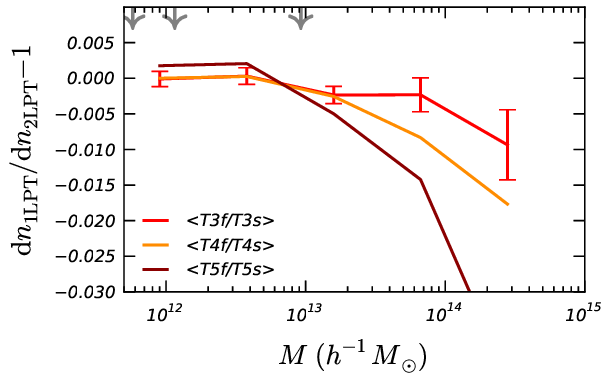
Effect of the order of Lagrangian perturbation theory (1LPT vs 2LPT) in the initial conditions on the halo mass function.

2014 · New Astron. 30 (2014) 79

Effects of the initial conditions on cosmological N-body simulations

L'Huillier, B., Park, C., Kim, J.

We test how the pre-initial configuration, the order of Lagrangian perturbation theory and the starting redshift affect N-body results. Glass and grid give similar results at z≲2z \lesssim 2, while first-order LPT underestimates massive haloes by about 2% and small-scale power by 6%.

DOI · arXiv:1401.6180

Key papersSimulationsFirst author

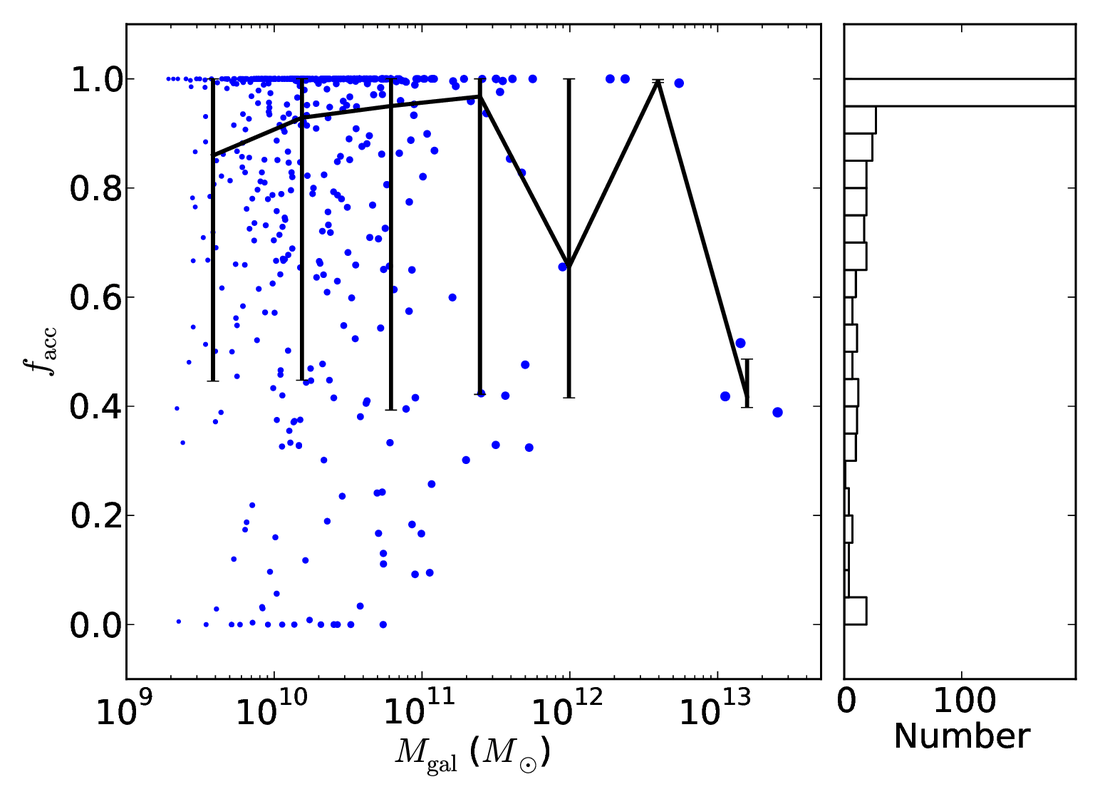
Fraction of stellar mass gained through smooth accretion rather than mergers, versus galaxy mass. The mean is 77%.

2012 · A&A 544 (2012) A68

Mass assembly of galaxies: smooth accretion versus mergers

L'Huillier, B., Combes, F., Semelin, B.

Multi-zoom cosmological simulations show that galaxies grow mostly by smooth accretion, which brings on average 77% of their mass, while mergers bring 23%. Only the most massive galaxies grow significantly through mergers.

DOI · arXiv:1108.4247

Key papersGalaxy formationSimulationsFirst author

← All papers