The concordance model of cosmology is built on several assumptions:
the Universe is homogeneous and isotropic;
gravity is described by General Relativity (GR).
Under these assumptions, the metric of the Universe is the Friedmann–Lemaître–Robertson–Walker (FLRW) metric, describing an expanding universe.
Within this framework, the current concordance model is ΛCDM: the energy budget is dominated by the cosmological constant Λ, responsible for the late-time acceleration of the expansion, and matter is dominated by a cold, smooth, non-baryonic component — dark matter. However, neither component has been directly detected, and neither is part of the standard model of particle physics. One may therefore question the underlying hypotheses: Is FLRW the correct metric? Is the Universe isotropic and homogeneous? Is dark energy a cosmological constant?
Testing the FLRW metric & the curvature
Combining model-independent reconstructions of the expansion history h(z)=H(z)/H0 from the Joint Light-curve Analysis (JLA) supernovae with baryon acoustic oscillation measurements from the Baryon Oscillation Spectroscopic Survey (SDSS-III/BOSS), Arman Shafieloo and I measured, in a model-independent way, the combination of the Hubble constant H0 and the sound horizon at the drag epoch rd. We then introduced a new litmus test of the flat-FLRW metric, Θ(z), related to the Clarkson test Ok(z) through
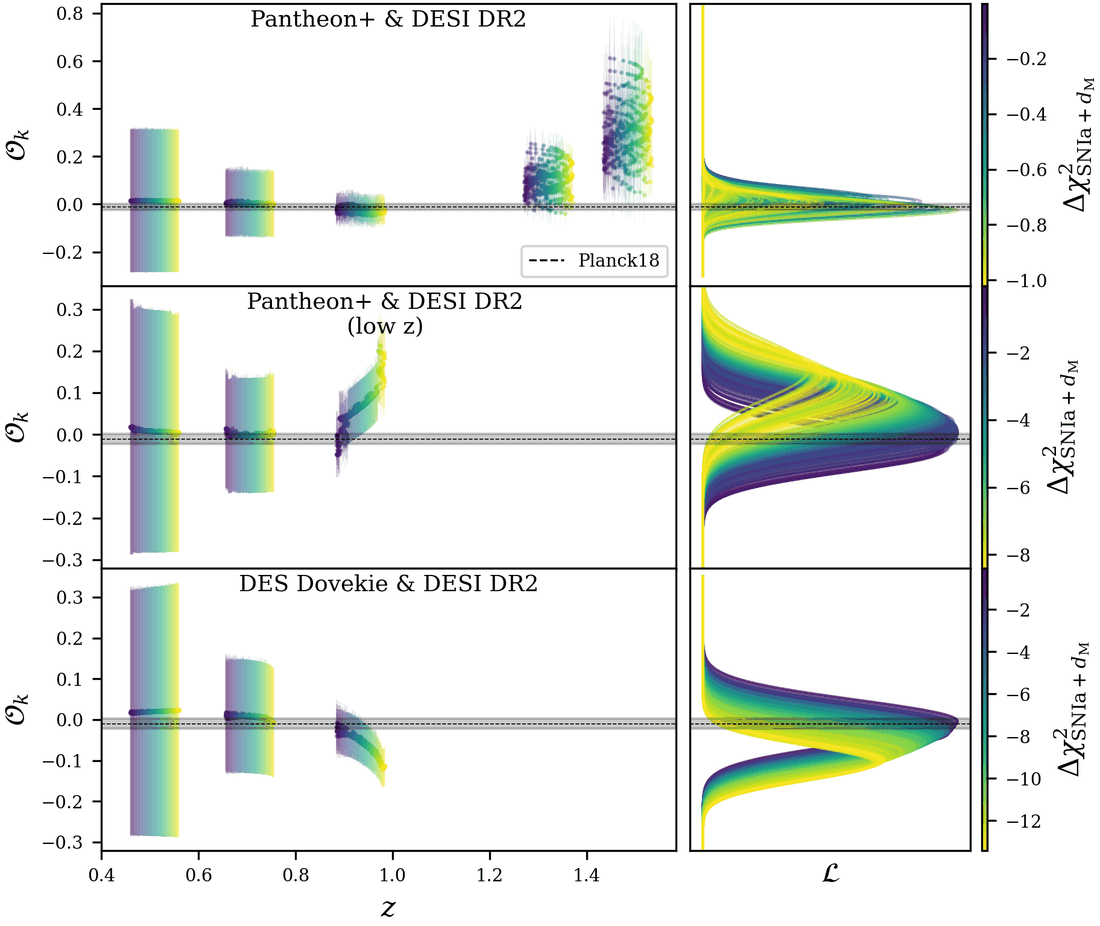
Ok(z) from supernova reconstructions combined with DESI DR2, for three data sets, colour-coded by Δχ2; right: the resulting likelihoods.
Is the Universe flat? A test with DESI DR2
2026 · JCAP 08 (2026) 016
Model independent test of the FLRW metric and the curvature in light of DESI DR2
Millard, C.†, L'Huillier, B.*, Douspis, M.
We reconstruct distances and the Hubble rate from Pantheon+ and DES supernovae without assuming any dark energy model, and combine them with DESI DR2 baryon acoustic oscillations to test the FLRW metric and measure the spatial curvature. With Pantheon+ and DESI DR2 we find Ωk,0=0.045−0.081+0.045, consistent with flatness and with Planck 2018.
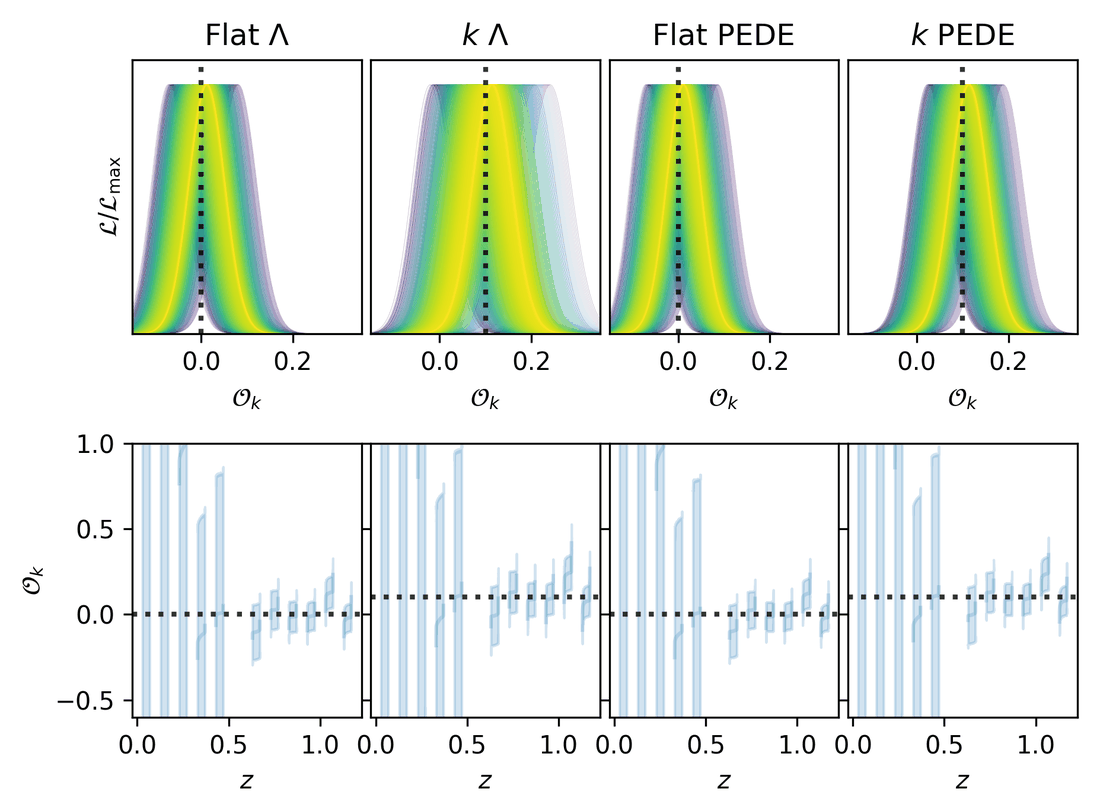
The curvature diagnostic Ok on mocks from four fiducial models: it recovers Ωk,0=0.1 when the input is curved.
Litmus tests for Rubin and DESI
2025 · JCAP 05 (2025) 030
Litmus tests of the flat ΛCDM model and model-independent measurement of H0rd with LSST and DESI
L'Huillier, B., Mitra, A., Shafieloo, A., Keeley, R. E., Koo, H.
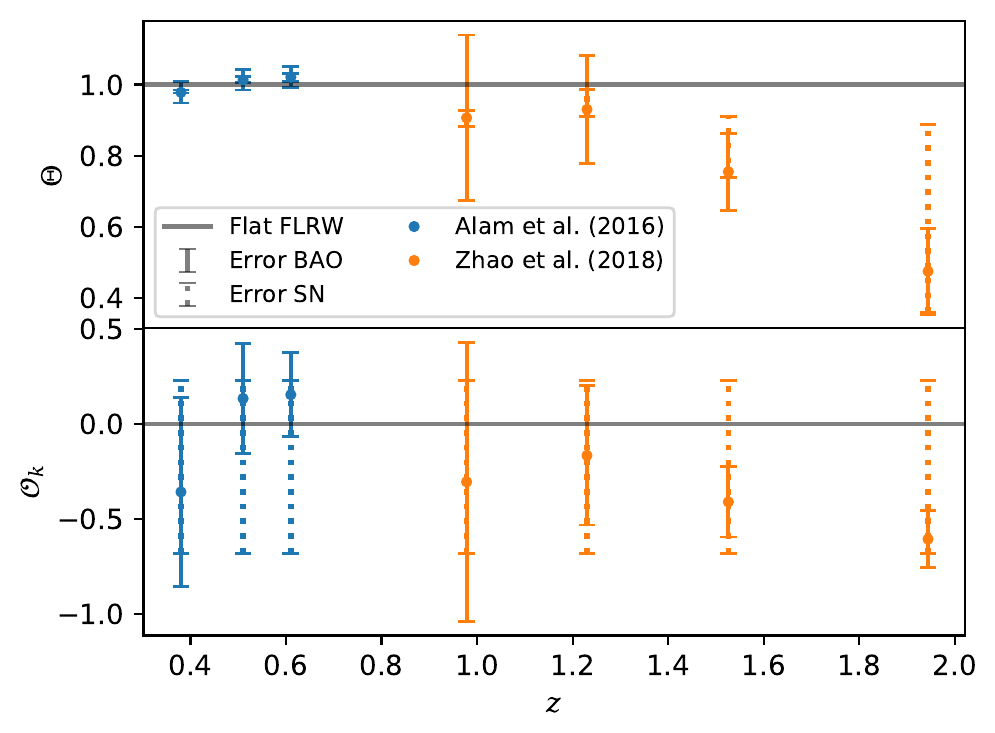
Reconstructing the expansion history from simulated LSST supernovae and combining it with simulated DESI 5-year BAO, we forecast constraints of up to ±4% on the curvature and ±0.1 on c/(H0rd), without assuming any form of dark energy.
Θ(z) (top) and Ok(z) (bottom) from supernovae and BOSS/eBOSS BAO. A flat FLRW universe gives Θ=1.
2018 · Phys. Rev. D 98 (2018) 083526
Falsifying ΛCDM: model-independent tests of the concordance model with eBOSS DR14Q and Pantheon
Shafieloo, A., L'Huillier, B.*, Starobinsky, A. A.
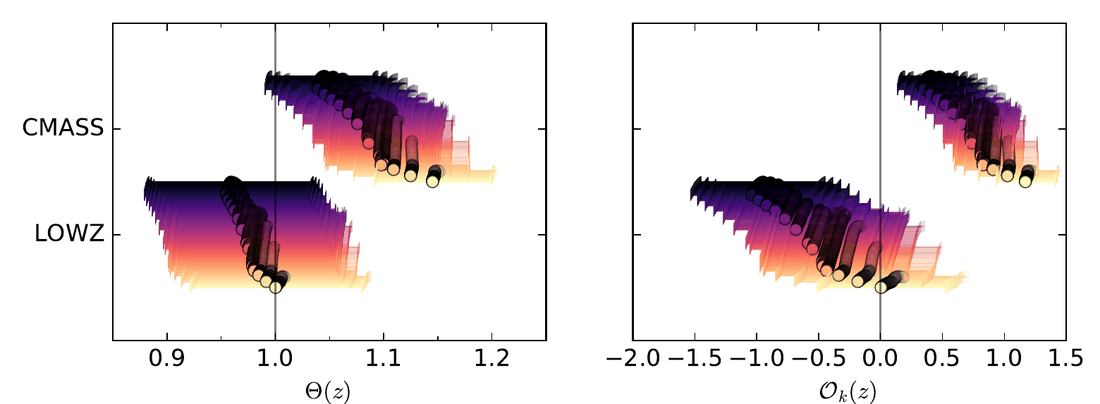
Combining model-independent expansion reconstructions from Pantheon supernovae and BAO, we test the FLRW metric and flatness, and use eBOSS DR14Q growth data to constrain Ωm, γ and σ8. Everything is consistent with a flat FLRW universe, General Relativity and Λ, with some tension at z>1.
Θ(z) and the curvature diagnostic Ok(z) at the BOSS LOWZ and CMASS redshifts, one point per supernova-based reconstruction. A flat FLRW universe gives Θ=1 and Ok=0.
Testing ΛCDM without assuming it
2017 · JCAP 01 (2017) 015
Model-independent test of the FLRW metric, the flatness of the Universe, and non-local measurement of H0rd
L'Huillier, B., Shafieloo, A.
Combining BOSS DR12 BAO with JLA supernovae, we measure H0rd without assuming a cosmological model and introduce the Θ(z) diagnostic of the flat-FLRW metric. The results are consistent with a flat FLRW universe within 2σ.