이 가정 아래에서 우주의 계량은 팽창하는 우주를 기술하는 프리드만–르메트르–로버트슨–워커(FLRW) 계량이 됩니다.
이 틀 안에서 현재의 표준 모형은 ΛCDM입니다. 우주의 에너지는 후기 우주의 가속 팽창을 일으키는 우주상수 Λ가 지배하고, 물질은 차갑고 비바리온적인 성분인 암흑물질이 대부분을 차지합니다. 그러나 두 성분 모두 직접 검출된 적이 없고, 입자물리학의 표준 모형에도 포함되어 있지 않습니다. 따라서 그 바탕에 있는 가정들을 질문해 볼 수 있습니다. FLRW가 올바른 계량인가? 우주는 등방적이고 균일한가? 암흑에너지는 우주상수인가?
FLRW 계량과 곡률 검증
JLA(Joint Light-curve Analysis) 초신성 자료로 팽창 역사 h(z)=H(z)/H0를 모형에 의존하지 않고 재구성한 뒤 SDSS-III/BOSS의 바리온 음향 진동 측정과 결합하여, Arman Shafieloo 박사와 저는 허블 상수 H0와 끌림 시기(drag epoch)의 음향 지평선 rd의 곱을 모형 독립적으로 측정했습니다. 또한 평탄한 FLRW 계량에 대한 새로운 리트머스 검증 Θ(z)를 도입했는데, 이는 클라크슨 검증 Ok(z)와 다음과 같이 연결됩니다.
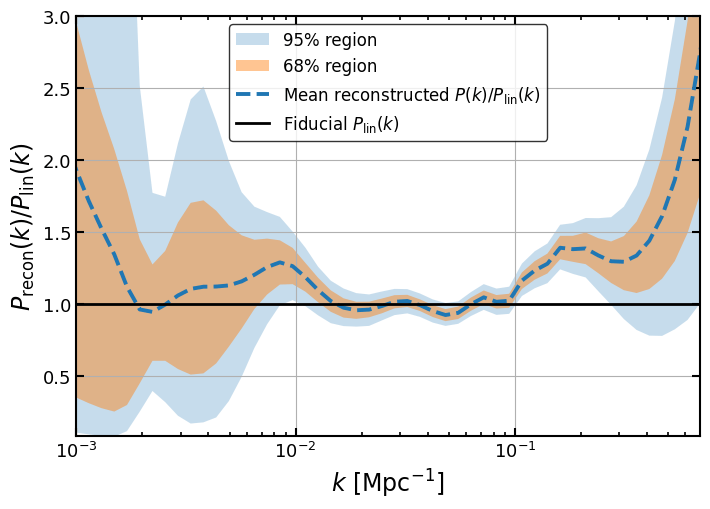
Reconstructed linear matter power spectrum divided by the fiducial prediction, with 68% and 95% Monte Carlo bands.
2026 · arXiv 프리프린트
Finding the distribution of matter using lenses – I: deconvolution-based reconstruction with CMB lensing
Dawn, A., Jiang, J.-Q., Hazra, D. K., L'Huillier, B., Shafieloo, A.
We reconstruct the linear matter power spectrum at z=0 from joint Planck PR4, ACT DR6 and SPT-3G CMB lensing, using a modified Richardson–Lucy deconvolution. The result follows the linear prediction on large scales, lies systematically higher for k≳0.1Mpc−1, and partly preserves the BAO feature.
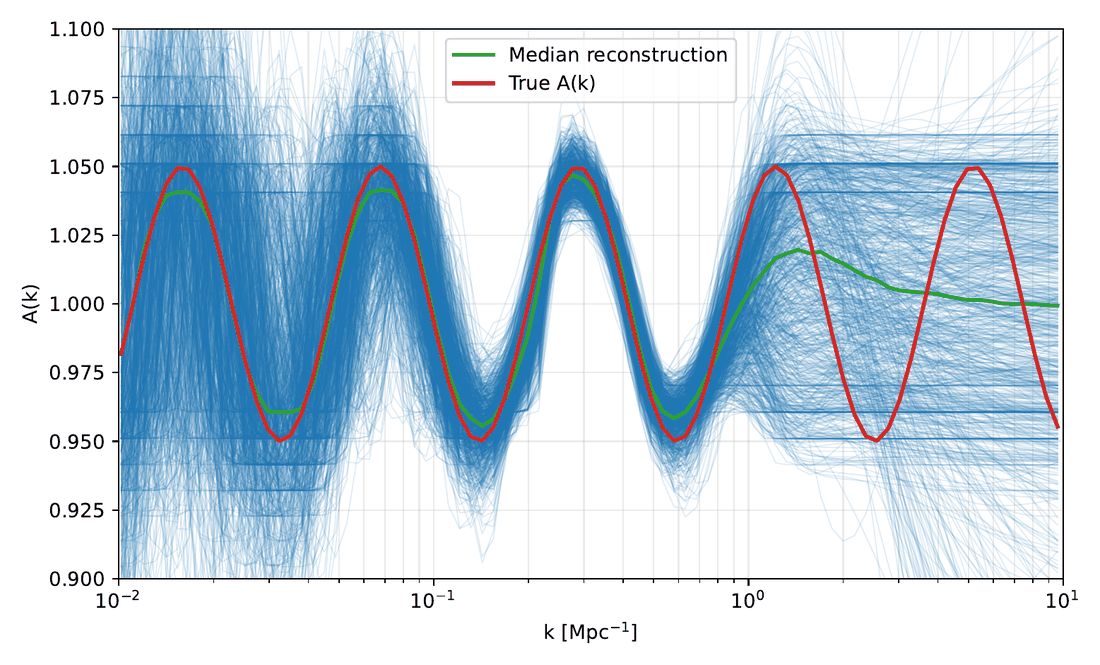
Reconstructions of a 5% oscillatory feature from 1000 noisy LSST-like mocks (blue), their median (green) and the truth (red).
2026 · arXiv 프리프린트
Finding the distribution of matter using lenses – II: deconvolution-based reconstruction with 3×2pt measurements
Jiang, J.-Q., Dawn, A., Hazra, D. K., L'Huillier, B., Shafieloo, A.
A regularised Richardson–Lucy framework tests scale-dependent departures from the nonlinear matter power spectrum using galaxy clustering, galaxy–galaxy lensing and cosmic shear. On LSST Year-10-like mocks, oscillations of about 1% or more are recovered over 0.1≲k≲0.5Mpc−1, and a 1% oscillation is detected at about 2.6σ.
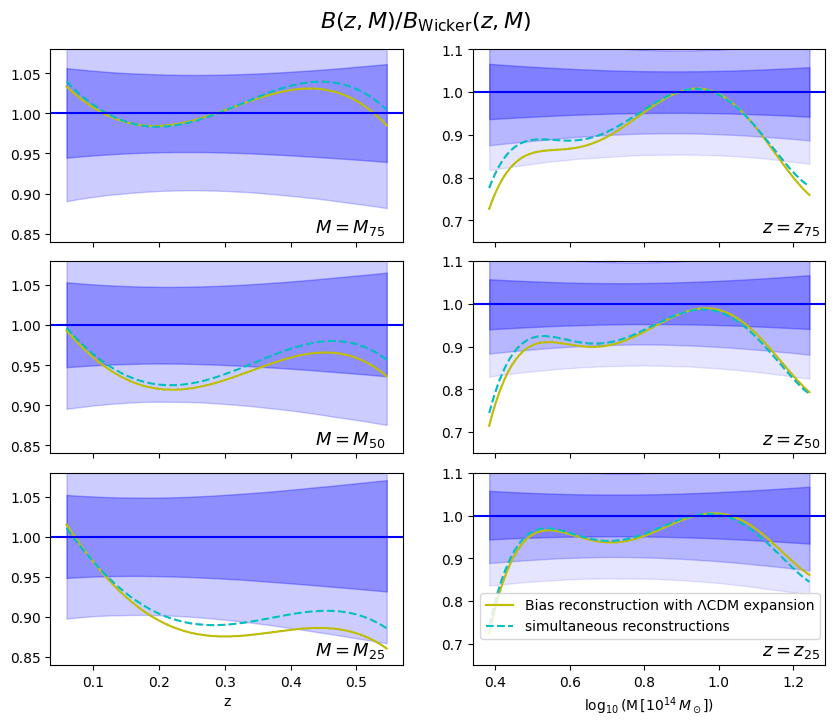
Reconstructed cluster bias, normalised by the Wicker et al. 2023 model, as a function of redshift (left) and mass (right).
2026 · arXiv 프리프린트
Non-parametric estimation of the baryon gas fraction and the cosmological bias with clusters
Kim, H.†, Wicker, R., L'Huillier, B., Douspis, M., Salvati, L., Shafieloo, A.
From a model-independent expansion history reconstructed from supernovae, we infer with iterative smoothing how the hydrostatic mass bias of galaxy clusters depends on mass and redshift, using X-ray gas fractions. Reconciling clusters with CMB constraints requires this bias to evolve with time.
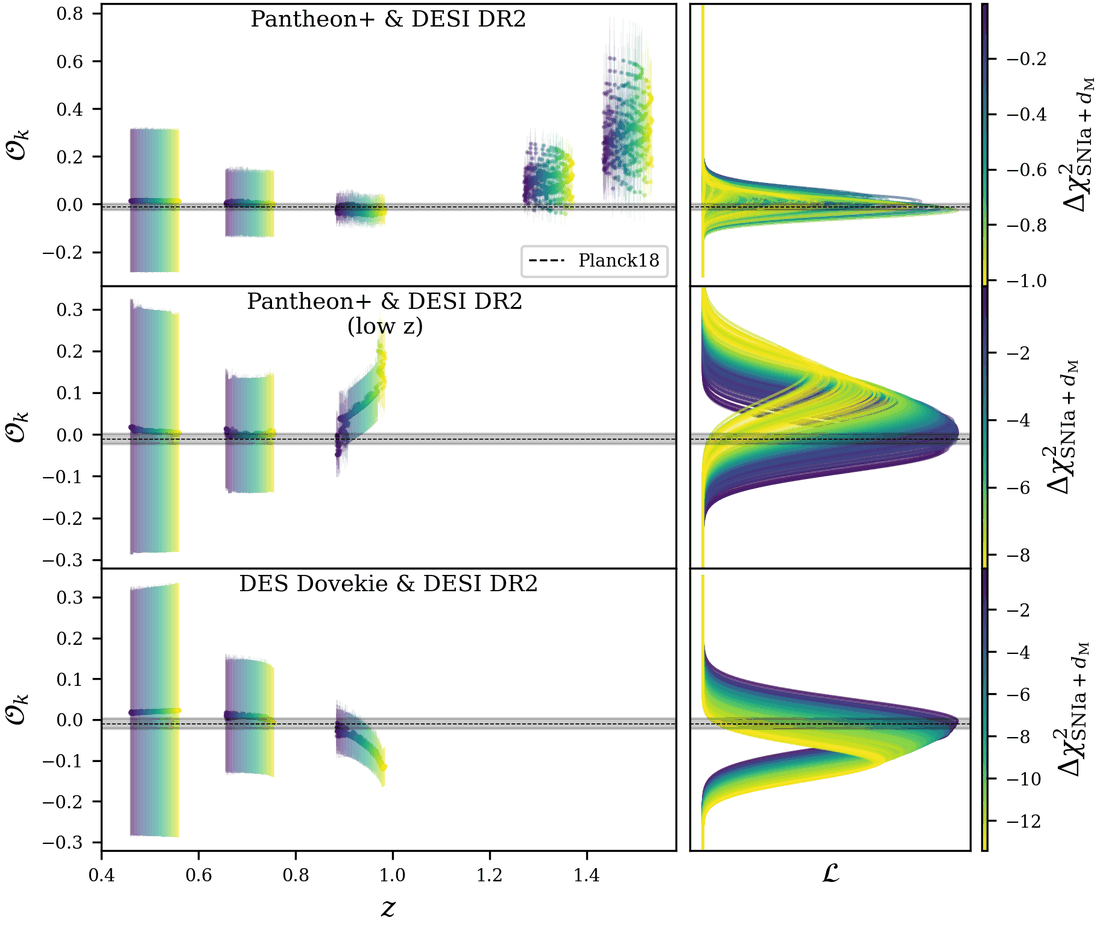
Ok(z) from supernova reconstructions combined with DESI DR2, for three data sets, colour-coded by Δχ2; right: the resulting likelihoods.
2026 · JCAP 08 (2026) 016
Model independent test of the FLRW metric and the curvature in light of DESI DR2
Millard, C.†, L'Huillier, B.*, Douspis, M.
We reconstruct distances and the Hubble rate from Pantheon+ and DES supernovae without assuming any dark energy model, and combine them with DESI DR2 baryon acoustic oscillations to test the FLRW metric and measure the spatial curvature. With Pantheon+ and DESI DR2 we find Ωk,0=0.045−0.081+0.045, consistent with flatness and with Planck 2018.
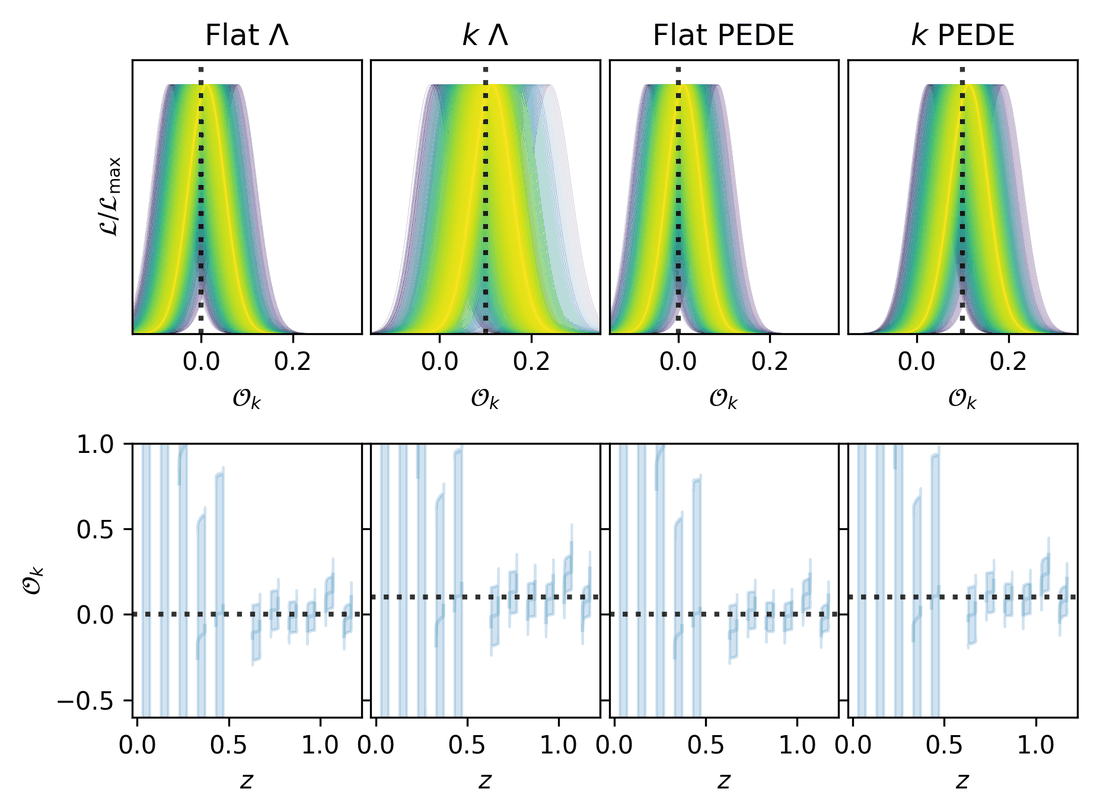
The curvature diagnostic Ok on mocks from four fiducial models: it recovers Ωk,0=0.1 when the input is curved.
2025 · JCAP 05 (2025) 030
Litmus tests of the flat ΛCDM model and model-independent measurement of H0rd with LSST and DESI
L'Huillier, B., Mitra, A., Shafieloo, A., Keeley, R. E., Koo, H.
Reconstructing the expansion history from simulated LSST supernovae and combining it with simulated DESI 5-year BAO, we forecast constraints of up to ±4% on the curvature and ±0.1 on c/(H0rd), without assuming any form of dark energy.
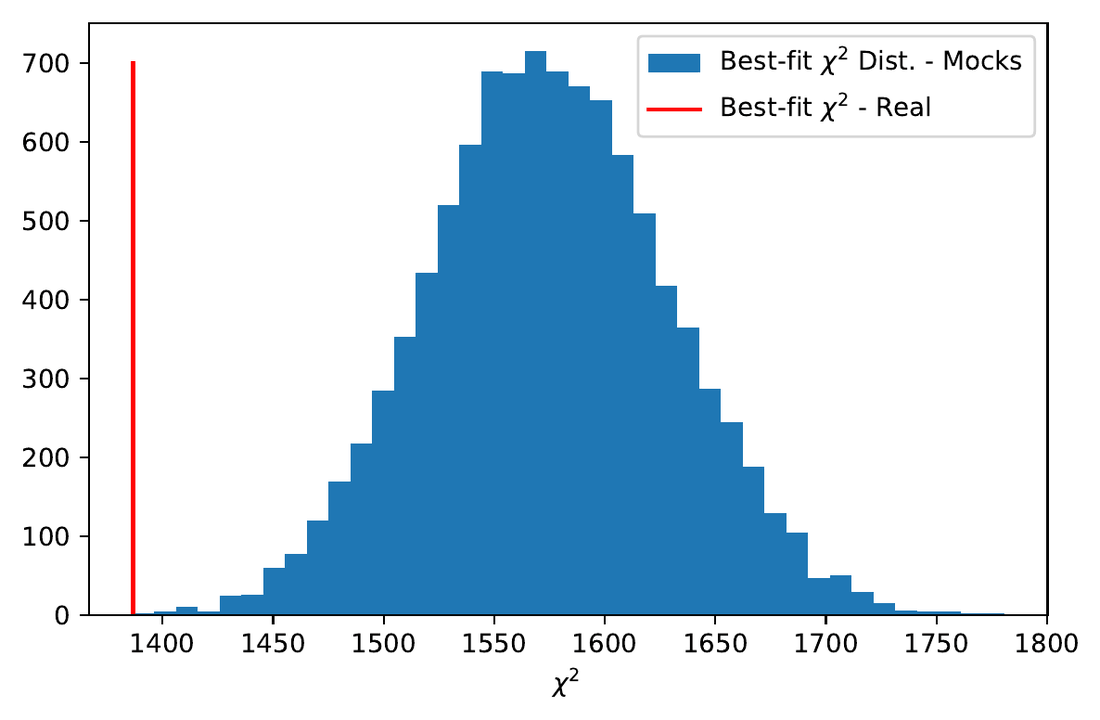
χ2 of the best-fit flat ΛCDM model on Pantheon+ (red) compared with its distribution over ΛCDM mocks (blue).
2024 · Universe 10 (2024) 439
An analysis of variance of the Pantheon+ dataset: systematics in the covariance matrix?
Keeley, R. E., Shafieloo, A., L'Huillier, B.
The best-fit ΛCDM χ2 of Pantheon+ is unusually small, and its residuals scatter less than the covariance matrix predicts, pointing to errors overestimated by about 7%. After accounting for this, no deviation from ΛCDM is found.
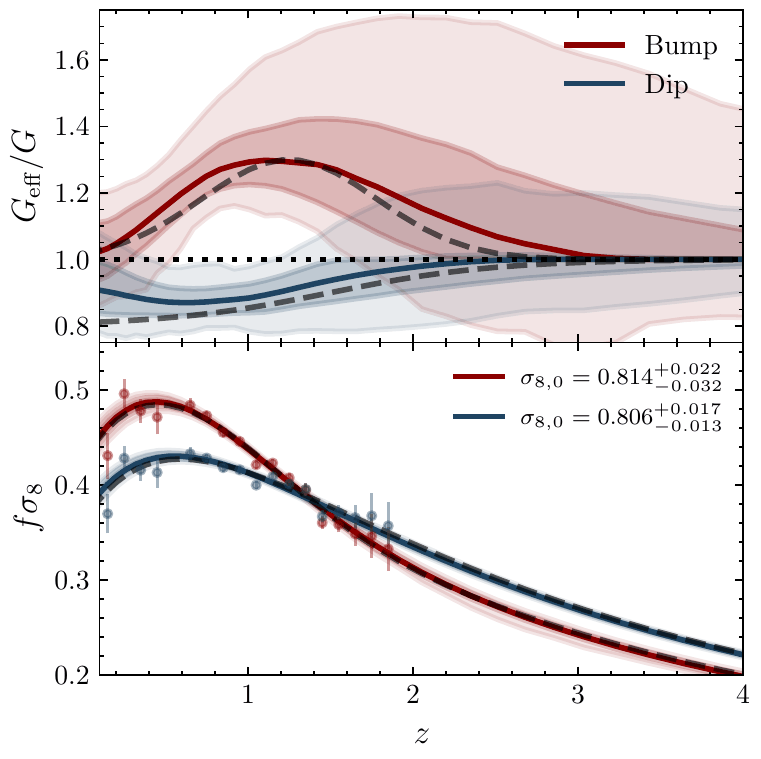
Realistic forecast: reconstructed Geff/G and fσ8 for two modified-gravity scenarios (bump and dip). Both rule out GR at more than 2σ around z≈1.
2023 · Phys. Rev. D 108 (2023) 023504
Joint reconstructions of growth and expansion histories from stage-IV surveys with minimal assumptions. II. Modified gravity and massive neutrinos
Calderón, R., L'Huillier, B., Polarski, D., Shafieloo, A., Starobinsky, A. A.
We reconstruct the effective gravitational coupling Geff(z) as a Gaussian process from forecast stage-IV growth data. DESI-like surveys could detect departures from General Relativity if dark energy is well determined; massive neutrinos do not change this, but assuming a ΛCDM expansion biases the inferred Ωm and σ8.
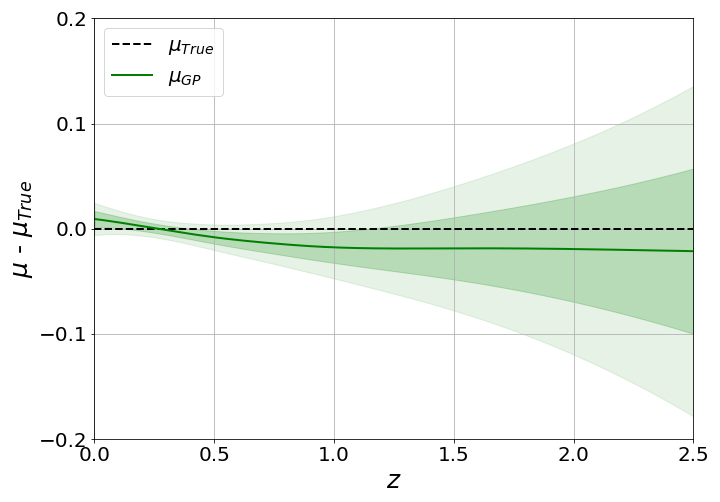
Gaussian-process reconstruction of the distance modulus relative to the truth, fully marginalised over hyperparameters and CPL parameters.
2023 · JCAP 02 (2023) 014
How to use GP: effects of the mean function and hyperparameter selection on Gaussian process regression
Hwang, S.-g.†, L'Huillier, B.*, Keeley, R. E., Jee, M. J., Shafieloo, A.
The choice of mean function and hyperparameters biases Gaussian process reconstructions of supernova distances: a zero mean gives unphysical results and a best-fit ΛCDM mean biases them. Marginalising over a family of mean functions and over the hyperparameters removes the bias, whatever the kernel.
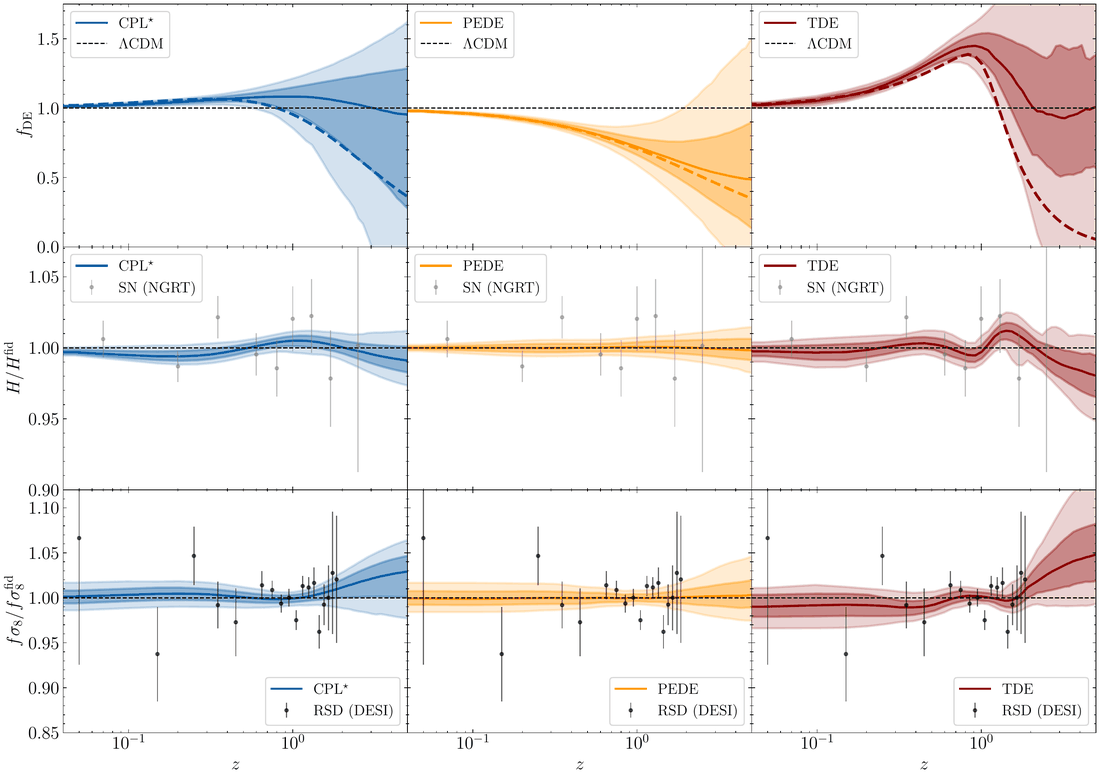
Joint reconstructions of the effective gravitational coupling, H(z) and fσ8(z) for three fiducial cosmologies; dashed lines show the truth.
2022 · Phys. Rev. D 106 (2022) 083513
Joint reconstructions of growth and expansion histories from stage-IV surveys with minimal assumptions I: dark energy beyond Λ
Calderón, R., L'Huillier, B., Polarski, D., Shafieloo, A., Starobinsky, A. A.
Gaussian processes reconstruct the dark energy density from forecast stage-IV supernova, BAO and redshift-space-distortion data, assuming only a flat FLRW universe that becomes matter-dominated at high redshift, which also yields the growth history. Several dark energy models can be distinguished from ΛCDM at 2σ or more.
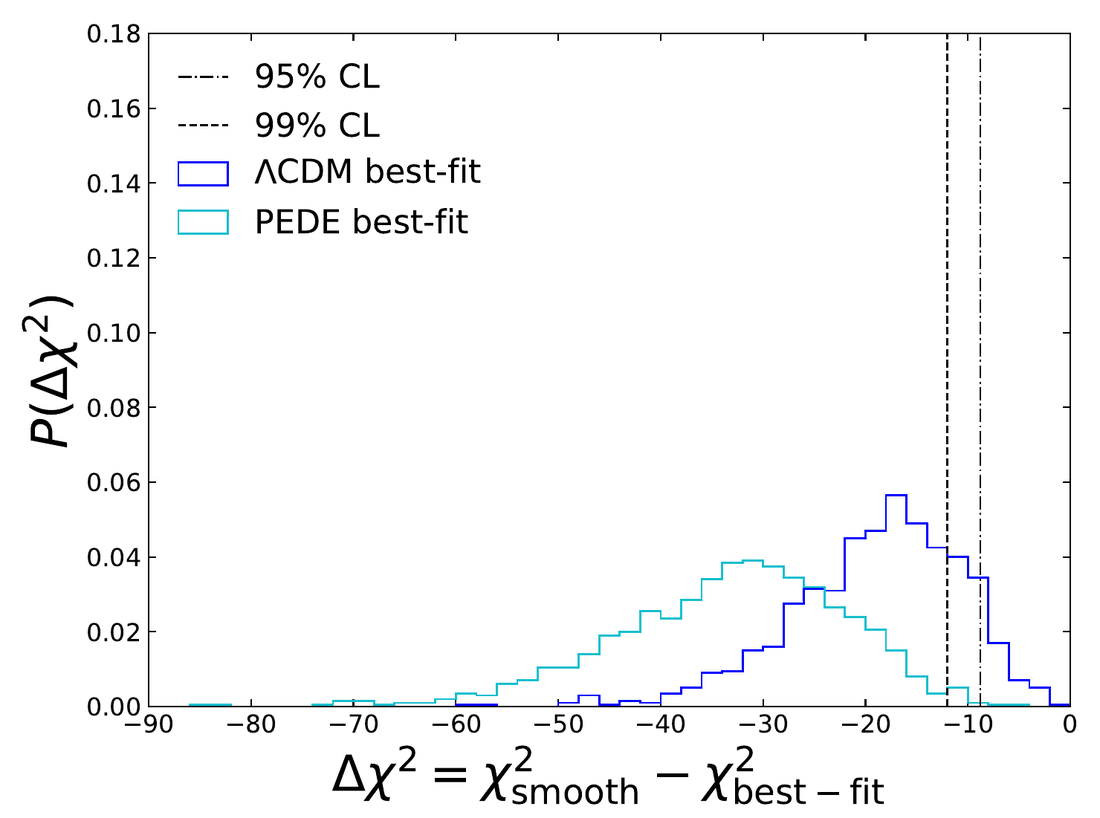
Δχ2 distributions for ΛCDM and PEDE over Roman-like mocks from a third model; vertical lines mark the 95% and 99% limits.
2022 · JCAP 03 (2022) 047
Bayesian vs frequentist: comparing Bayesian model selection with a frequentist approach using the iterative smoothing method
Koo, H., Keeley, R. E., Shafieloo, A., L'Huillier, B.
On simulated Roman supernova data, Bayesian model selection finds the true model when it is among the candidates, but otherwise only picks the least wrong one. A frequentist test based on iterative smoothing can instead conclude that all tested models are false.
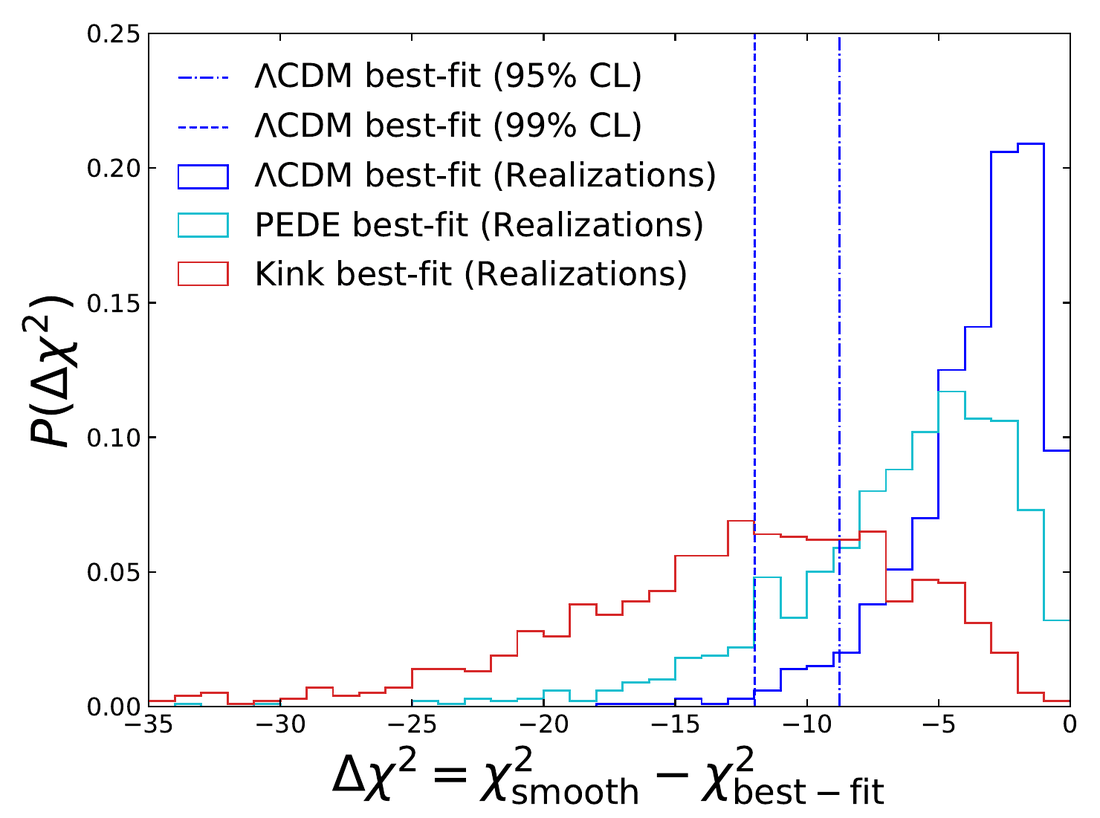
Distributions of Δχ2 between the smoothed and best-fit models over WFIRST-like ΛCDM mocks, for ΛCDM, PEDE and Kink.
2021 · JCAP 03 (2021) 034
Model selection and parameter estimation using the iterative smoothing method
Koo, H., Shafieloo, A., Keeley, R. E., L'Huillier, B.
Likelihood distributions derived from the non-parametric iterative smoothing method let us test a dark energy model and estimate its parameters without comparing it to an alternative. On WFIRST-like mocks we quantify how confidently different dark energy models can be distinguished.
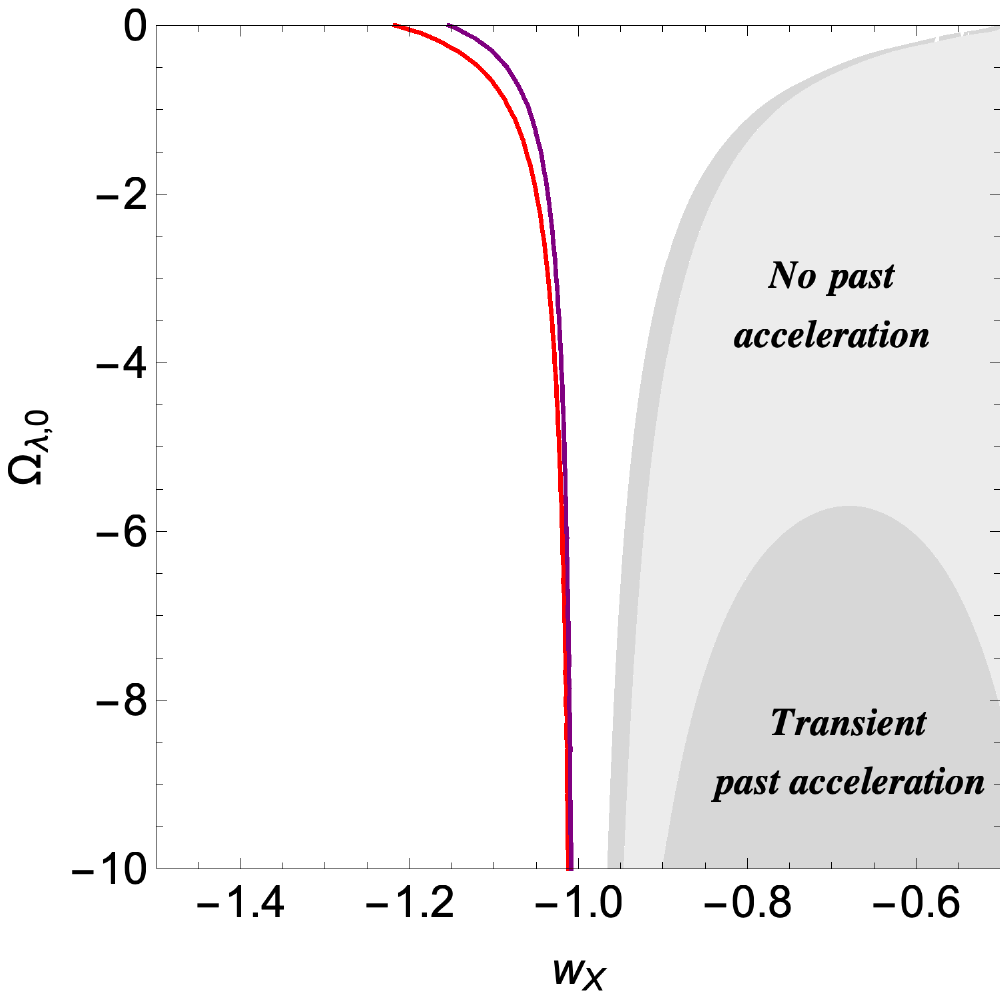
Where a universe with a negative cosmological constant still accelerates today (white), accelerated only in the past (dark grey), or never accelerated (light grey), for Ωm=0.3.
2021 · Phys. Rev. D 103 (2021) 023526
Negative cosmological constant in the dark sector?
Calderón, R., Gannouji, R., L'Huillier, B.*, Polarski, D.
We study dark sectors made of a negative cosmological constant plus a late-time accelerating component. The acceleration is often transient and some models eventually contract; current data show no decisive evidence for a negative Λ, but the best fits are phantom at z≳1.
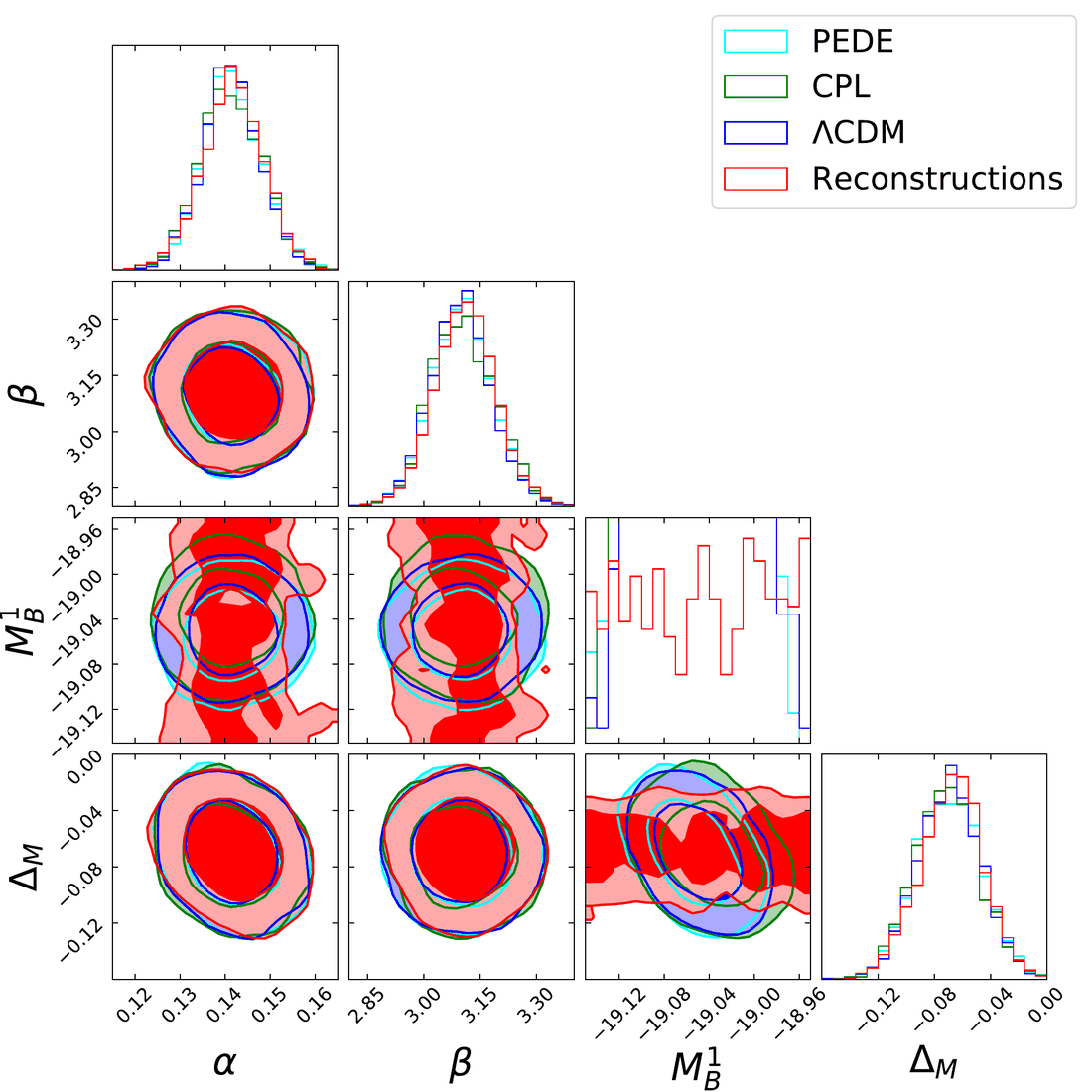
Constraints on the JLA light-curve parameters from iterative smoothing (red) compared with ΛCDM, CPL and PEDE.
2020 · ApJ 899 (2020) 9
Model-independent constraints on Type Ia supernova light-curve hyper-parameters and reconstructions of the expansion history of the Universe
Koo, H., Shafieloo, A., Keeley, R. E., L'Huillier, B.
Reconstructing the expansion history from JLA supernovae with iterative smoothing while sampling the light-curve hyper-parameters, we find hyper-parameters consistent with those from ΛCDM, CPL and PEDE fits, and no significant redshift evolution.
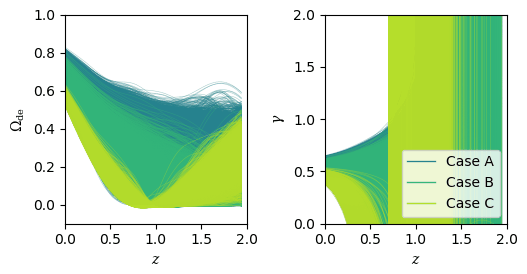
Reconstructions of Ωde(z) (left) and the growth index γ(z) (right) that fit the growth data better than ΛCDM, for three cases.
2020 · MNRAS 494 (2020) 819
Defying the laws of Gravity I: model-independent reconstruction of the Universe expansion from growth data
L'Huillier, B., Shafieloo, A., Polarski, D., Starobinsky, A. A.
From redshift-space distortion data alone, we reconstruct the growth history with crossing statistics and Gaussian processes, derive the expansion history from it, and fit supernovae to constrain Ωm,0 and σ8,0. The results are consistent with flat ΛCDM and General Relativity.
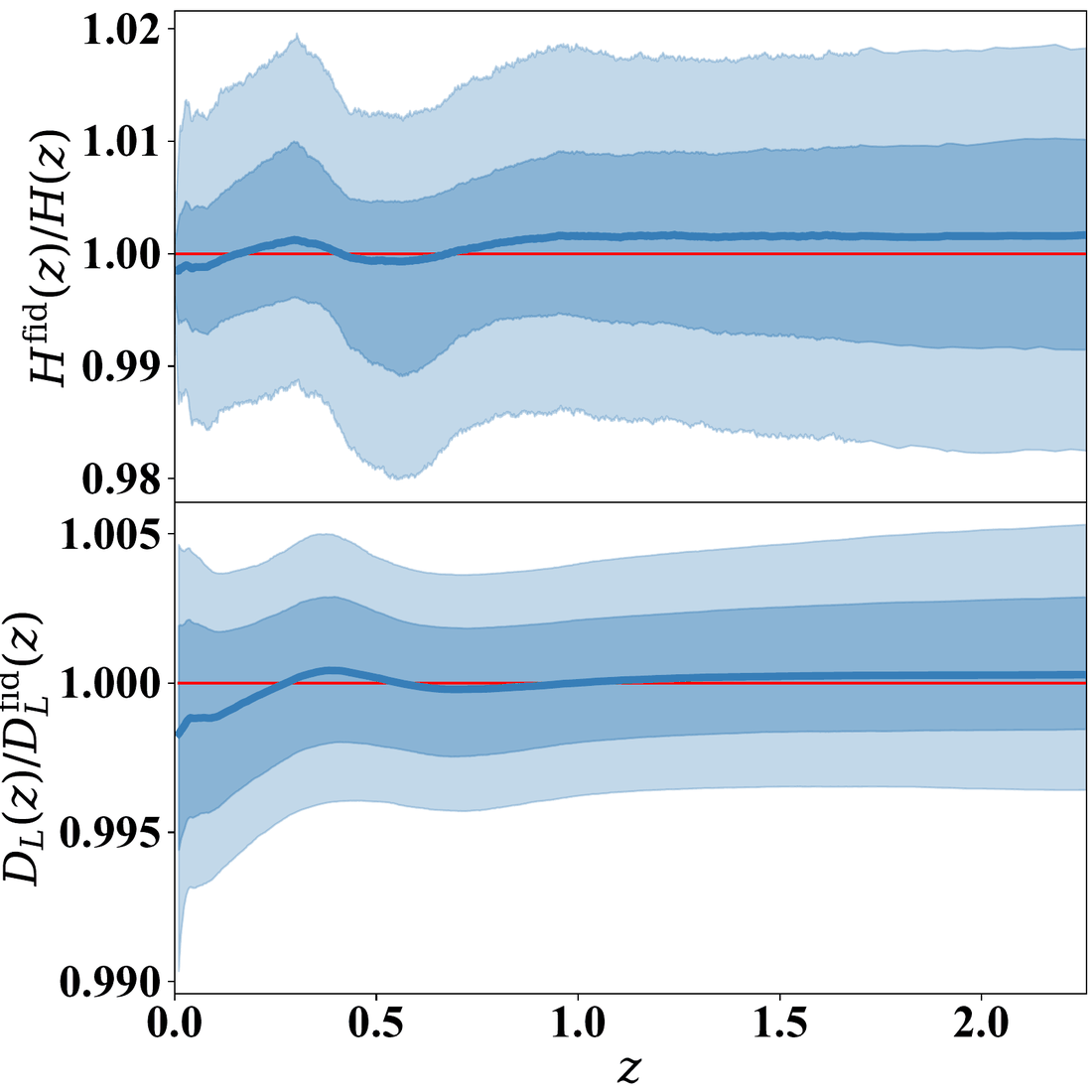
Gaussian-process reconstructions of 1/H(z) and DL(z) from standard sirens and supernovae for a ΛCDM input, relative to the best-fit ΛCDM.
2020 · MNRAS 491 (2020) 3983
Debiasing cosmic gravitational wave sirens
Keeley, R. E., Shafieloo, A., L'Huillier, B., Linder, E. V.
Gaussian process regression can remove the bias in reconstructing H(z) from gravitational-wave standard sirens, and combined with supernovae it tests H0 and ΛCDM. Dark-siren redshifts need close to spectroscopic precision to avoid significant bias.
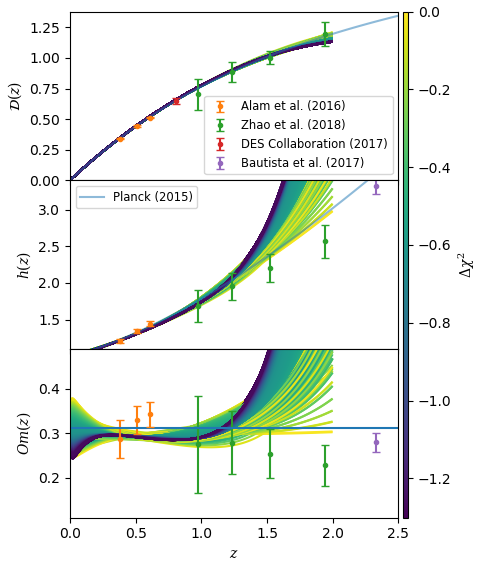
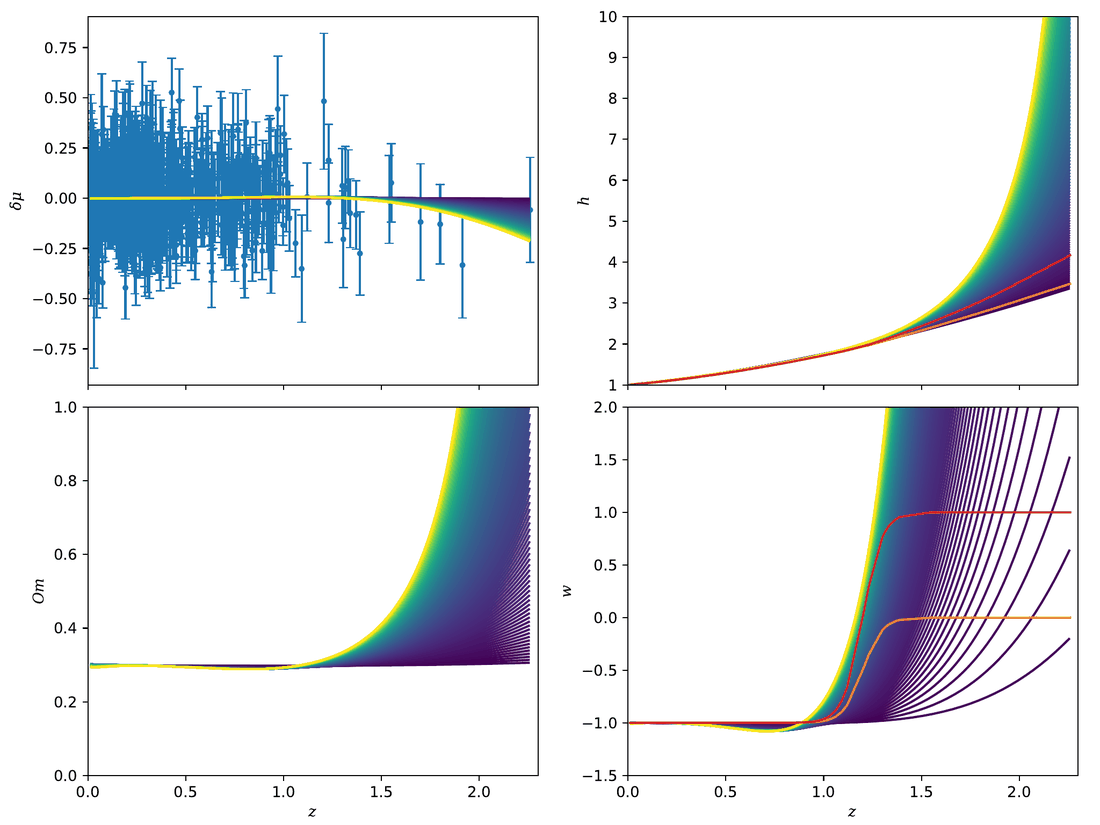
Iterative smoothing of Pantheon: residuals, h(z), the Om diagnostic and w(z). Every curve fits the data better than the best-fit ΛCDM.
2019 · MNRAS 485 (2019) 2783
Model independent expansion history from supernovae: cosmology versus systematics
L'Huillier, B., Shafieloo, A., Linder, E. V., Kim, A. G.
A model-independent analysis of the Pantheon supernovae shows deviations from ΛCDM at z≳1. They vanish with a simple Malmquist-like correction, but neither χ2 tests nor Gaussian processes find that this extra correction is statistically required.
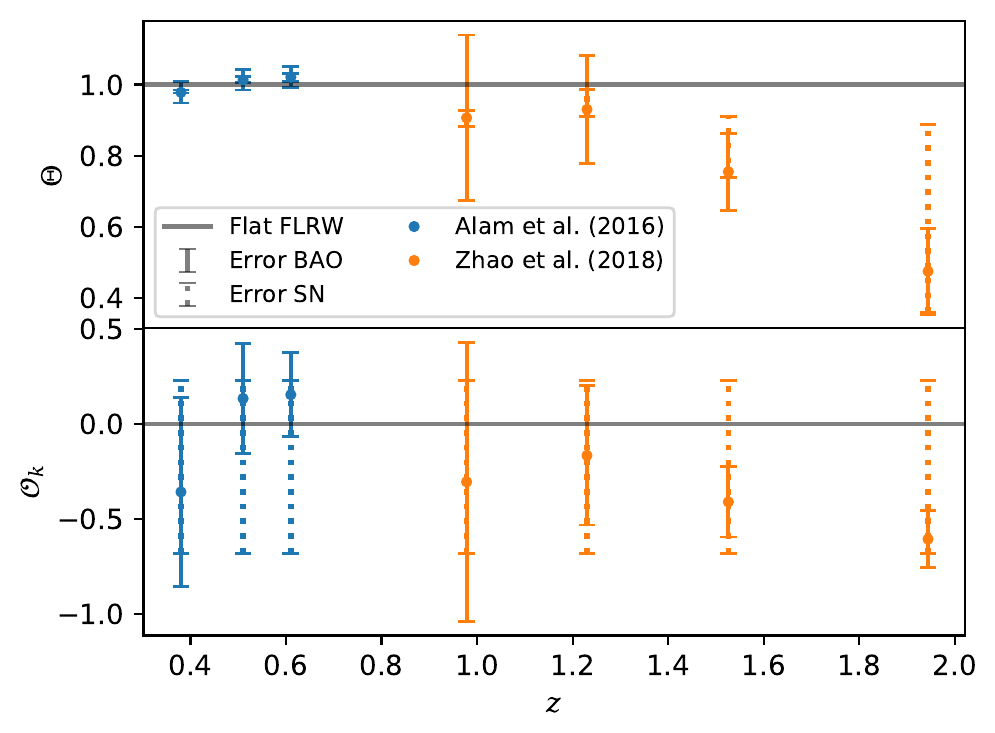
Θ(z) (top) and Ok(z) (bottom) from supernovae and BOSS/eBOSS BAO. A flat FLRW universe gives Θ=1.
2018 · Phys. Rev. D 98 (2018) 083526
Falsifying ΛCDM: model-independent tests of the concordance model with eBOSS DR14Q and Pantheon
Shafieloo, A., L'Huillier, B.*, Starobinsky, A. A.
Combining model-independent expansion reconstructions from Pantheon supernovae and BAO, we test the FLRW metric and flatness, and use eBOSS DR14Q growth data to constrain Ωm, γ and σ8. Everything is consistent with a flat FLRW universe, General Relativity and Λ, with some tension at z>1.
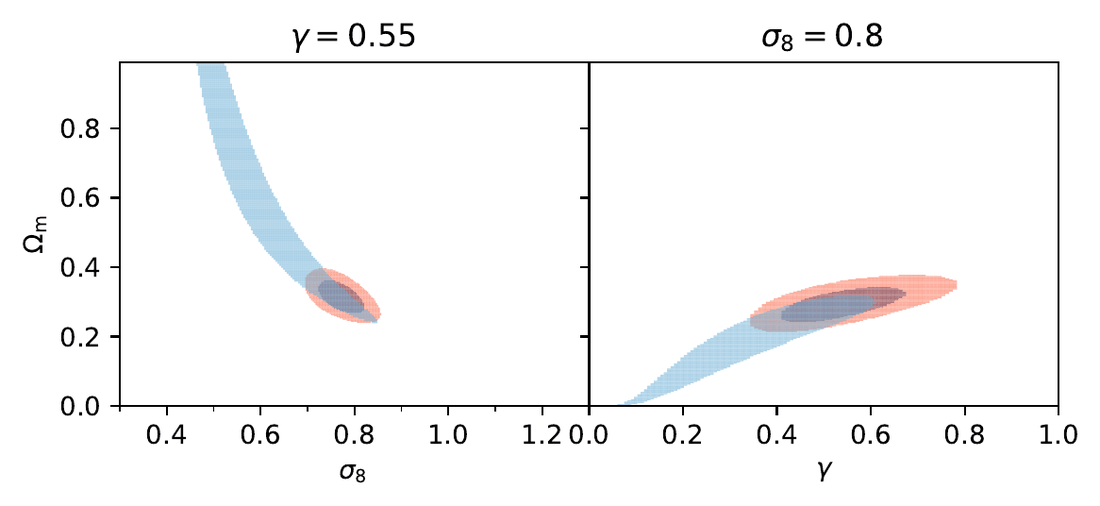
Model-independent regions allowed by growth data (blue) compared with ΛCDM (red), at fixed γ=0.55 (left) and fixed σ8=0.8 (right).
2018 · MNRAS 476 (2018) 3263
Model-independent cosmological constraints from growth and expansion
L'Huillier, B., Shafieloo, A., Kim, H.†
We reconstruct the expansion history from supernovae and fit growth-rate data to constrain Ωm, the growth index γ and σ8 without a dark energy model. The results agree with ΛCDM in General Relativity, and requiring a positive dark energy density tightens them further.
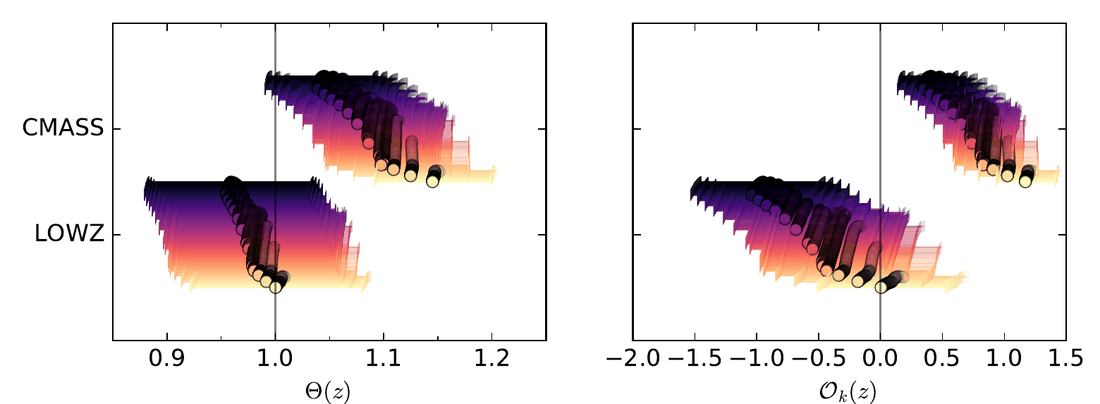
Θ(z) and the curvature diagnostic Ok(z) at the BOSS LOWZ and CMASS redshifts, one point per supernova-based reconstruction. A flat FLRW universe gives Θ=1 and Ok=0.
2017 · JCAP 01 (2017) 015
Model-independent test of the FLRW metric, the flatness of the Universe, and non-local measurement of H0rd
L'Huillier, B., Shafieloo, A.
Combining BOSS DR12 BAO with JLA supernovae, we measure H0rd without assuming a cosmological model and introduce the Θ(z) diagnostic of the flat-FLRW metric. The results are consistent with a flat FLRW universe within 2σ.