논문

암흑물질 헤일로

논문 4편

논문

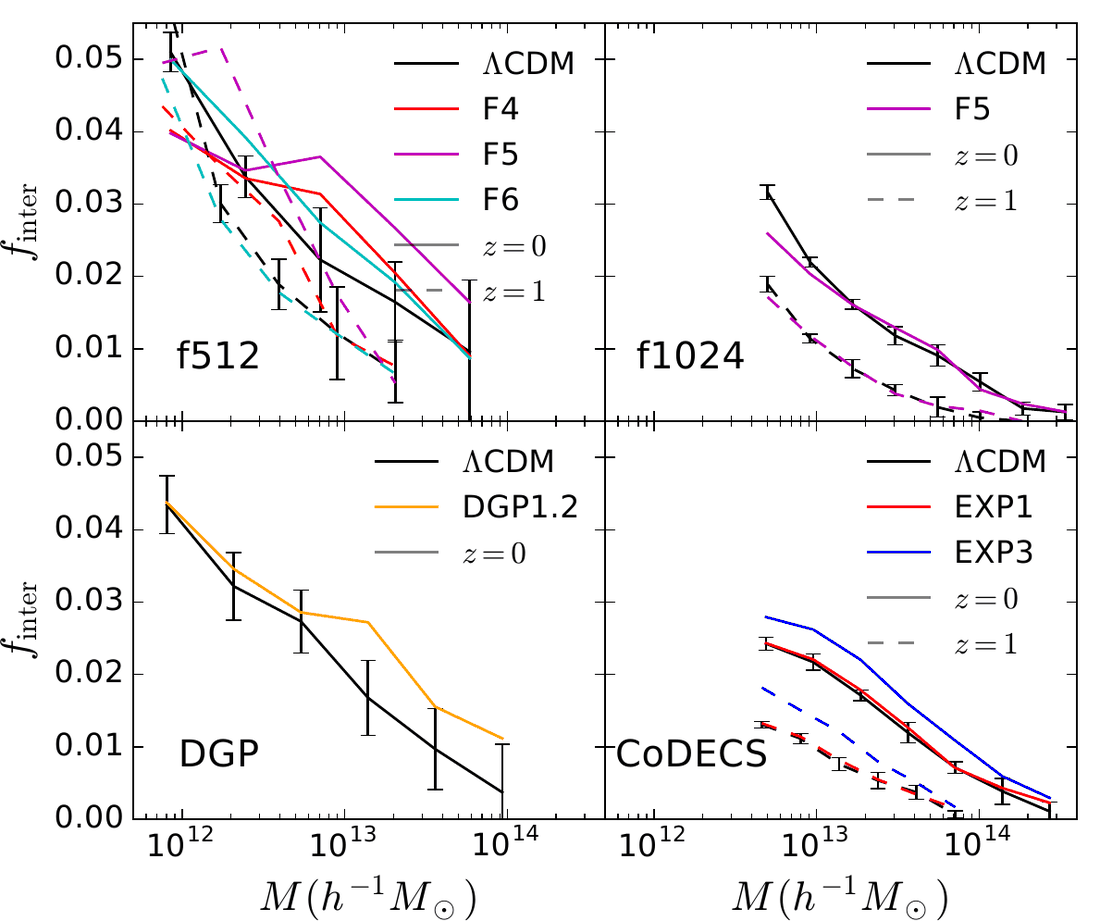
Halo interaction rate versus mass in ΛCDM and in f(R), DGP and coupled dark energy simulations.
Halo interaction rate versus mass in ΛCDM and in f(R)f(R), DGP and coupled dark energy simulations.

일반상대성이론을 넘어선 헤일로

2017 · MNRAS 468 (2017) 3174

Dark matter haloes in modified gravity and dark energy: interaction rate, small- and large-scale alignment

L'Huillier, B., Winther, H. A., Mota, D. F., Park, C., Kim, J.

In N-body simulations of f(R)f(R) gravity, DGP and coupled dark energy, f(R)f(R) raises halo spin and weakens the spin alignment of interacting pairs, while only strongly coupled dark energy increases the halo interaction rate and the alignment of halo shapes with the large-scale structure.

DOI · arXiv:1703.07357
주요 논문수정 중력암흑에너지암흑물질 헤일로시뮬레이션제1저자

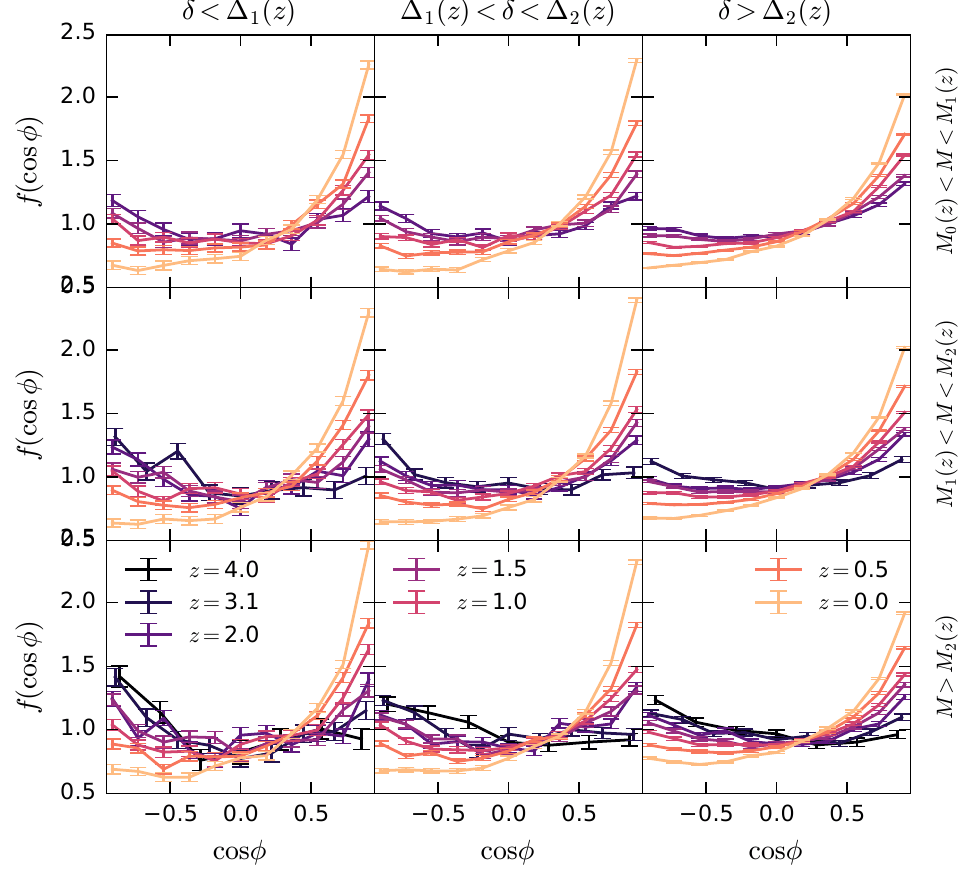
Evolution of the alignment between the spins of interacting haloes, by environment (columns) and mass (rows).

2017 · MNRAS 466 (2017) 4875

Ecology of dark matter haloes – II. Effects of interactions on the alignment of halo pairs

L'Huillier, B., Park, C., Kim, J.

In Horizon Run 4, interacting haloes have lower spin and are more spherical than typical haloes. Pairs start with antiparallel spins that gradually become parallel, interactions are mostly radial, and alignments are strongest for massive, close pairs and persist up to z=4z = 4.

DOI · arXiv:1701.04417

은하 형성암흑물질 헤일로시뮬레이션제1저자

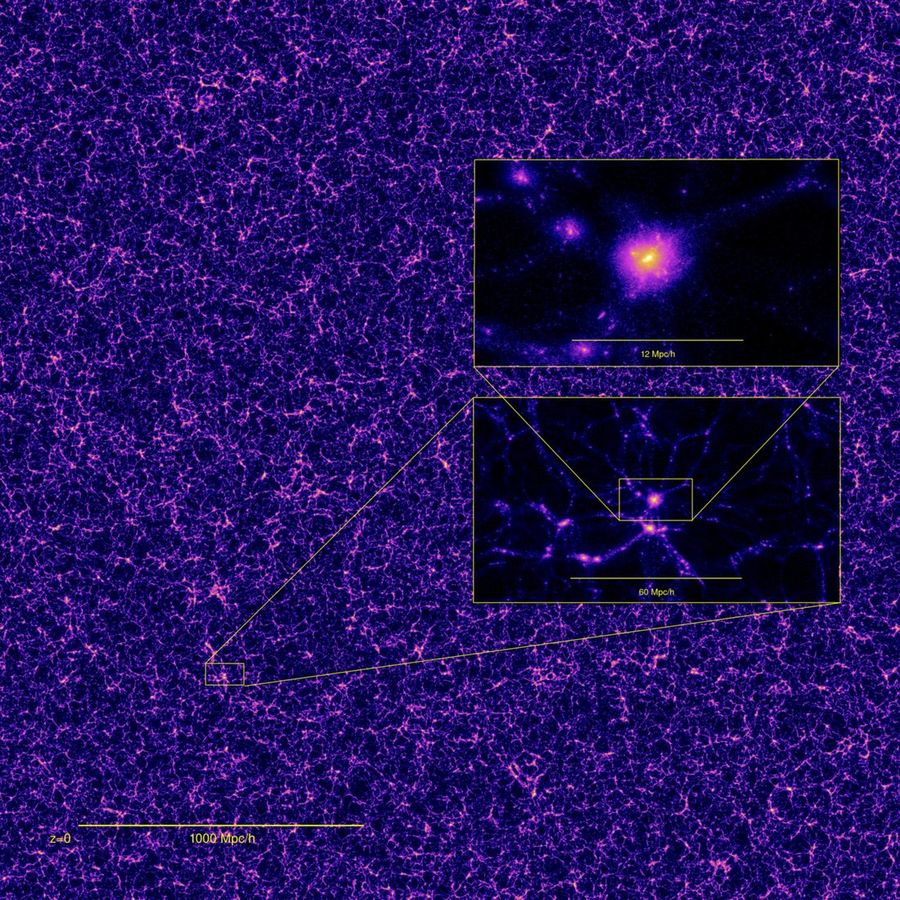
A 7h-1Mpc-thick slice through Horizon Run 4 at z = 0, with two successive zooms onto a galaxy cluster.
A 7 h−1 Mpc7\,h^{-1}\,\mathrm{Mpc}-thick slice through Horizon Run 4 at z=0z = 0, with two successive zooms onto a galaxy cluster.

2015 · J. Korean Astron. Soc. 48 (2015) 213

Horizon Run 4 simulation: coupled evolution of galaxies and large-scale structures of the Universe

Kim, J., Park, C., L'Huillier, B., Hong, S. E.

Horizon Run 4 follows 630036300^3 particles in a 3150 h−1 Mpc3150\,h^{-1}\,\mathrm{Mpc} box, with halo merger trees down to 2.7×10¹¹ h−1 M⊙2.7\times10^{11}\,h^{-1}\,M_\odot. The halo mass function departs from universality and evolves with redshift, and the BAO peak in mock galaxy correlations broadens and shifts. The data are public.

DOI · arXiv:1508.05107

주요 논문우주 거대구조암흑물질 헤일로시뮬레이션

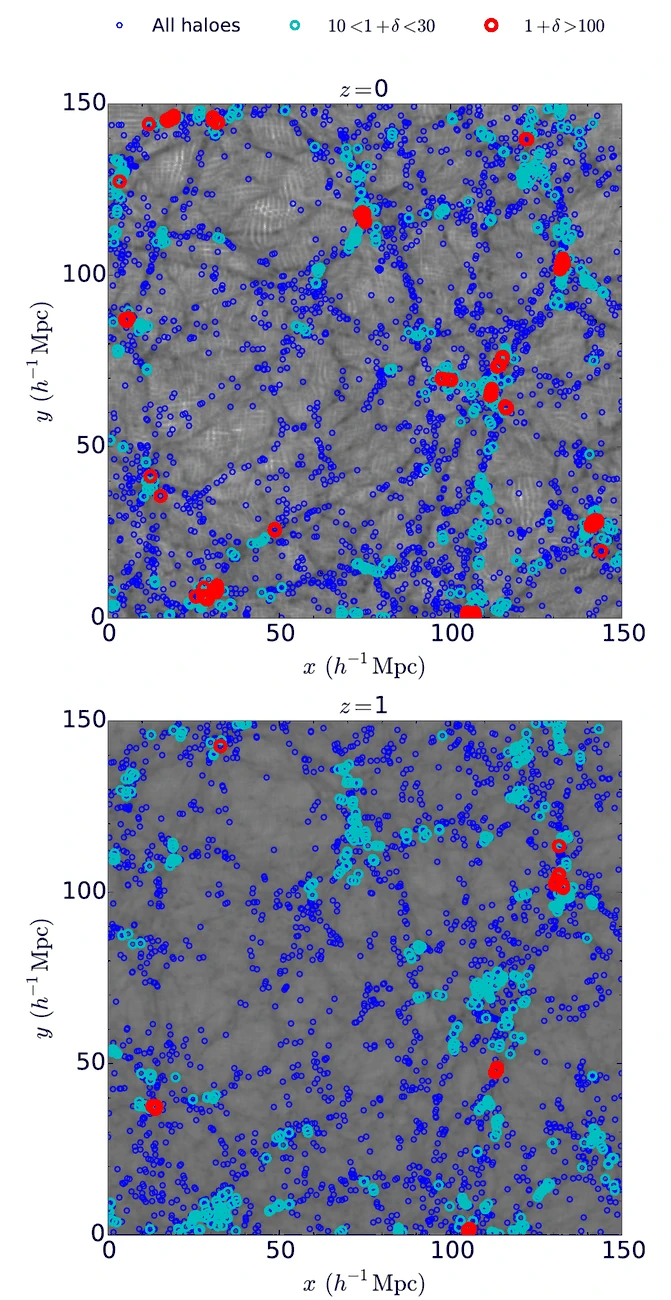
Haloes in the cosmic web at z = 0 (top) and z = 1 (bottom): the densest environments (red) sit in the nodes, intermediate ones (cyan) in filaments.
Haloes in the cosmic web at z=0z = 0 (top) and z=1z = 1 (bottom): the densest environments (red) sit in the nodes, intermediate ones (cyan) in filaments.

2015 · MNRAS 451 (2015) 527

The ecology of dark matter haloes – I. The rates and types of halo interactions

L'Huillier, B., Park, C., Kim, J.

Using Horizon Run 4, we measure how often haloes interact as a function of environment, separation, mass ratio, mass and redshift. Most interactions happen at density contrast δ≈20\delta \approx 20, while the interacting fraction peaks at δ≈1000\delta \approx 1000; we provide a fitting formula and identify two interaction modes.

DOI · arXiv:1505.00788

은하 형성암흑물질 헤일로시뮬레이션제1저자

← 전체 논문