Publications

Sélection de modèles

2 articles

La sélection de modèles cherche lequel de plusieurs modèles les données favorisent, ou si l’un d’eux est seulement acceptable. L’approche bayésienne standard compare les évidences, mais ne peut que classer les candidats : si le vrai modèle n’en fait pas partie, elle choisit quand même le moins faux.

Avec Hanwool Koo, Arman Shafieloo et Ryan Keeley, nous avons construit une alternative fréquentiste fondée sur le lissage itératif. Elle teste chaque modèle pour lui-même, sans le comparer à un autre, et peut conclure que tous les candidats sont faux. Nous avons comparé les deux approches sur des données simulées de supernovae pour le télescope spatial Roman.

Publications

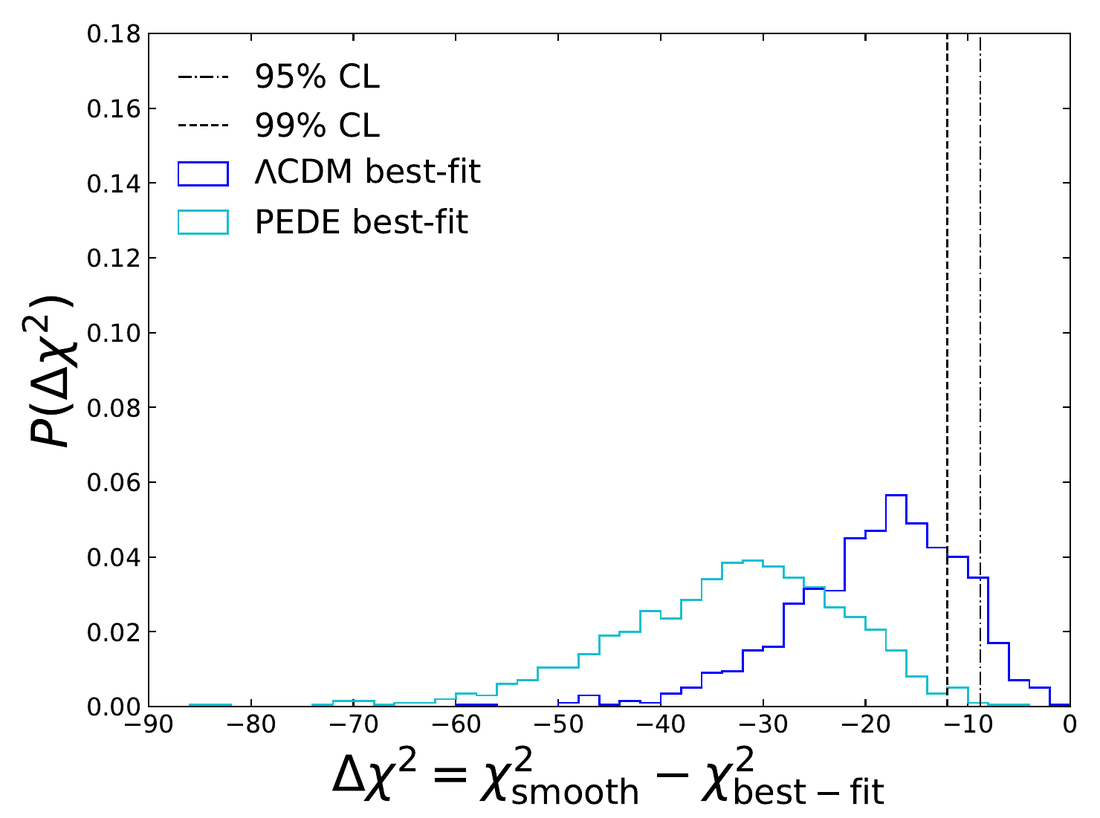
Deltachi2 distributions for ΛCDM and PEDE over Roman-like mocks from a third model; vertical lines mark the 95% and 99% limits.
Δχ2\Delta\chi^2 distributions for ΛCDM and PEDE over Roman-like mocks from a third model; vertical lines mark the 95% and 99% limits.

2022 · JCAP 03 (2022) 047

Bayesian vs frequentist: comparing Bayesian model selection with a frequentist approach using the iterative smoothing method

Koo, H., Keeley, R. E., Shafieloo, A., L'Huillier, B.

On simulated Roman supernova data, Bayesian model selection finds the true model when it is among the candidates, but otherwise only picks the least wrong one. A frequentist test based on iterative smoothing can instead conclude that all tested models are false.

DOI · arXiv:2110.10977

Énergie noireSupernovae IaLissage itératifSélection de modèles
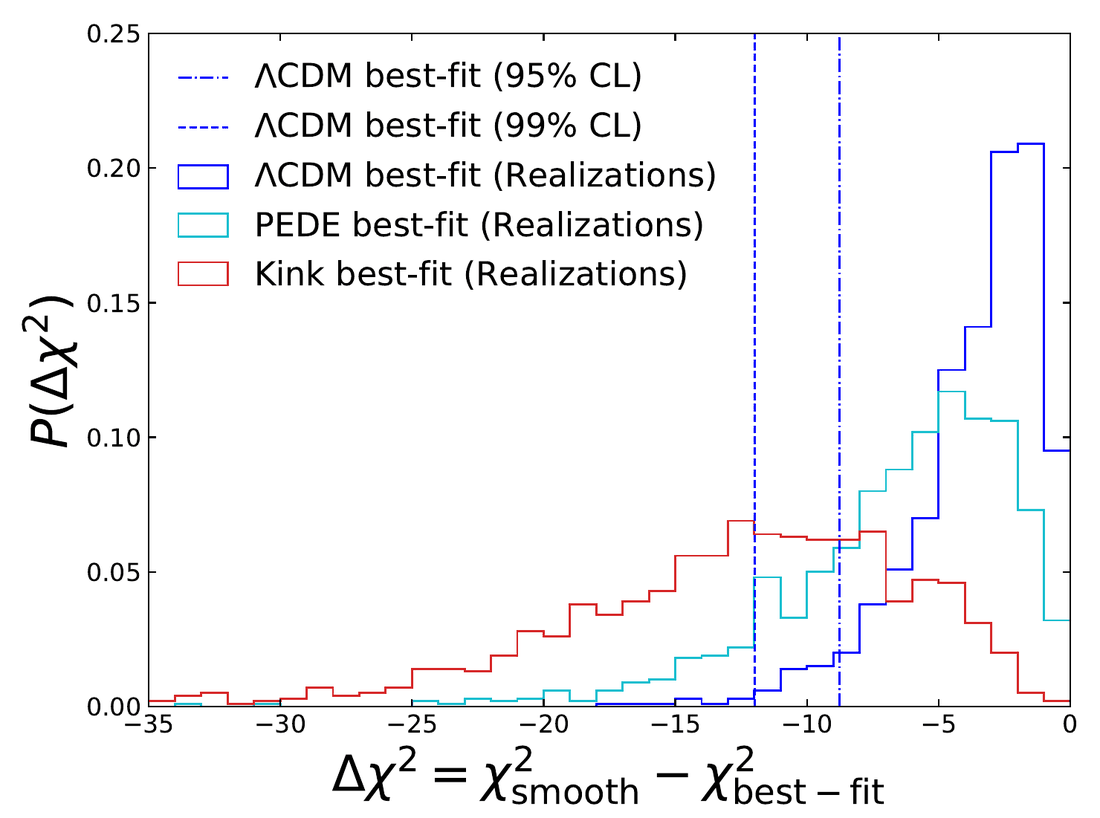
Distributions of Deltachi2 between the smoothed and best-fit models over WFIRST-like ΛCDM mocks, for ΛCDM, PEDE and Kink.
Distributions of Δχ2\Delta\chi^2 between the smoothed and best-fit models over WFIRST-like ΛCDM mocks, for ΛCDM, PEDE and Kink.

2021 · JCAP 03 (2021) 034

Model selection and parameter estimation using the iterative smoothing method

Koo, H., Shafieloo, A., Keeley, R. E., L'Huillier, B.

Likelihood distributions derived from the non-parametric iterative smoothing method let us test a dark energy model and estimate its parameters without comparing it to an alternative. On WFIRST-like mocks we quantify how confidently different dark energy models can be distinguished.

DOI · arXiv:2009.12045

Énergie noireSupernovae IaLissage itératifSélection de modèles

← Tous les articles