Publications

Lissage itératif

10 articles

Le lissage itératif reconstruit une fonction, par exemple la relation distance–décalage vers le rouge des supernovae, sans supposer de forme paramétrique. Partant d’une estimation initiale, il lisse de façon répétée, avec un noyau, les résidus pondérés par les erreurs entre les données et la reconstruction courante, jusqu’à ce que la reconstruction ajuste les données. En partant de nombreuses estimations initiales, on obtient un ensemble de reconstructions compatibles avec les données.

Comme elle ne repose sur aucun modèle, cette méthode permet d’en tester un : si aucun membre d’une famille de modèles ne tombe dans l’ensemble, le modèle est exclu. Je l’utilise pour tester la métrique FLRW et la platitude de l’Univers, pour mesurer H0rd sans supposer de modèle cosmologique et, avec mes étudiants et collaborateurs, pour construire des vraisemblances destinées à la sélection de modèles.

Publications

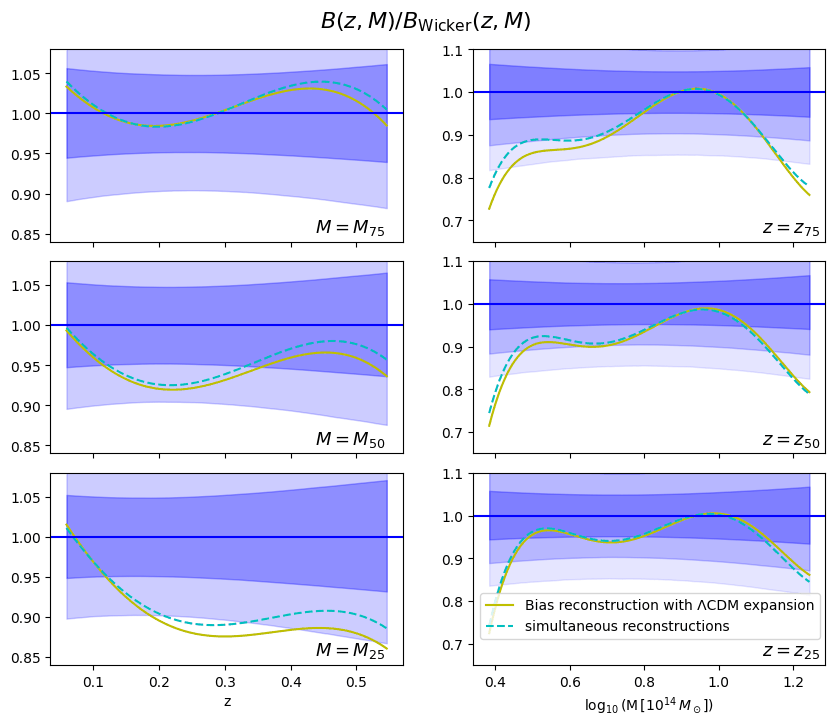
Reconstructed cluster bias, normalised by the Wicker et al. 2023 model, as a function of redshift (left) and mass (right).

2026 · prépublication arXiv

Non-parametric estimation of the baryon gas fraction and the cosmological bias with clusters

Kim, H.†, Wicker, R., L'Huillier, B., Douspis, M., Salvati, L., Shafieloo, A.

From a model-independent expansion history reconstructed from supernovae, we infer with iterative smoothing how the hydrostatic mass bias of galaxy clusters depends on mass and redshift, using X-ray gas fractions. Reconciling clusters with CMB constraints requires this bias to evolve with time.

arXiv:2603.13763

Amas de galaxiesSupernovae IaLissage itératifAvec mes étudiants
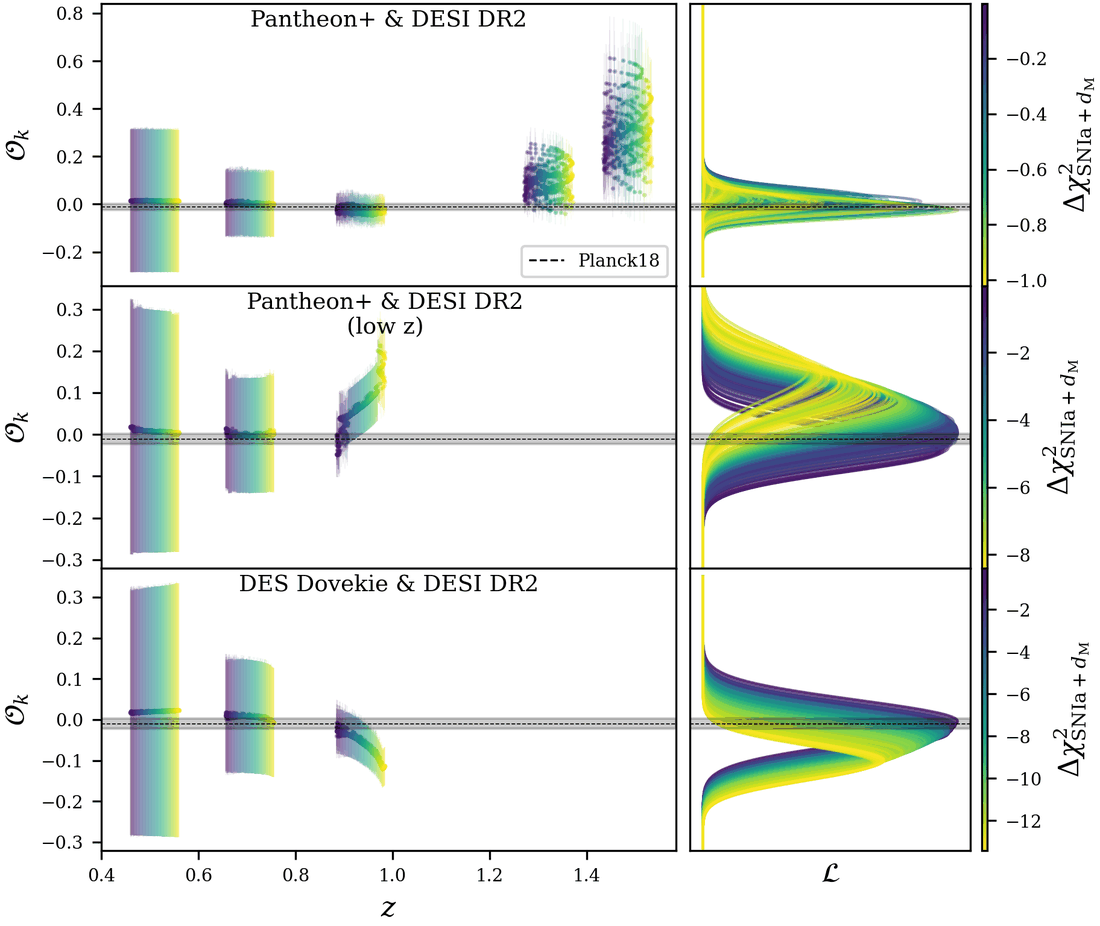
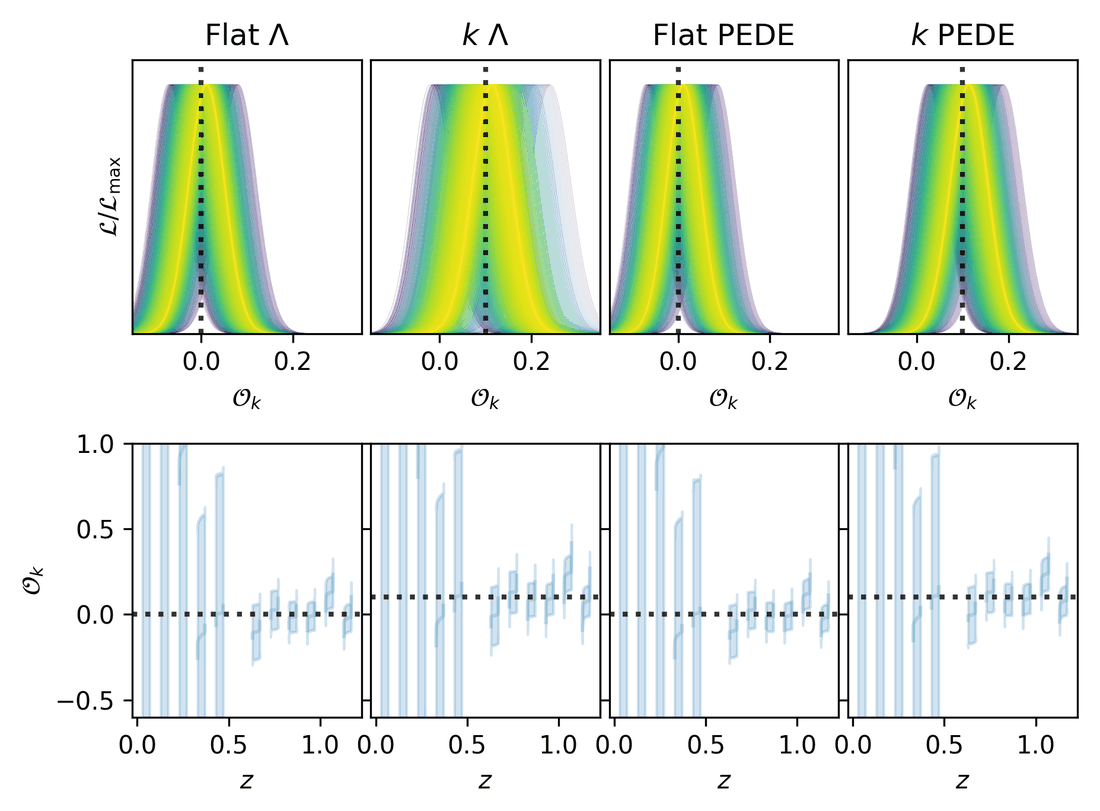
Ok(z) from supernova reconstructions combined with DESI DR2, for three data sets, colour-coded by Deltachi2; right: the resulting likelihoods.
Ok(z)\mathcal{O}_k(z) from supernova reconstructions combined with DESI DR2, for three data sets, colour-coded by Δχ2\Delta\chi^2; right: the resulting likelihoods.

L’Univers est-il plat ? Un test avec DESI DR2

2026 · JCAP 08 (2026) 016

Model independent test of the FLRW metric and the curvature in light of DESI DR2

Millard, C.†, L'Huillier, B.*, Douspis, M.

We reconstruct distances and the Hubble rate from Pantheon+ and DES supernovae without assuming any dark energy model, and combine them with DESI DR2 baryon acoustic oscillations to test the FLRW metric and measure the spatial curvature. With Pantheon+ and DESI DR2 we find Ωk,0=0.045−0.081+0.045\Omega_{k,0} = 0.045^{+0.045}_{-0.081}, consistent with flatness and with Planck 2018.

DOI · arXiv:2601.20293

Articles clésCourbure et FLRWSupernovae IaBAOLissage itératifAvec mes étudiants
The curvature diagnostic Ok on mocks from four fiducial models: it recovers Omegak,0 = 0.1 when the input is curved.
The curvature diagnostic Ok\mathcal{O}_k on mocks from four fiducial models: it recovers Ωk,0=0.1\Omega_{k,0} = 0.1 when the input is curved.

Des tests décisifs pour Rubin et DESI

2025 · JCAP 05 (2025) 030

Litmus tests of the flat ΛCDM model and model-independent measurement of H0rdH_0 r_\mathrm{d} with LSST and DESI

L'Huillier, B., Mitra, A., Shafieloo, A., Keeley, R. E., Koo, H.

Reconstructing the expansion history from simulated LSST supernovae and combining it with simulated DESI 5-year BAO, we forecast constraints of up to ±4% on the curvature and ±0.1 on c/(H0rd)c/(H_0 r_\mathrm{d}), without assuming any form of dark energy.

DOI · arXiv:2407.07847

Articles clésCourbure et FLRWSupernovae IaBAOLissage itératifPremier auteur

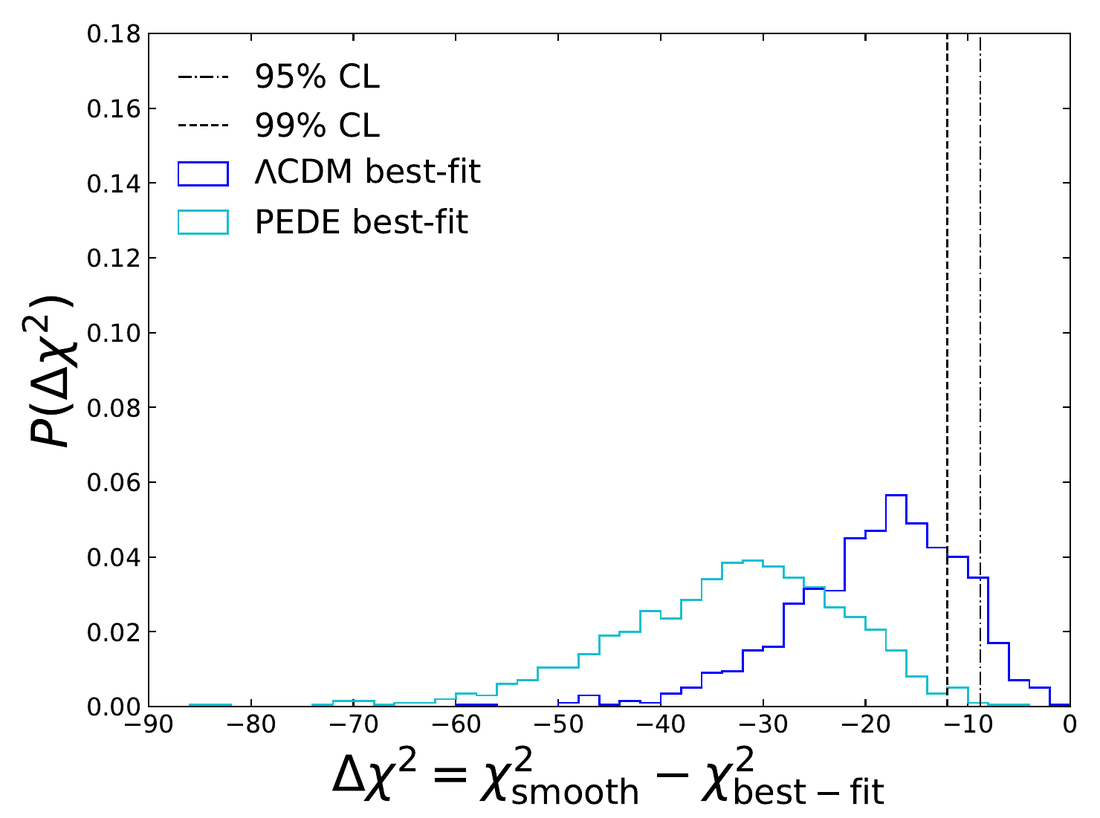
Deltachi2 distributions for ΛCDM and PEDE over Roman-like mocks from a third model; vertical lines mark the 95% and 99% limits.
Δχ2\Delta\chi^2 distributions for ΛCDM and PEDE over Roman-like mocks from a third model; vertical lines mark the 95% and 99% limits.

2022 · JCAP 03 (2022) 047

Bayesian vs frequentist: comparing Bayesian model selection with a frequentist approach using the iterative smoothing method

Koo, H., Keeley, R. E., Shafieloo, A., L'Huillier, B.

On simulated Roman supernova data, Bayesian model selection finds the true model when it is among the candidates, but otherwise only picks the least wrong one. A frequentist test based on iterative smoothing can instead conclude that all tested models are false.

DOI · arXiv:2110.10977

Énergie noireSupernovae IaLissage itératifSélection de modèles

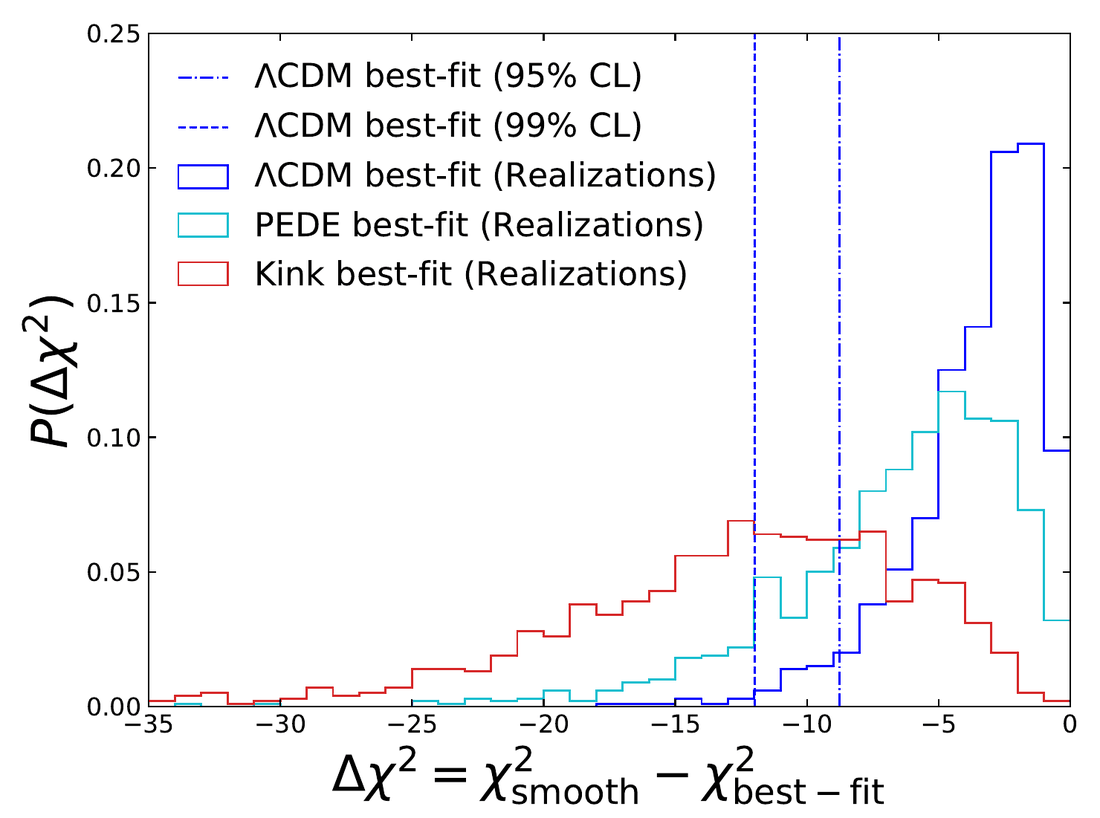
Distributions of Deltachi2 between the smoothed and best-fit models over WFIRST-like ΛCDM mocks, for ΛCDM, PEDE and Kink.
Distributions of Δχ2\Delta\chi^2 between the smoothed and best-fit models over WFIRST-like ΛCDM mocks, for ΛCDM, PEDE and Kink.

2021 · JCAP 03 (2021) 034

Model selection and parameter estimation using the iterative smoothing method

Koo, H., Shafieloo, A., Keeley, R. E., L'Huillier, B.

Likelihood distributions derived from the non-parametric iterative smoothing method let us test a dark energy model and estimate its parameters without comparing it to an alternative. On WFIRST-like mocks we quantify how confidently different dark energy models can be distinguished.

DOI · arXiv:2009.12045

Énergie noireSupernovae IaLissage itératifSélection de modèles

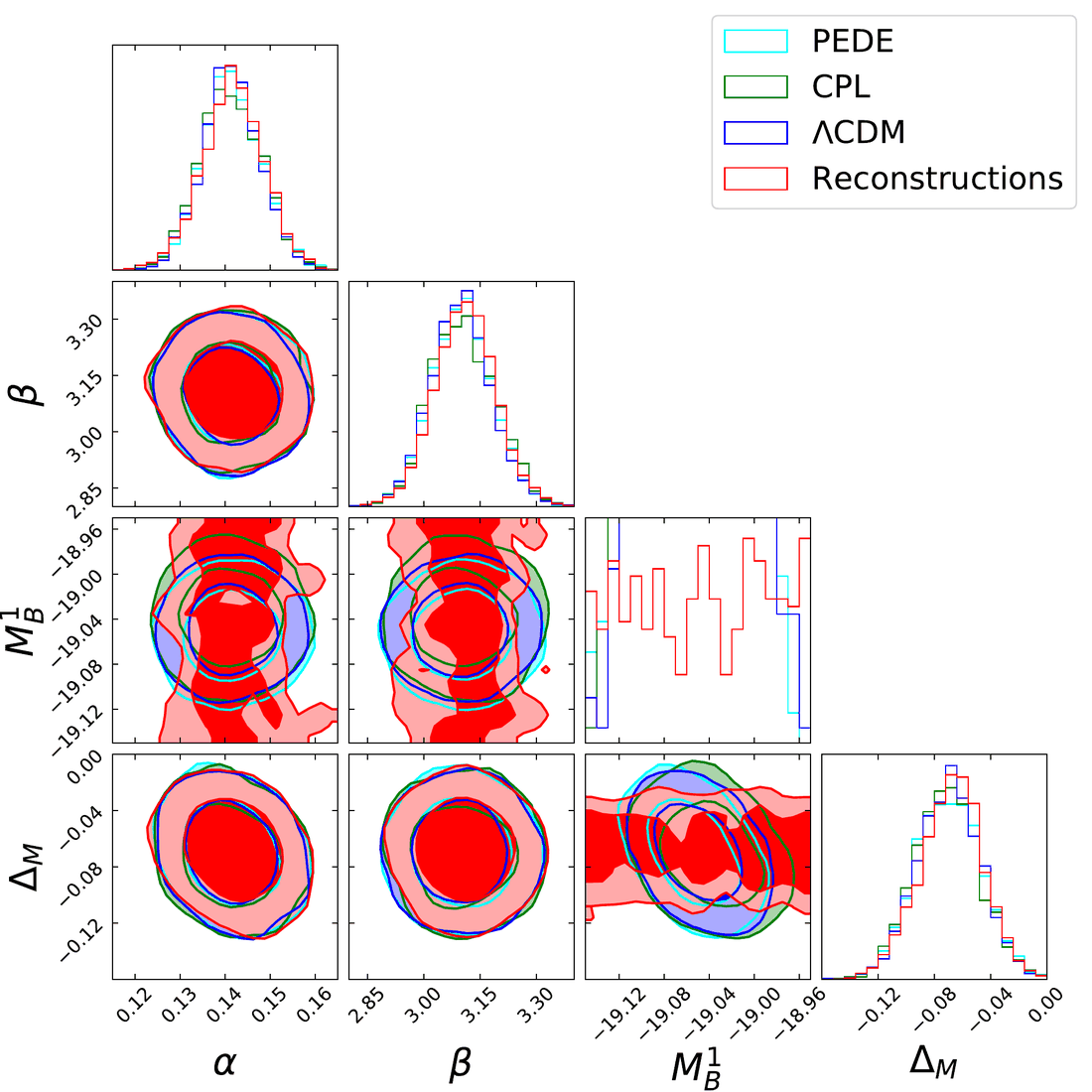
Constraints on the JLA light-curve parameters from iterative smoothing (red) compared with ΛCDM, CPL and PEDE.

2020 · ApJ 899 (2020) 9

Model-independent constraints on Type Ia supernova light-curve hyper-parameters and reconstructions of the expansion history of the Universe

Koo, H., Shafieloo, A., Keeley, R. E., L'Huillier, B.

Reconstructing the expansion history from JLA supernovae with iterative smoothing while sampling the light-curve hyper-parameters, we find hyper-parameters consistent with those from ΛCDM, CPL and PEDE fits, and no significant redshift evolution.

DOI · arXiv:2001.10887

Supernovae IaLissage itératif

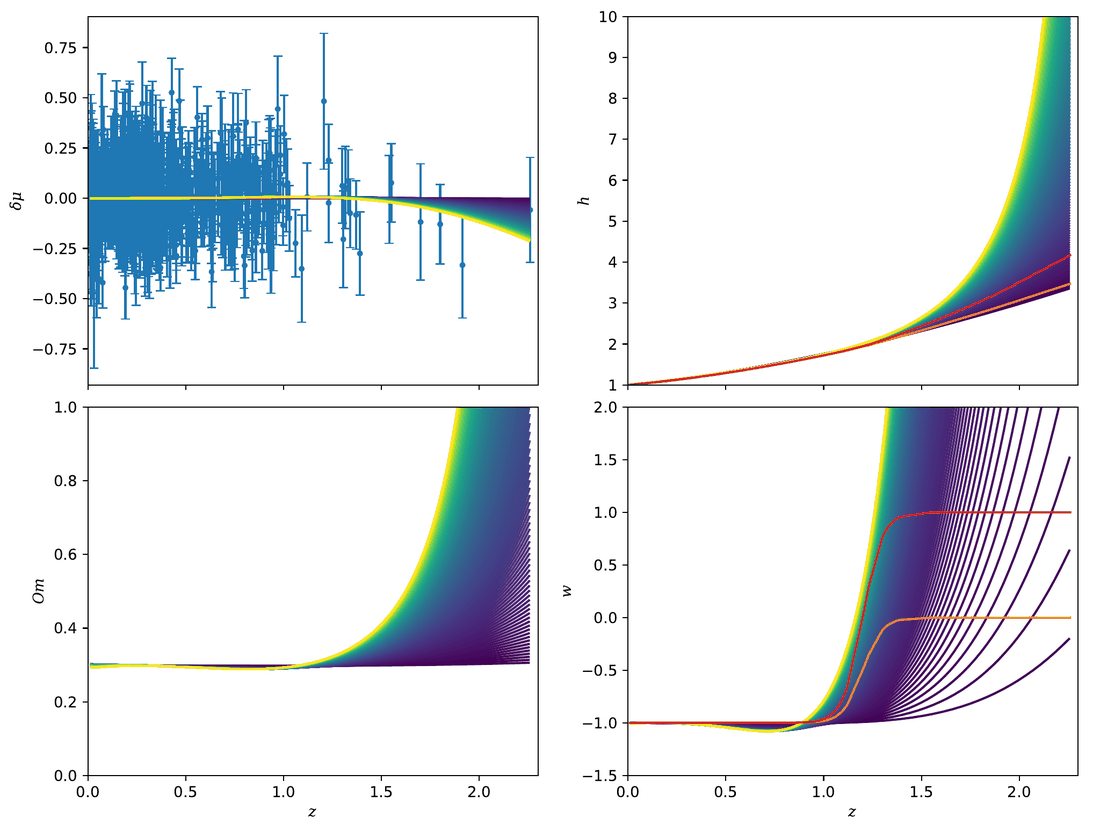
Iterative smoothing of Pantheon: residuals, h(z), the Om diagnostic and w(z). Every curve fits the data better than the best-fit ΛCDM.
Iterative smoothing of Pantheon: residuals, h(z)h(z), the OmOm diagnostic and w(z)w(z). Every curve fits the data better than the best-fit ΛCDM.

2019 · MNRAS 485 (2019) 2783

Model independent expansion history from supernovae: cosmology versus systematics

L'Huillier, B., Shafieloo, A., Linder, E. V., Kim, A. G.

A model-independent analysis of the Pantheon supernovae shows deviations from ΛCDM at z≳1z \gtrsim 1. They vanish with a simple Malmquist-like correction, but neither χ2\chi^2 tests nor Gaussian processes find that this extra correction is statistically required.

DOI · arXiv:1812.03623

Supernovae IaProcessus gaussiensLissage itératifPremier auteur

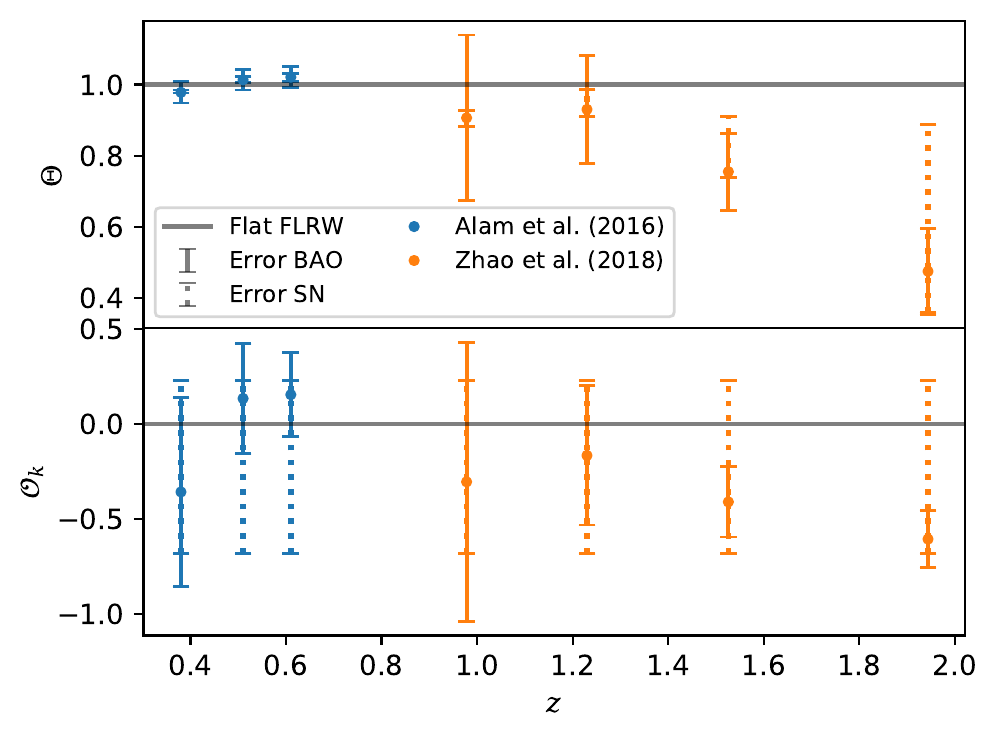
Theta(z) (top) and Ok(z) (bottom) from supernovae and BOSS/eBOSS BAO. A flat FLRW universe gives Theta = 1.
Θ(z)\Theta(z) (top) and Ok(z)\mathcal{O}_k(z) (bottom) from supernovae and BOSS/eBOSS BAO. A flat FLRW universe gives Θ=1\Theta = 1.

2018 · Phys. Rev. D 98 (2018) 083526

Falsifying ΛCDM: model-independent tests of the concordance model with eBOSS DR14Q and Pantheon

Shafieloo, A., L'Huillier, B.*, Starobinsky, A. A.

Combining model-independent expansion reconstructions from Pantheon supernovae and BAO, we test the FLRW metric and flatness, and use eBOSS DR14Q growth data to constrain Ωm\Omega_\mathrm{m}, γ\gamma and σ8\sigma_8. Everything is consistent with a flat FLRW universe, General Relativity and Λ\Lambda, with some tension at z>1z > 1.

DOI · arXiv:1804.04320

Articles clésCourbure et FLRWGravité modifiéeSupernovae IaBAOCroissance des structures (RSD)Lissage itératif

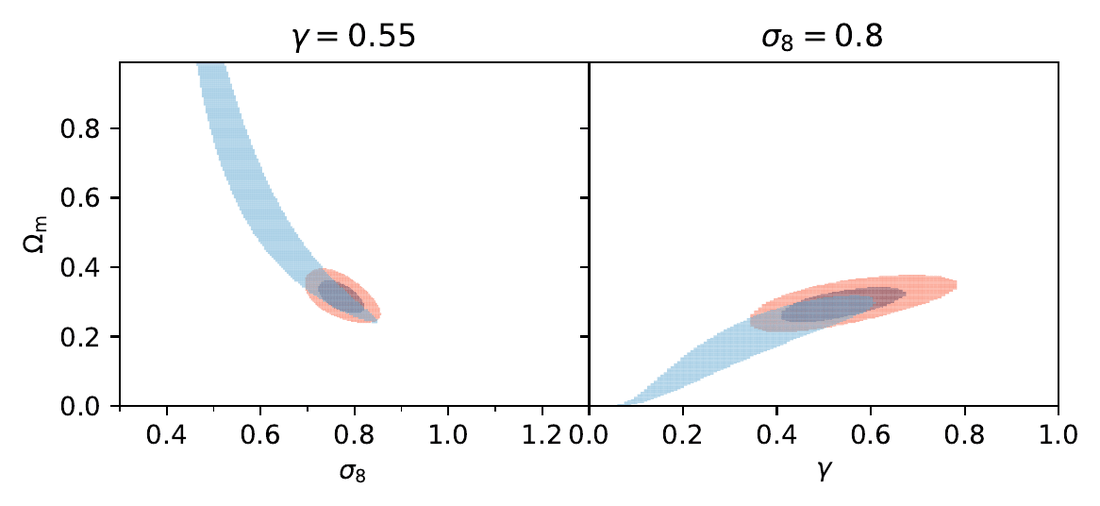
Model-independent regions allowed by growth data (blue) compared with ΛCDM (red), at fixed gamma = 0.55 (left) and fixed sigma8 = 0.8 (right).
Model-independent regions allowed by growth data (blue) compared with ΛCDM (red), at fixed γ=0.55\gamma = 0.55 (left) and fixed σ8=0.8\sigma_8 = 0.8 (right).

2018 · MNRAS 476 (2018) 3263

Model-independent cosmological constraints from growth and expansion

L'Huillier, B., Shafieloo, A., Kim, H.†

We reconstruct the expansion history from supernovae and fit growth-rate data to constrain Ωm\Omega_\mathrm{m}, the growth index γ\gamma and σ8\sigma_8 without a dark energy model. The results agree with ΛCDM in General Relativity, and requiring a positive dark energy density tightens them further.

DOI · arXiv:1712.04865

Articles clésGravité modifiéeSupernovae IaCroissance des structures (RSD)Lissage itératifPremier auteurAvec mes étudiants

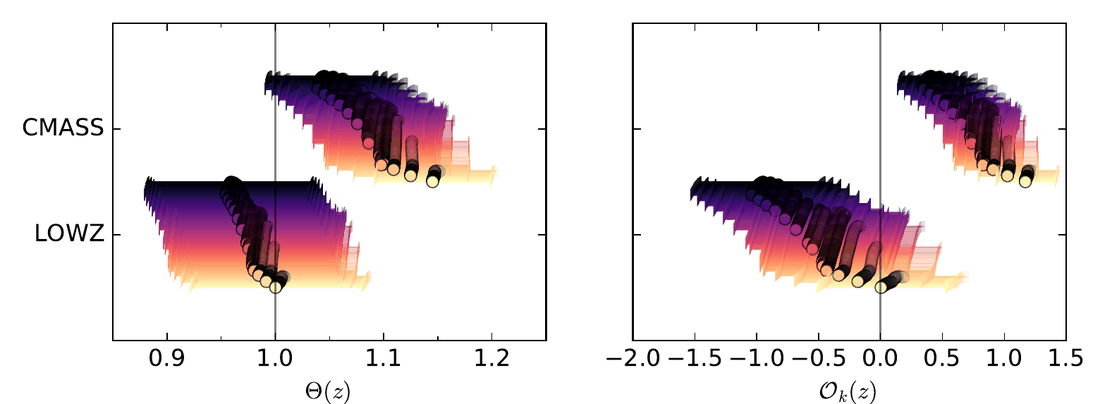
Theta(z) and the curvature diagnostic Ok(z) at the BOSS LOWZ and CMASS redshifts, one point per supernova-based reconstruction. A flat FLRW universe gives Theta = 1 and Ok = 0.
Θ(z)\Theta(z) and the curvature diagnostic Ok(z)\mathcal{O}_k(z) at the BOSS LOWZ and CMASS redshifts, one point per supernova-based reconstruction. A flat FLRW universe gives Θ=1\Theta = 1 and Ok=0\mathcal{O}_k = 0.

Tester ΛCDM sans le supposer

2017 · JCAP 01 (2017) 015

Model-independent test of the FLRW metric, the flatness of the Universe, and non-local measurement of H0rdH_0 r_\mathrm{d}

L'Huillier, B., Shafieloo, A.

Combining BOSS DR12 BAO with JLA supernovae, we measure H0rdH_0 r_\mathrm{d} without assuming a cosmological model and introduce the Θ(z)\Theta(z) diagnostic of the flat-FLRW metric. The results are consistent with a flat FLRW universe within 2σ2\sigma.

DOI · arXiv:1606.06832

Articles clésCourbure et FLRWSupernovae IaBAOLissage itératifPremier auteur

← Tous les articles