Publications

Énergie noire

6 articles

Environ 70 % du contenu énergétique de l’Univers est à l’origine de l’accélération de son expansion, et sa nature reste inconnue. Dans ΛCDM, il s’agit d’une constante cosmologique ; ce pourrait aussi être un champ dynamique, ou le signe que la relativité générale cesse d’être valable aux échelles cosmologiques.

Mon approche consiste à laisser parler les données : reconstruire l’histoire de l’expansion sans supposer de modèle d’énergie noire, puis déterminer quels modèles, Λ compris, restent compatibles avec elle. J’utilise aussi des simulations à N corps pour comprendre comment une énergie noire qui s’agrège modifierait la formation des structures.

Publications

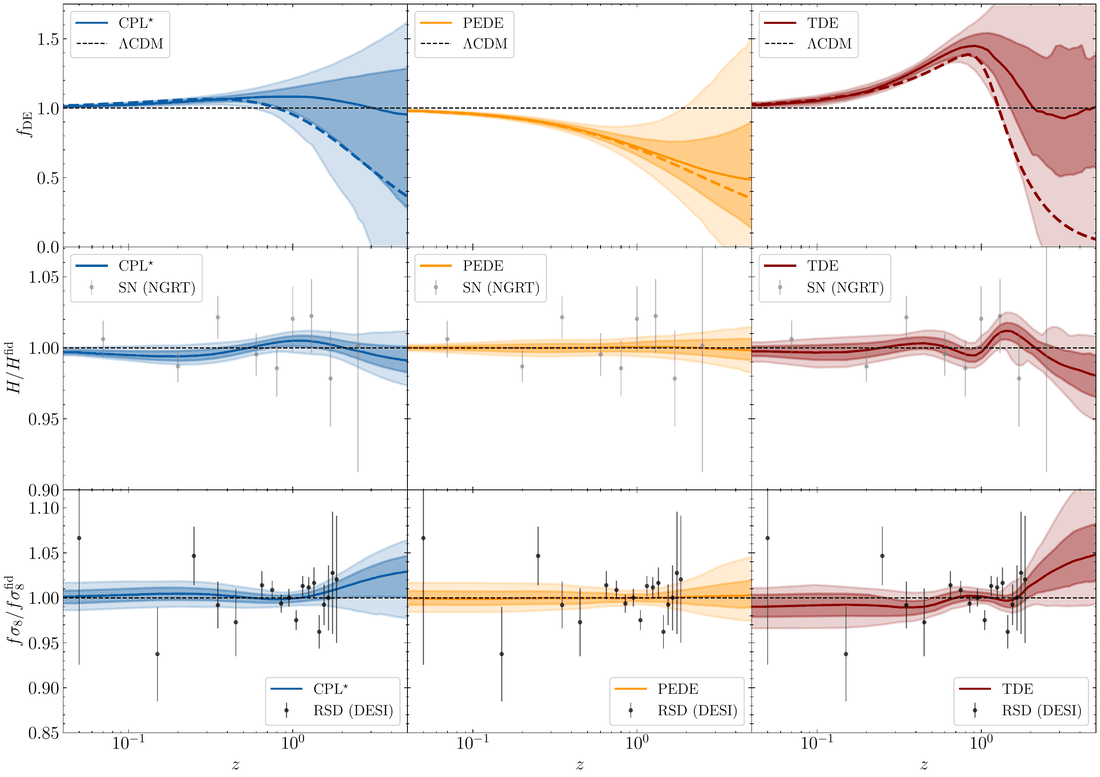
Joint reconstructions of the effective gravitational coupling, H(z) and fsigma8(z) for three fiducial cosmologies; dashed lines show the truth.
Joint reconstructions of the effective gravitational coupling, H(z)H(z) and fσ8(z)f\sigma_8(z) for three fiducial cosmologies; dashed lines show the truth.

2022 · Phys. Rev. D 106 (2022) 083513

Joint reconstructions of growth and expansion histories from stage-IV surveys with minimal assumptions I: dark energy beyond Λ\Lambda

Calderón, R., L'Huillier, B., Polarski, D., Shafieloo, A., Starobinsky, A. A.

Gaussian processes reconstruct the dark energy density from forecast stage-IV supernova, BAO and redshift-space-distortion data, assuming only a flat FLRW universe that becomes matter-dominated at high redshift, which also yields the growth history. Several dark energy models can be distinguished from ΛCDM at 2σ2\sigma or more.

DOI · arXiv:2206.13820

Énergie noireSupernovae IaBAOCroissance des structures (RSD)Processus gaussiens
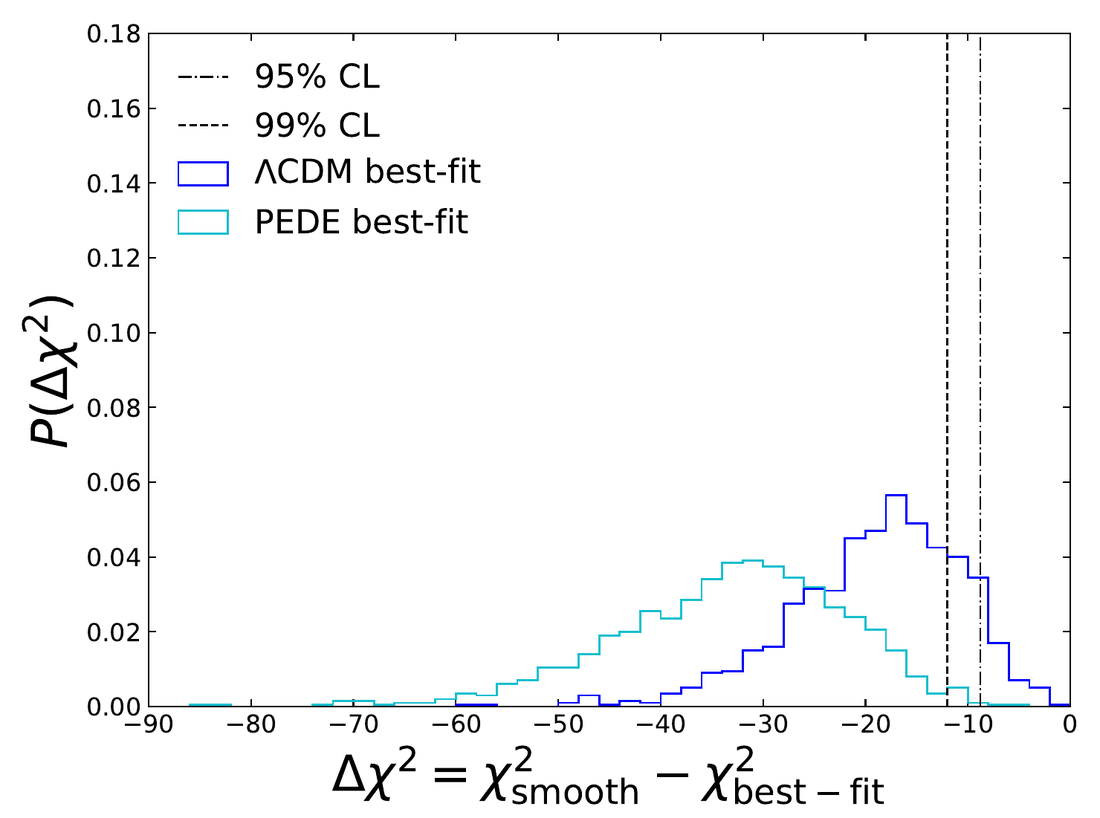
Deltachi2 distributions for ΛCDM and PEDE over Roman-like mocks from a third model; vertical lines mark the 95% and 99% limits.
Δχ2\Delta\chi^2 distributions for ΛCDM and PEDE over Roman-like mocks from a third model; vertical lines mark the 95% and 99% limits.

2022 · JCAP 03 (2022) 047

Bayesian vs frequentist: comparing Bayesian model selection with a frequentist approach using the iterative smoothing method

Koo, H., Keeley, R. E., Shafieloo, A., L'Huillier, B.

On simulated Roman supernova data, Bayesian model selection finds the true model when it is among the candidates, but otherwise only picks the least wrong one. A frequentist test based on iterative smoothing can instead conclude that all tested models are false.

DOI · arXiv:2110.10977

Énergie noireSupernovae IaLissage itératifSélection de modèles

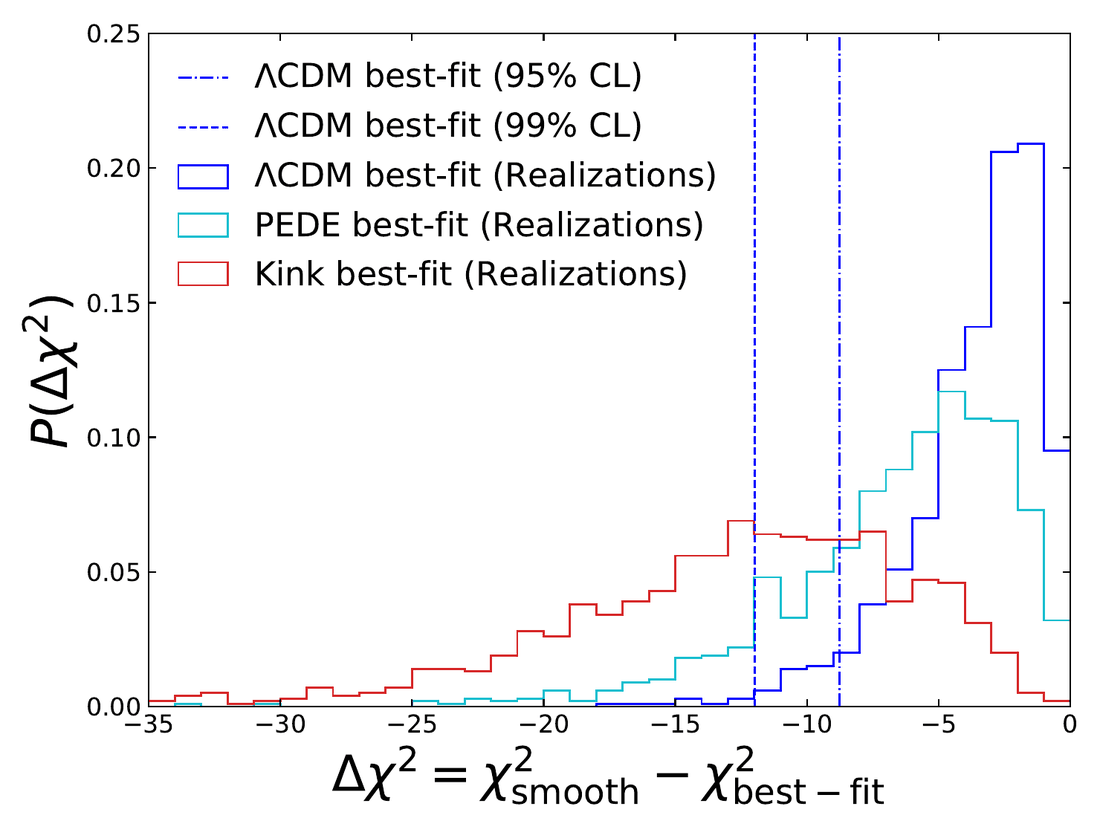
Distributions of Deltachi2 between the smoothed and best-fit models over WFIRST-like ΛCDM mocks, for ΛCDM, PEDE and Kink.
Distributions of Δχ2\Delta\chi^2 between the smoothed and best-fit models over WFIRST-like ΛCDM mocks, for ΛCDM, PEDE and Kink.

2021 · JCAP 03 (2021) 034

Model selection and parameter estimation using the iterative smoothing method

Koo, H., Shafieloo, A., Keeley, R. E., L'Huillier, B.

Likelihood distributions derived from the non-parametric iterative smoothing method let us test a dark energy model and estimate its parameters without comparing it to an alternative. On WFIRST-like mocks we quantify how confidently different dark energy models can be distinguished.

DOI · arXiv:2009.12045

Énergie noireSupernovae IaLissage itératifSélection de modèles

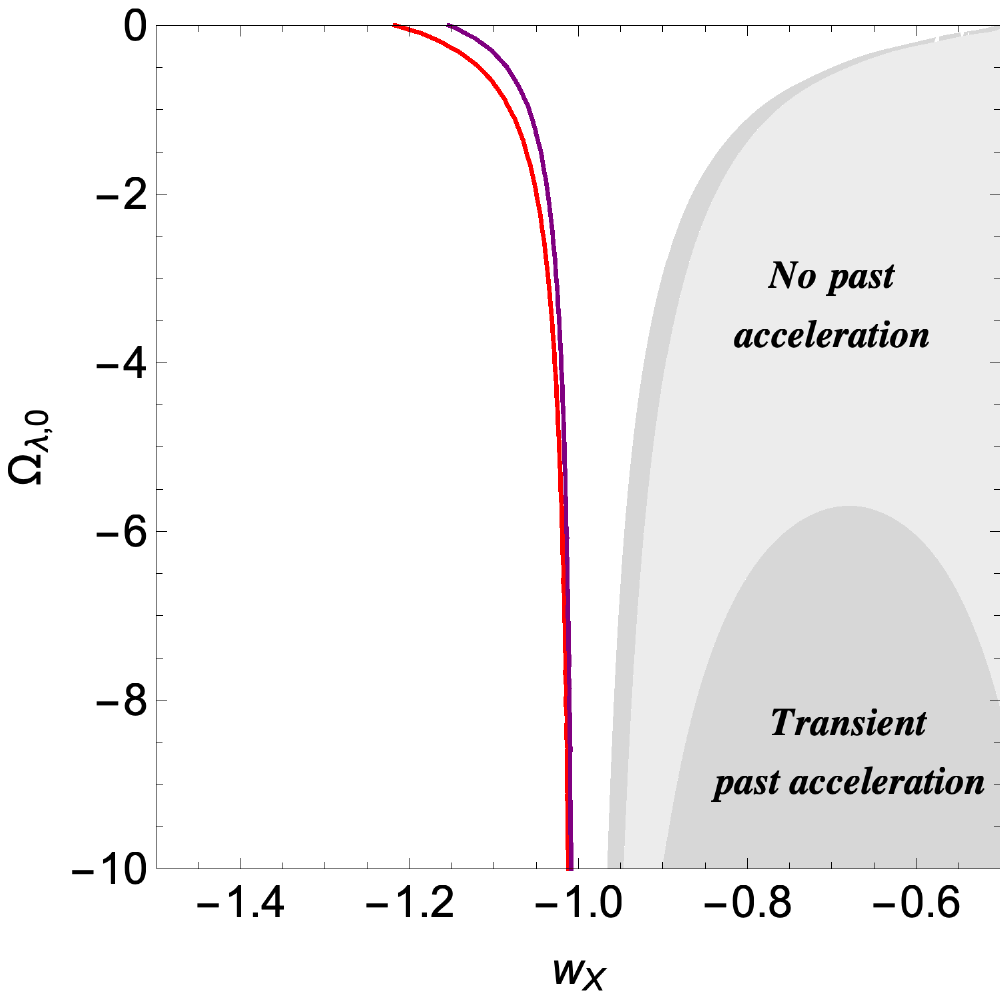
Where a universe with a negative cosmological constant still accelerates today (white), accelerated only in the past (dark grey), or never accelerated (light grey), for Omegam = 0.3.
Where a universe with a negative cosmological constant still accelerates today (white), accelerated only in the past (dark grey), or never accelerated (light grey), for Ωm=0.3\Omega_\mathrm{m} = 0.3.

2021 · Phys. Rev. D 103 (2021) 023526

Negative cosmological constant in the dark sector?

Calderón, R., Gannouji, R., L'Huillier, B.*, Polarski, D.

We study dark sectors made of a negative cosmological constant plus a late-time accelerating component. The acceleration is often transient and some models eventually contract; current data show no decisive evidence for a negative Λ\Lambda, but the best fits are phantom at z≳1z \gtrsim 1.

DOI · arXiv:2008.10237

Articles clésÉnergie noire

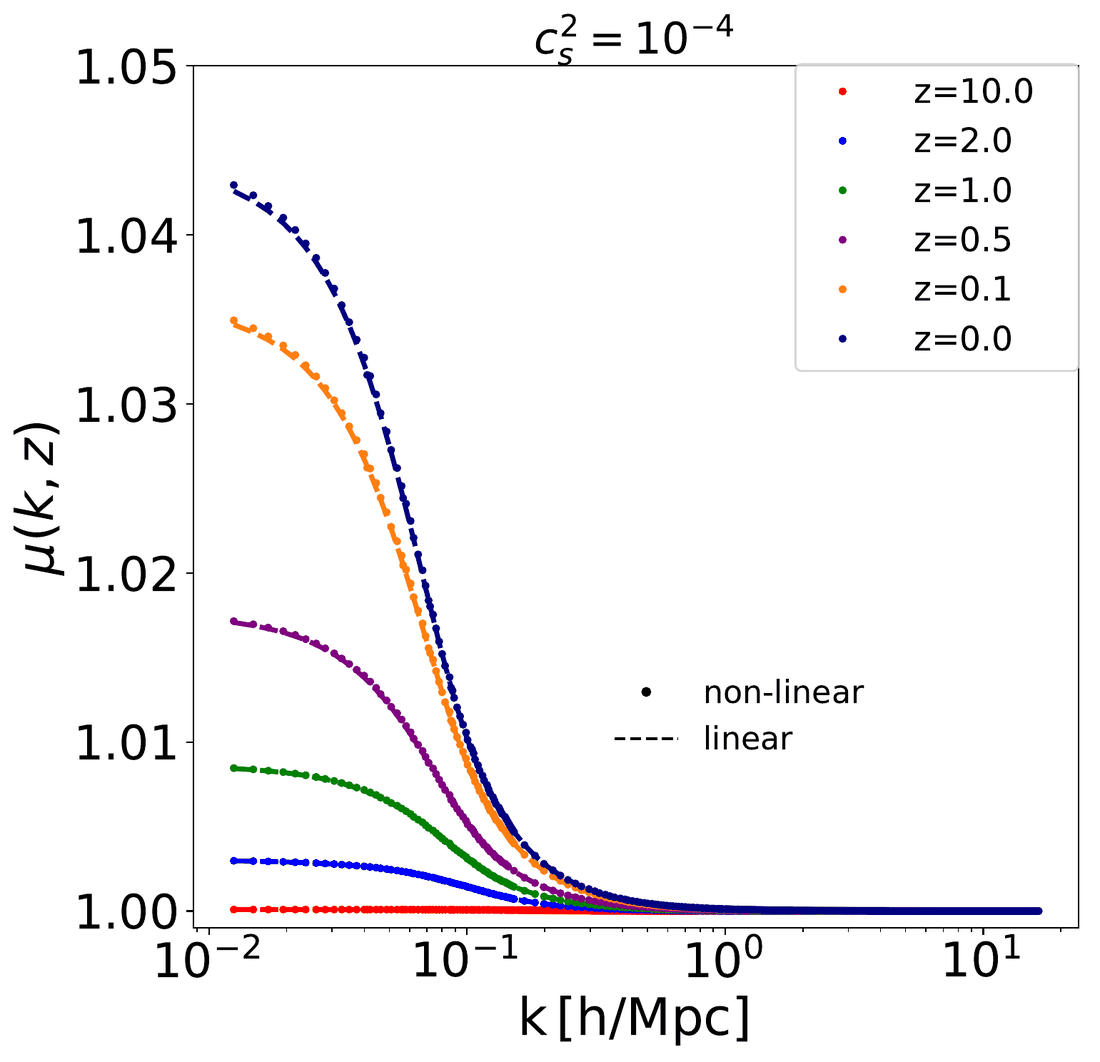
Ratio mu(k,z) of the k-essence to ΛCDM gravitational potential for sound speed cs2 = 10-4, non-linear (points) versus linear (dashed).
Ratio μ(k,z)\mu(k,z) of the k-essence to ΛCDM gravitational potential for sound speed cs2=10−4c_s^2 = 10^{-4}, non-linear (points) versus linear (dashed).

2020 · JCAP 04 (2020) 039

Parametrising non-linear dark energy perturbations

Hassani, F., L'Huillier, B., Shafieloo, A., Kunz, M., Adamek, J.

Using k-evolution N-body simulations, we quantify non-linear k-essence dark energy perturbations through an effective modification μ\mu of the Poisson equation, show that linear theory is accurate at large sound speeds, and propose a simulation-calibrated parametrisation of μ\mu.

DOI · arXiv:1910.01105

Énergie noireGrandes structuresSimulations

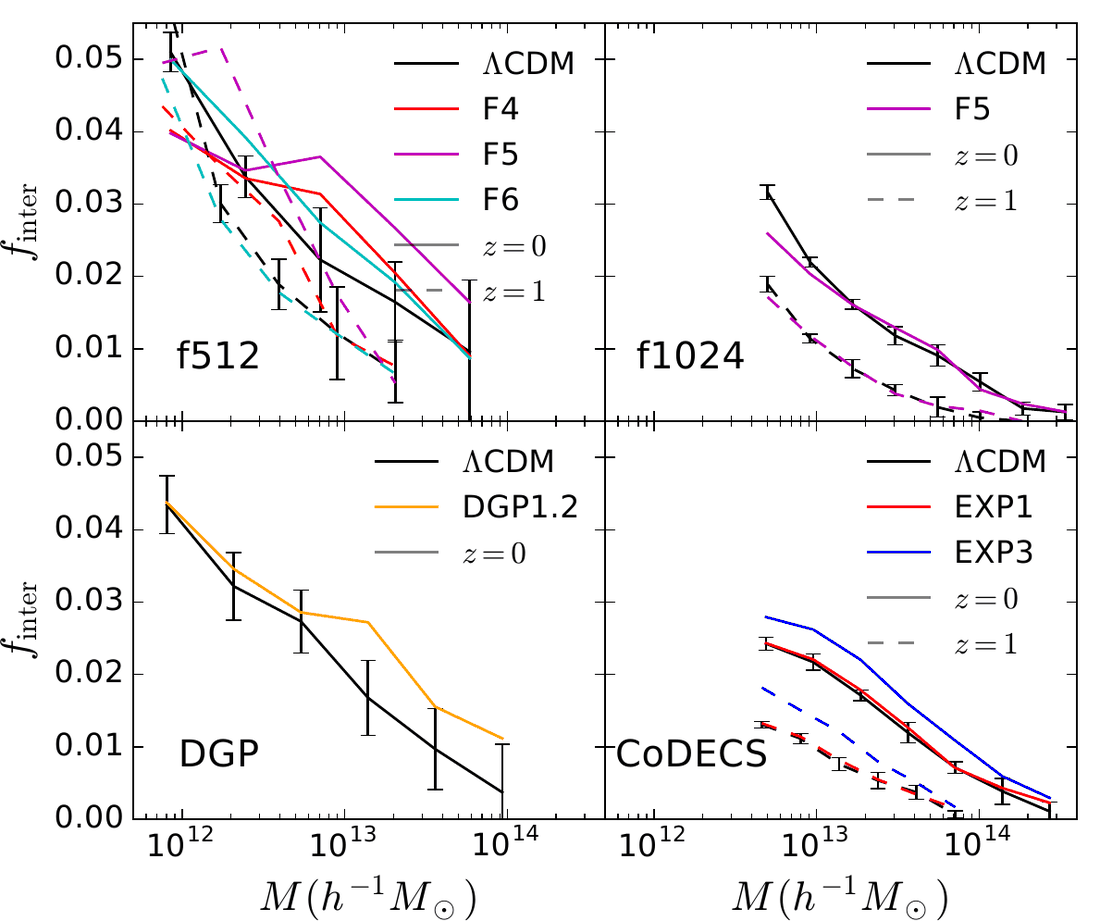
Halo interaction rate versus mass in ΛCDM and in f(R), DGP and coupled dark energy simulations.
Halo interaction rate versus mass in ΛCDM and in f(R)f(R), DGP and coupled dark energy simulations.

Des halos au-delà de la relativité générale

2017 · MNRAS 468 (2017) 3174

Dark matter haloes in modified gravity and dark energy: interaction rate, small- and large-scale alignment

L'Huillier, B., Winther, H. A., Mota, D. F., Park, C., Kim, J.

In N-body simulations of f(R)f(R) gravity, DGP and coupled dark energy, f(R)f(R) raises halo spin and weakens the spin alignment of interacting pairs, while only strongly coupled dark energy increases the halo interaction rate and the alignment of halo shapes with the large-scale structure.

DOI · arXiv:1703.07357

Articles clésGravité modifiéeÉnergie noireHalos de matière noireSimulationsPremier auteur

← Tous les articles