Le modèle standard de la cosmologie repose sur plusieurs hypothèses :
l’Univers est homogène et isotrope ;
la gravitation est décrite par la relativité générale (RG).
Sous ces hypothèses, la métrique de l’Univers est celle de Friedmann–Lemaître–Robertson–Walker (FLRW), qui décrit un univers en expansion.
Dans ce cadre, le modèle de concordance actuel est ΛCDM : le bilan énergétique est dominé par la constante cosmologique Λ, responsable de l’accélération récente de l’expansion, et la matière est dominée par une composante froide, lisse et non baryonique — la matière noire. Pourtant, aucune de ces deux composantes n’a été détectée directement, et aucune ne fait partie du modèle standard de la physique des particules. On peut donc interroger les hypothèses sous-jacentes : la métrique FLRW est-elle la bonne ? L’Univers est-il isotrope et homogène ? L’énergie noire est-elle une constante cosmologique ?
Tester la métrique FLRW et la courbure
En combinant des reconstructions indépendantes de tout modèle de l’histoire de l’expansion h(z)=H(z)/H0 à partir des supernovae de la Joint Light-curve Analysis (JLA) avec les mesures d’oscillations acoustiques baryoniques du Baryon Oscillation Spectroscopic Survey (SDSS-III/BOSS), Arman Shafieloo et moi avons mesuré, sans hypothèse de modèle, la combinaison de la constante de Hubble H0 et de l’horizon sonore à l’époque de découplage des baryons rd. Nous avons ensuite introduit un nouveau test de la métrique FLRW plate, Θ(z), relié au test de Clarkson Ok(z) par
où D est la distance comobile en unités de c/H0. Dans un univers FLRW, Ok=Ωk,0 à tout redshift ; s’il est de plus plat, Θ=1 et Ok=0.
Nos résultats sont compatibles avec un Univers FLRW plat, mais montrent un léger indice de tension dans le sous-échantillon CMASS (L'Huillier & Shafieloo, JCAP 01 (2017) 015).
Publications
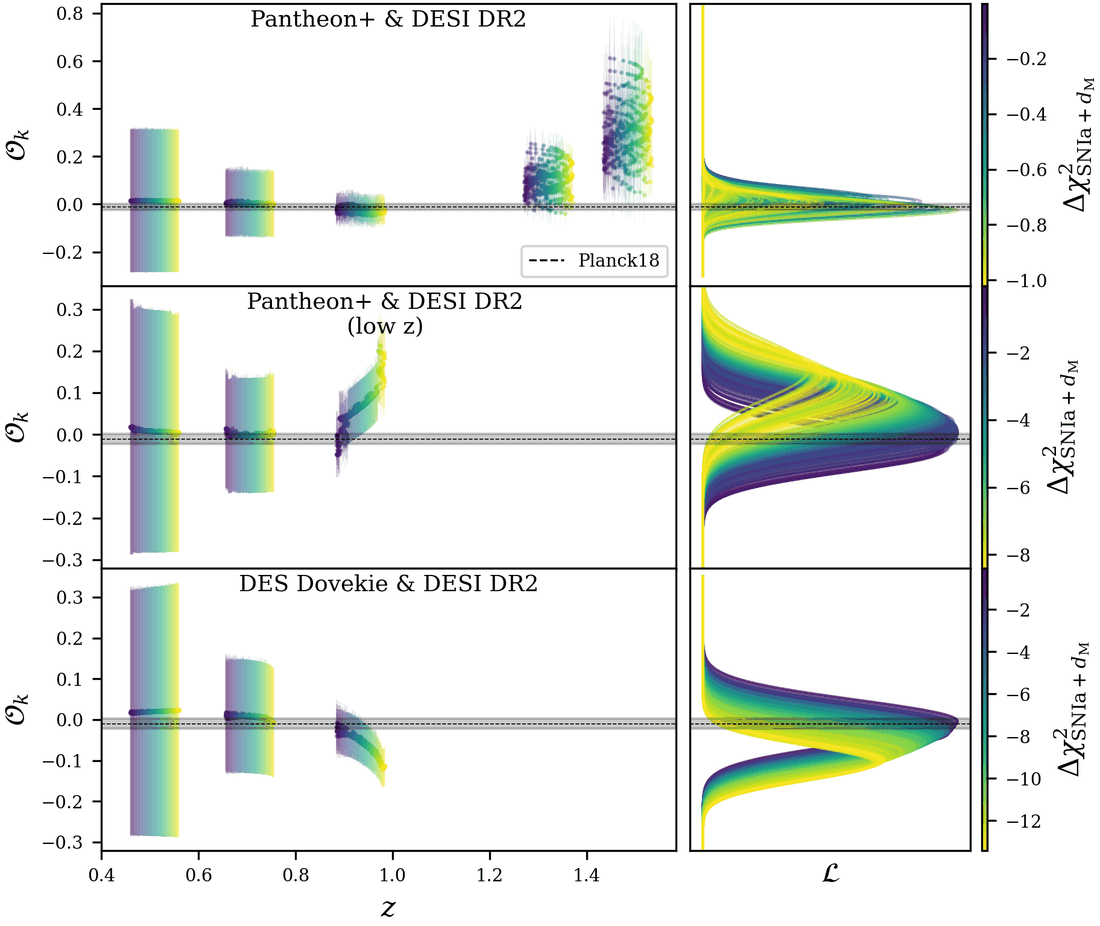
Ok(z) from supernova reconstructions combined with DESI DR2, for three data sets, colour-coded by Δχ2; right: the resulting likelihoods.
L’Univers est-il plat ? Un test avec DESI DR2
2026 · JCAP 08 (2026) 016
Model independent test of the FLRW metric and the curvature in light of DESI DR2
Millard, C.†, L'Huillier, B.*, Douspis, M.
We reconstruct distances and the Hubble rate from Pantheon+ and DES supernovae without assuming any dark energy model, and combine them with DESI DR2 baryon acoustic oscillations to test the FLRW metric and measure the spatial curvature. With Pantheon+ and DESI DR2 we find Ωk,0=0.045−0.081+0.045, consistent with flatness and with Planck 2018.
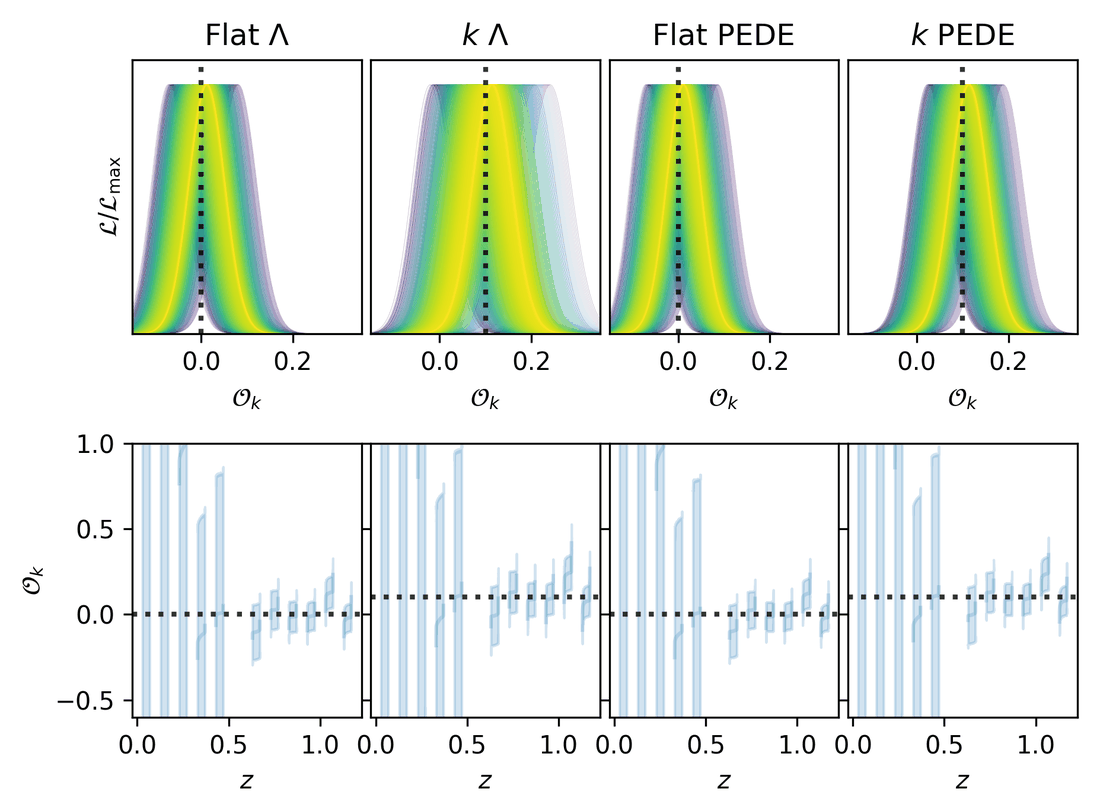
The curvature diagnostic Ok on mocks from four fiducial models: it recovers Ωk,0=0.1 when the input is curved.
Des tests décisifs pour Rubin et DESI
2025 · JCAP 05 (2025) 030
Litmus tests of the flat ΛCDM model and model-independent measurement of H0rd with LSST and DESI
L'Huillier, B., Mitra, A., Shafieloo, A., Keeley, R. E., Koo, H.
Reconstructing the expansion history from simulated LSST supernovae and combining it with simulated DESI 5-year BAO, we forecast constraints of up to ±4% on the curvature and ±0.1 on c/(H0rd), without assuming any form of dark energy.
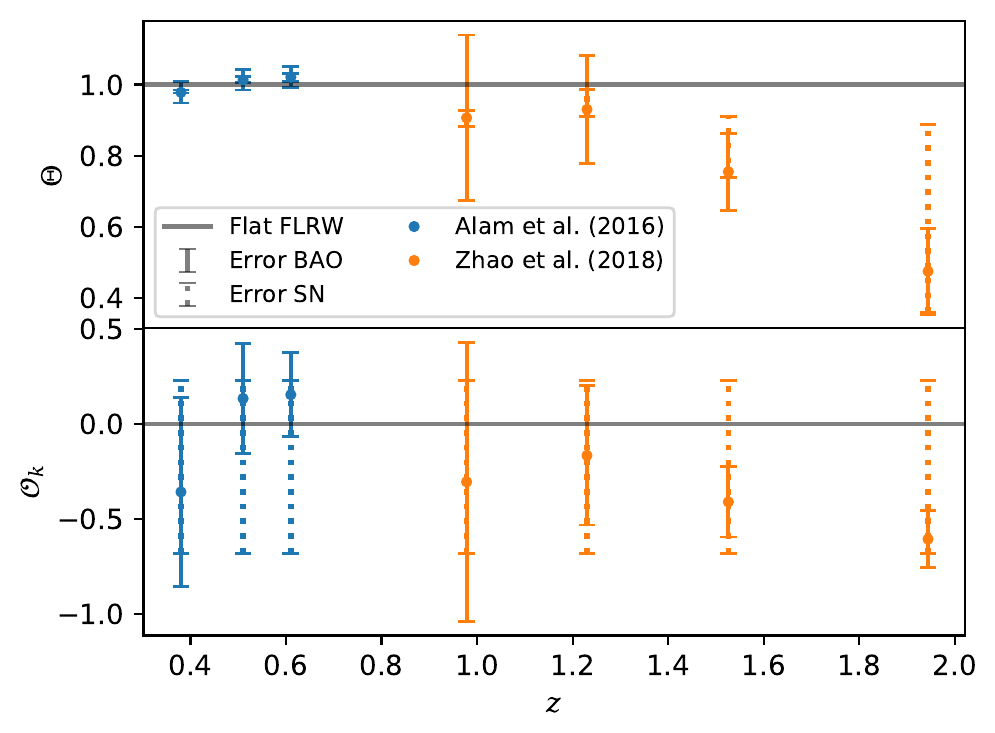
Θ(z) (top) and Ok(z) (bottom) from supernovae and BOSS/eBOSS BAO. A flat FLRW universe gives Θ=1.
2018 · Phys. Rev. D 98 (2018) 083526
Falsifying ΛCDM: model-independent tests of the concordance model with eBOSS DR14Q and Pantheon
Shafieloo, A., L'Huillier, B.*, Starobinsky, A. A.
Combining model-independent expansion reconstructions from Pantheon supernovae and BAO, we test the FLRW metric and flatness, and use eBOSS DR14Q growth data to constrain Ωm, γ and σ8. Everything is consistent with a flat FLRW universe, General Relativity and Λ, with some tension at z>1.
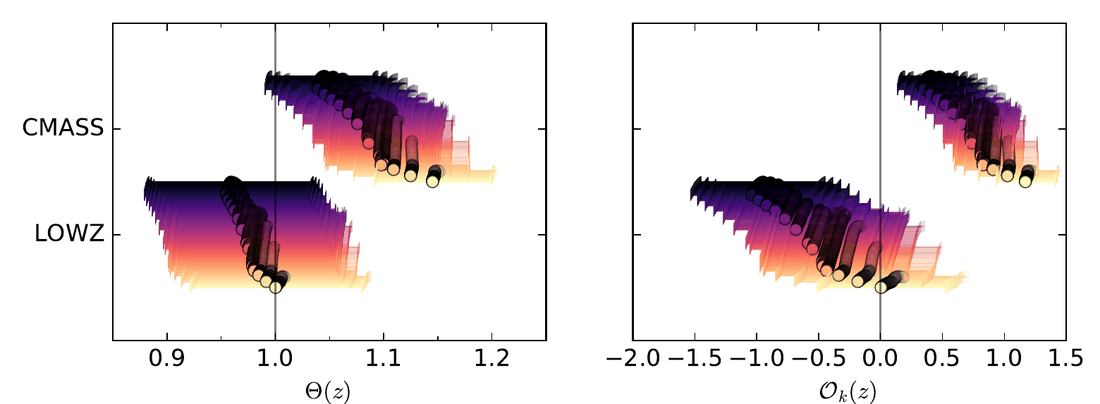
Θ(z) and the curvature diagnostic Ok(z) at the BOSS LOWZ and CMASS redshifts, one point per supernova-based reconstruction. A flat FLRW universe gives Θ=1 and Ok=0.
Tester ΛCDM sans le supposer
2017 · JCAP 01 (2017) 015
Model-independent test of the FLRW metric, the flatness of the Universe, and non-local measurement of H0rd
L'Huillier, B., Shafieloo, A.
Combining BOSS DR12 BAO with JLA supernovae, we measure H0rd without assuming a cosmological model and introduce the Θ(z) diagnostic of the flat-FLRW metric. The results are consistent with a flat FLRW universe within 2σ.