Gaussian process regression
How the choice of mean function and the way hyperparameters are set bias GP reconstructions, and how to avoid it.
Hwang+ 2023, JCAP
See the papers
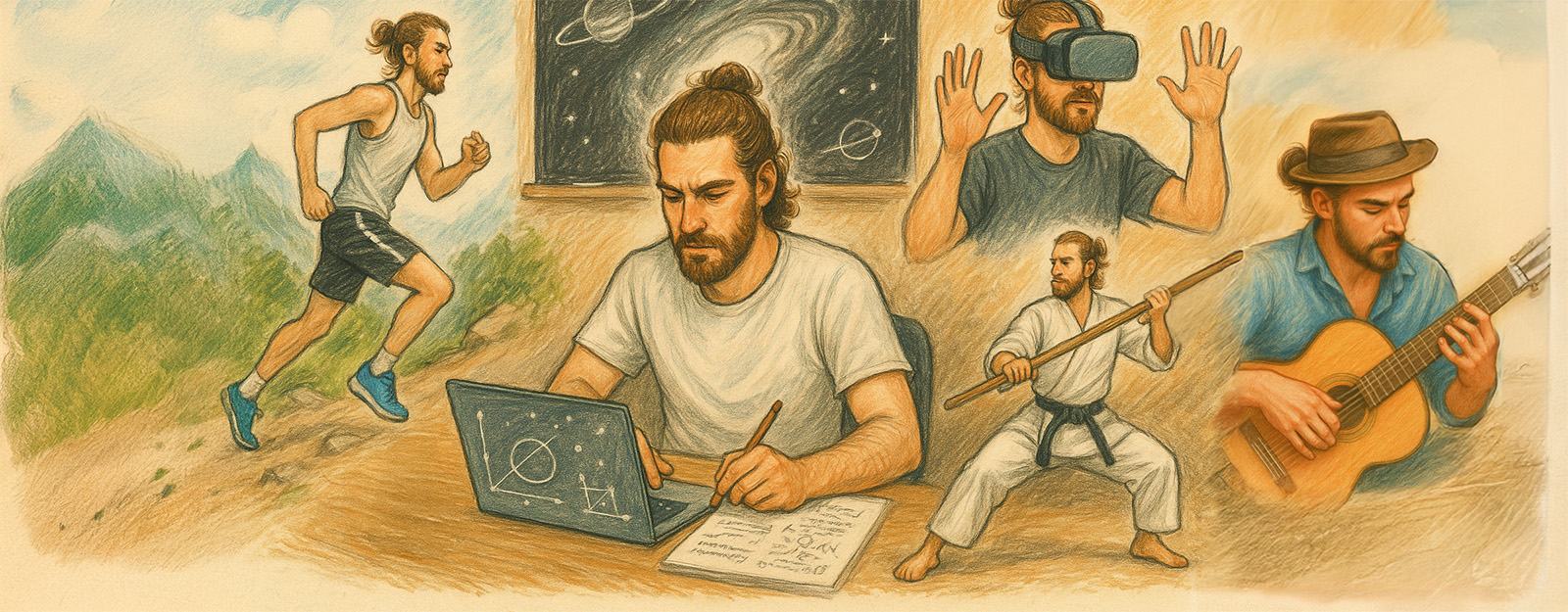
I am an Assistant Professor in the Department of Physics and Astronomy at Sejong University in Seoul, South Korea. I develop statistical and computational methods (Gaussian processes, non-parametric reconstruction, Bayesian model selection, deconvolution) and use them to test the standard model of cosmology with data from DESI, supernovae and gravitational lensing.
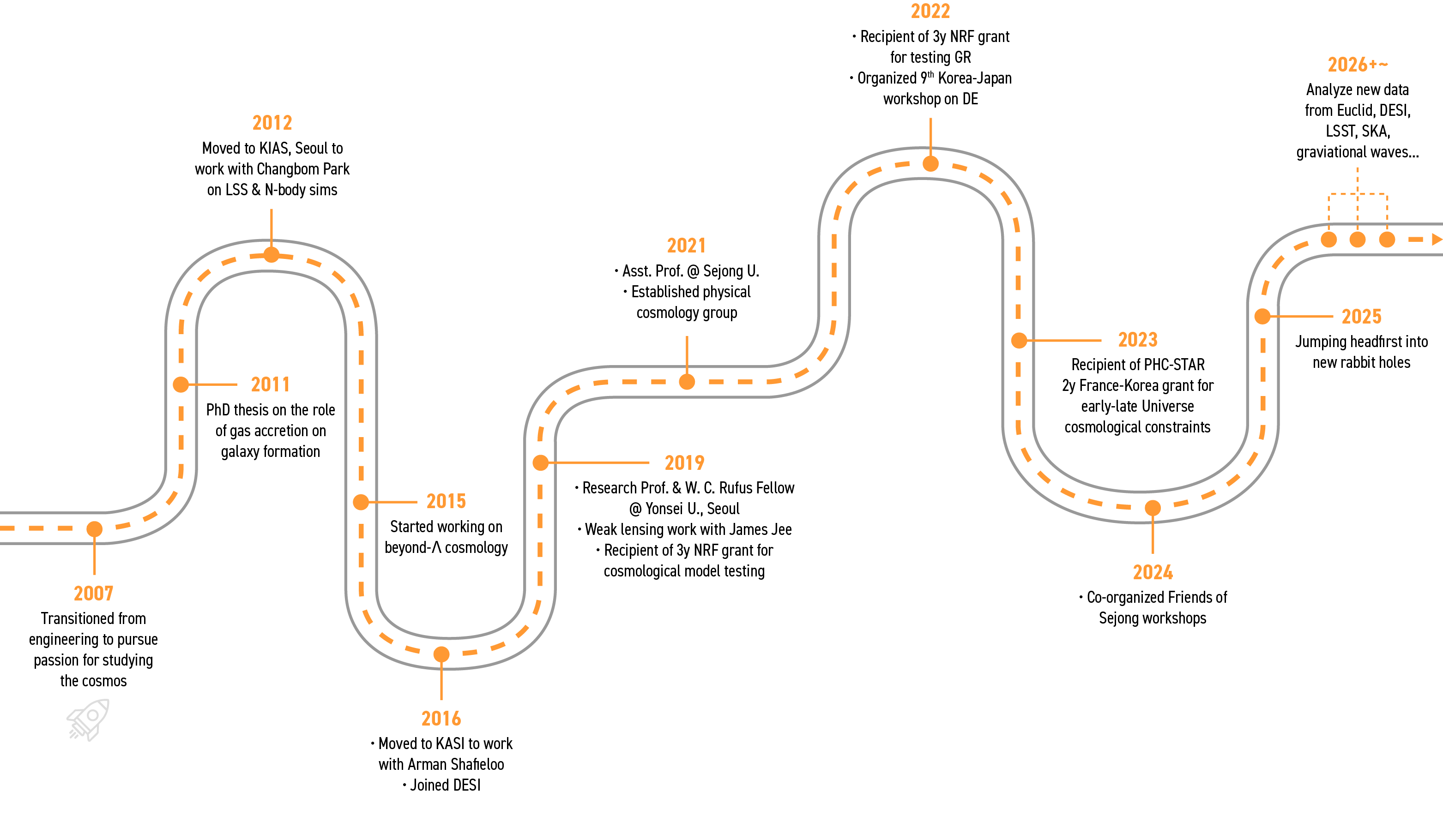
My research is supported by the National Research Foundation of Korea. I explore the limits of the concordance ΛCDM model using N-body simulations—both within and beyond the standard model—and apply advanced statistical methods to test its assumptions. I was also a member of the DESI collaboration, contributing to the time domain and the cosmological simulations working groups.
Before my PhD, I trained as an engineer in signal and image processing at Supélec (now CentraleSupélec), and completed an MSc in fundamental and applied mathematics (Université Paul Verlaine, Metz) and an MSc in astrophysics (Université Paris Diderot). I completed my PhD at LUX, Paris Observatory and Paris Sorbonne University, working in the Galaxies and Cosmology group with Françoise Combes and Benoit Semelin, and as a member of the Momentum project. During that time, I also taught physics and data analysis as a teaching assistant at the Université Paris Cité.
Since 2012, I have been based in South Korea—a growing hub for research, in particular in astronomy and cosmology. I was a Research Fellow from 2012 to 2016 at the Korea Institute for Advanced Study (KIAS), working with Profs. Changbom Park and Juhan Kim in the Astrophysics and Cosmology group on cosmological structure formation using numerical simulations such as Horizon Run 4. I then joined the CosKASI group at the Korea Astronomy and Space Science Institute in Daejeon, working with Arman Shafieloo, before becoming Research Professor and W. C. Rufus Fellow working with James Jee at Yonsei University. Since 2021, I have also been an associate member of KIAS, and from 2022 to 2025 I was an associate member of the Center for Gravitational-Wave Universe at Seoul National University.
Korea-Japan workshop on DE•Friends of Sejong workshop 2023 & 2024•PHC-STAR France-Korea project•2025 France-Korea Workshop on Cosmology
The same tools serve cosmology and any problem where an unknown function has to be inferred from noisy, indirect data.
How the choice of mean function and the way hyperparameters are set bias GP reconstructions, and how to avoid it.
Hwang+ 2023, JCAP
See the papersReconstruct the expansion and growth histories directly from data, without assuming a model (iterative smoothing, Gaussian processes), then test models against them.
L’Huillier & Shafieloo 2017; Shafieloo+ 2018; L’Huillier+ 2018, 2019, 2020, 2025; Calderón+ 2022, 2023; Millard+ 2026
See all the papersBayesian evidence compared with a frequentist approach based on iterative smoothing.
Koo+ 2021, 2022, JCAP
See the papersRecovering the matter power spectrum by Richardson–Lucy deconvolution of lensing data.
Dawn+ 2026; Jiang+ 2026
See the papersCosmological N-body simulations: initial conditions and numerical accuracy, halo interactions and alignments, dark energy and modified gravity, counts-in-cells statistics.
Horizon Run 4 (Kim+ 2015); L’Huillier+ 2012, 2014, 2015, 2017; Uhlemann+ 2017, 2018; Hassani+ 2020
See all the papersOptimal transport and machine learning to scale these reconstructions to Stage-IV data, with my students.
The groupEgg-shaped galaxies may be aligned to the black holes at their hearts.
Read articlePost on LinkedIn by the Scientific Sector of the French Embassy in Korea
Two papers with A. Dawn, J.-Q. Jiang, D. K. Hazra and A. Shafieloo on reconstructing the matter power spectrum by deconvolving lensing data: “Finding the distribution of matter using lenses – I” with CMB lensing (arXiv:2609.08457) and “– II” with 3×2pt measurements (arXiv:2609.08460).
Mathias Tan (CentraleSupélec) joins the group as a Master's intern to work on cosmological applications of optimal transport.
Si Hyeong Noh starts his PhD in the group.
Paper with Jeffrey Hodgson et al. published in Astronomy & Astrophysics: “A refined method for measuring cosmological distances using variability and proper motions in AGNs with VLBI-detected counter jets”. A&A 712, A240
Cléa Millard's paper “Model independent test of the FLRW metric and the curvature in light of DESI DR2” is published in JCAP. JCAP08(2026)016 · arXiv:2601.20293
Featured in Le Petit Échotier (Seoul Accueil, no. 202): « La science au-delà des frontières, Regards vers l'infini avec le Pr L'Huillier, cosmologiste français en Corée du Sud ». Read the article (PDF, pp. 60–63)
Invited talk at the 2026 KGWG Summer Meeting, Pohang: “Testing the ΛCDM Model with Gravitational Waves”.
Cléa Millard's paper was accepted. Congratulations Cléa!
Ussan Abbassi (École Normale Supérieure) joins the group to work on cosmology with gravitational waves.
Hyeon Kim's paper on the non-parametric estimation of the baryon gas fraction and the cosmological bias with clusters was submitted: arXiv:2603.13763.
Tarik Ouadjou (CentraleSupélec) joins the group to work on machine learning with the Square Kilometre Array (SKA).
Cléa Millard's first paper, on tests of the FLRW model, was submitted: arXiv:2601.20293.
The Lycée Français de Séoul team I mentored won 3rd prize and the Prix de la Société Française d'Acoustique at the final of the 33rd Olympiades de Physique France, with the project « Voir (plus) rouge… mène au côté obscur de la force ! ». Sejong University press release
Invited talk at New Perspectives in Cosmology, APCTP, Pohang: “Litmus Tests of the Flat-ΛCDM Model with Stage IV Data”.
Si Hyeong Noh defended his Master's thesis. Congratulations!
The 2025 France-Korea Workshop on Cosmology was held at Sejong University.
Seung-gyu Hwang was awarded the France Excellence grant to start a PhD in the CosmoStat group at CEA Saclay. Congratulations Seung-gyu!
Invited talk at The End of Lambda? CosKASI Conference, Daejeon: “Testing the FLRW Metric and Flatness with Stage-IV Surveys”.
Seminar at CEICO/FZU, Prague: “Litmus Tests of the Cosmological Model with the Large-Scale Structure”, and talk at the Journées de la SF2A 2025, Toulouse.
Talk at the Korea–EU Research & Innovation Day 2025, Seoul: “Joint Cosmological Constraints from the Early and Late Universe” (video).
Discovery of an alignment between the small-scale jets of supermassive black holes and the orientation of their host galaxies, published in Nature Astronomy. See also the article in The Conversation Australia, France and Spain.
Press releases in Korean: Asia Times · Chosun Ilbo · Daily Smart · Digital Times · Dong-A · ENews Today · Kyosu.net · Money Today · Minju Sinmun · Newsis · NewsTNT · Newswell · ONews · PS News · UNN · Veritas-a · W Sobi
Invited talk at the 11th KIAS Workshop on Cosmology and Structure Formation, Seoul: “Litmus Tests of the Flat-ΛCDM Model with Stage IV Data”.
First France-Korea Workshop on Cosmology at Institut d'Astrophysique Spatiale, Université Paris-Saclay.
Ms. Cléa Millard joins the group as a PhD candidate.
Keynote speaker in the dark energy session of the 17th Marcel Grossmann Meeting, Pescara.
Seminar tour in France: “Constraining the Cosmological Model with the Large-Scale Structure” at LERMA (Observatoire de Paris), IAS (Université Paris-Saclay), LUTh (Meudon) and Observatoire de Strasbourg.
PHC STAR joint funding with Prof. Marian Douspis' group at Institut d'Astrophysique Spatiale, Université Paris-Saclay.
M. Hyeon Kim starts as an integrated Master's + PhD candidate.
M. Si Hyeong Noh joins the group as a Master's candidate.
NRF Grant (~180M KRW): “Testing General Relativity with Upcoming Surveys”.
Establishment of the physical cosmology group at Sejong University.
Press release about the VLBI measurement of cosmic distances in Hankyoreh (in Korean).
NRF Grant (~150k USD): “Testing the cosmological model with the large-scale structures”.
Address
Department of Physics and Astronomy, Sejong University
Gwangjin-gu, Neungdong-ro 209, Seoul 05006, South Korea